Sell Services to Crypto Projects in the AI Era
An AI-built demo can make your next budget decision feel urgent. If a crypto project can assemble a dashboard internally, should your analytics business keep improving its product, start a blog, or hire a marketer?
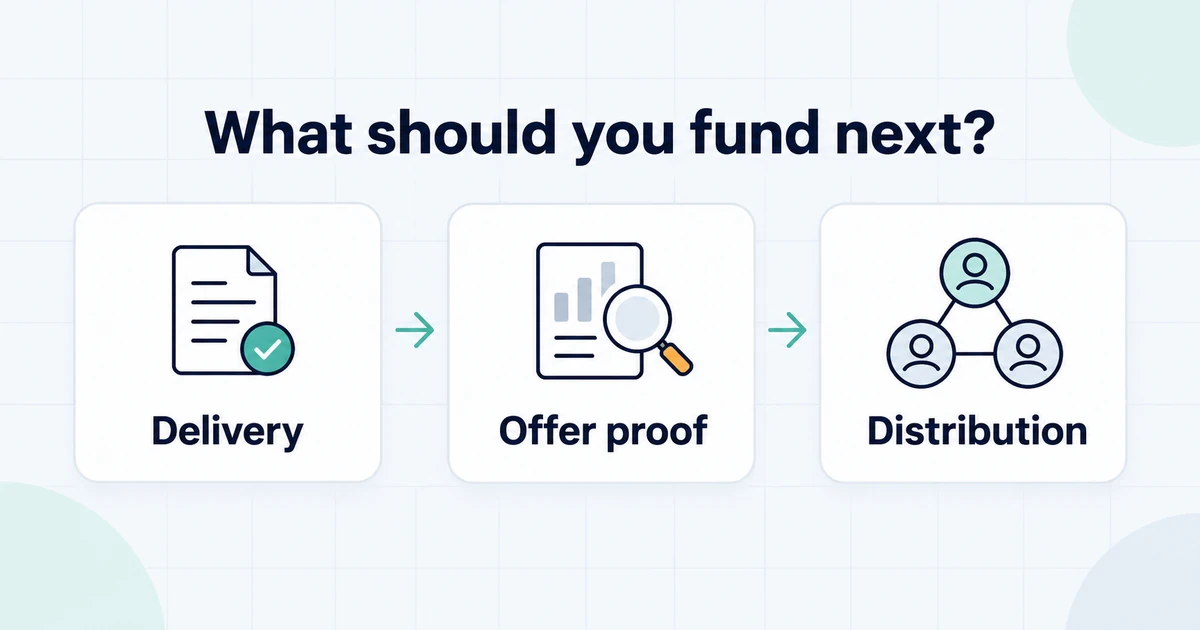
To sell services to crypto projects in that situation, start with the buying decision. Establish what a suitable team would pay you to take responsibility for, then identify what prevents that team from choosing you. The answer determines whether your next investment belongs in delivery, the offer, or distribution.
This is a decision you can investigate. Recent proposals, buyer questions, delivery costs, and rejected offers contain more useful clues than another impressive demo. Work through those clues before committing to a channel or a hire.
A faster demo changes only part of the buying decision
Building a demonstration, launching a usable service, and maintaining it for customers are different jobs. Faster progress on the first does not establish the cost of the other two.
A METR survey of 349 technical workers, published in May 2026, distinguished self-reported task speed from the value of work produced. Its convenience sample and self-reported estimates do not establish uniform productivity gains for Web3 businesses. Before reallocating effort, measure your own review, correction, implementation, and support work.
Consider a hypothetical analytics provider. A prospective customer's developer can create an interface showing protocol activity. The remaining questions concern where the data comes from, how errors are detected, which calculations are appropriate, and who maintains the system when requirements change.
Those questions give the provider something specific to compete on. A sample report with source definitions, known limitations, and an update process helps the buyer evaluate the service. More interface features may leave the buying concern unanswered.
There is also a credible case for doing the work internally. A simple, one-off report may not justify an ongoing external service. If the customer's team can produce and check it economically, acknowledge that. Your offer becomes more relevant where recurring verification, maintenance, or specialist work creates a responsibility the team wants to assign elsewhere.
The distinction applies beyond analytics. An audit buyer evaluates scope and expertise; an infrastructure buyer evaluates reliability and support. An easier demonstration does not remove those responsibilities. It does make it useful to explain them clearly.
Find where suitable projects stop progressing
Distribution is the set of routes through which suitable projects discover your business and move toward buying: search, referrals, partners, useful content, and direct conversations. Delivery remains a separate responsibility, though completed work can support future recommendations and case studies.
Review recent wins, rejections, and stalled opportunities. For each project, record the last meaningful step, the buyer's stated reason for stopping, and what remains your interpretation. A symptom should open an investigation.
| What you observe | An explanation to check | A small next test |
|---|---|---|
| Suitable projects rarely encounter the offer | You are absent from the places where they choose providers | Ask relevant buyers how they found their shortlist; test one route they name |
| Relevant messages receive few substantive replies | The timing, recipient, or proposed task may be wrong | Verify the task owner and public context before revising the message |
| Conversations stall before a scoped discussion | The need or approval process may still be unclear | Ask who owns the task and what would justify evaluating a provider |
| Proposals stall after a demo | The buyer may prefer internal work or doubt ongoing value | Compare a sample deliverable and maintenance responsibilities with an internal build |
| Customers buy but delivery disappoints | Scope, implementation, or expectations may be mismatched | Review promised work against what the customer actually received |
| Contracts increase but margins weaken | Discounts, manual work, or support may consume the gain | Review acquisition effort and direct delivery costs for those contracts |
For the hypothetical analytics business, two stalled proposals could require different responses. A founder who has never heard of the service presents a reach problem. A technical evaluator asking how data errors are handled presents a proof problem. Publishing the same additional article for both would leave at least one important question unresolved.
Use the table to choose what to investigate first. It cannot diagnose a business from one symptom, and a handful of conversations cannot establish a universal conversion benchmark.
Give one buyer a reason to choose the service
Choose a segment defined by its task and a relevant moment. For an analytics provider, that might be a project preparing to report activity across another chain. Verify the public announcement and ask what the team needs to measure.
A chain-expansion announcement does not prove a reporting gap. A funding announcement does not prove that your service has a budget. A new token does not establish an operating business or a qualified buyer.
Record the source, when you checked it, the possible need, and the person responsible for that task. Separately identify who evaluates the service and who authorizes spending. In a small team, those may be the same person. An active community administrator is not necessarily a purchasing contact.
Then make the service easy to evaluate. Explain what the customer receives, what you need from the team, what determines the price, and how completion is assessed. For the analytics example, specify the dataset, calculation rules, update frequency, known limitations, and support responsibility. The overview of service offers for different crypto project needs helps compare where that scope fits among provider categories.
Show a sample deliverable or a transparent demonstration before asking the buyer to accept a large claim. If you have a permission-safe case study, state the original task, the work performed, the measurement period, and the result. If you lack one, a labelled sample is useful without pretending to be customer evidence.
For a complex service, propose a limited initial engagement only when it answers a buying uncertainty. A review of one dataset or one integration can give both sides something concrete to assess. Define the price, scope, completion criteria, and decision that follows. A pilot with no decision attached can become unpaid support work.
Choose the channel that removes the next uncertainty
Use content and SEO when buyers need an answer they can inspect
A blog earns its place when a suitable buyer needs to understand a problem, assess your method, or compare approaches. Start with a question from an actual sales discussion: what does maintaining this internally involve, how are the calculations checked, or what would an integration require?
For the analytics provider, a worked sample and methodology explanation can support a proposal as well as a search visit. A technical evaluator can inspect the method; a founder can share the scope and responsibilities with the budget owner. If content is already your chosen route, use the guide to connecting a useful article to its next action.
Search engine optimization (SEO) is worth testing where buyers search for your service, its costs, compatibility, implementation, or alternatives. Examine those searches and the audiences the results serve before building a publishing calendar. Broad cryptocurrency interest may be unrelated to purchasing professional services.
AI can help organize and edit your material. Google's guidance on generative AI content warns that producing many pages without adding value for users may violate its scaled-content-abuse policy. Build articles around information the buyer can use: a method, a sample, a limitation, or an answer grounded in your work.
For Google AI Overviews and AI Mode, Google's documentation on AI search features says established SEO practices remain relevant and no special optimization is required. That does not guarantee inclusion, and it should not be generalized to every AI assistant.
If initial conversations are urgent, allow for the uncertainty of organic search. A resource can still help in a direct conversation before it attracts meaningful search traffic. Choose a review period that fits the work, without assuming a universal time to rank or win business.
Use outreach to test a specific project's interest
Direct outreach suits a situation where you can identify a relevant team and an observable reason to discuss the service. For the analytics example, offer a sample for the newly announced chain and ask whether reporting is an active task. Avoid asserting a problem you have not verified.
Choose a channel the recipient uses for professional contact. Sending the same pitch through email, Telegram, LinkedIn, and X does not establish relevance. Start with the most appropriate route and respect a refusal.
Before sending, verify that the project website, contract context, and contact details belong together. Remove stale or duplicate records, honor opt-outs, maintain suppression, and check sender authentication and deliverability. Collect only the contact information needed for the task. Confirm the applicable consent and outreach requirements; public contact details alone do not establish permission. These are operational reminders, not legal advice.
Market activity can help decide where to investigate. LeadGenCrypto's launch-count methodology and context describe token-based projects in its dataset with identified duplicates removed. The interactive launch charts let you inspect that activity by chain. Treat those records as research context: qualification still requires evidence of fit, a relevant task, and a buying discussion.
Use partnerships where another provider encounters the need first
Ask who works with your buyer before your service becomes relevant. An integrator might encounter reporting requirements during a deployment. A consultant might hear about the cost of maintaining an internal system.
Test whether that relationship creates a useful introduction. Agree what qualifies as a suitable project, who asks permission for the introduction, who owns communication, and who handles delivery. Make referral arrangements transparent where relevant. Do not imply a partnership exists until both parties have agreed.
A shared example or technical walkthrough can test the working relationship before either business promises a joint offer. For an API or software tool, an integration may also help buyers evaluate the service, but it creates maintenance obligations. Investigate the requirements before treating an ecosystem directory or integration as a dependable channel.
Hire for a defined constraint
The diagnosis should become the job brief.
If you do not yet know who buys and why, a marketer needs access to customer conversations and the authority to test positioning with the founder. A publication quota alone will not answer those questions.
If the segment and offer have been supported by purchases, the responsibility can be narrower. Search-led discovery calls for SEO and expert content work. Partner-led sales call for relationship development and clear handoffs. A technical service may need documentation, examples, and close work with engineers.
Choose a primary responsibility, the evidence that would show progress, and the support the person will receive. Avoid making one hire accountable for research, content, partnerships, sales, and delivery without deciding which constraint matters first.
If a marketer already works with you, review the mandate before judging the person. Someone hired for publishing needs customer access and a revised brief before being assessed on qualified opportunities. Faster AI production is a reason to revisit how work gets done; staffing decisions still need evidence about the role and its performance.
Run one decision test before spending more
Use this card for the next investment discussion. Fill it from buyer evidence; leave unknowns visible rather than guessing.
Service and project segment:
Observed buying or delivery constraint:
Evidence from buyer conversations or completed work:
Alternative explanation:
Smallest useful test:
Sample, method, or deliverable the buyer can inspect:
Person responsible and effort budget:
Privacy, opt-out, and delivery checks:
Signal that would support more investment:
Signal that would make us revise or stop:
Review date appropriate to this channel and buying cycle:
Next decision:
For the hypothetical analytics provider, the test could be a methodology walkthrough with a suitable evaluator who questioned the data. An agreed next step toward a scoped assessment would support further investigation. Repeated explanations that the internal report is sufficient would challenge the offer or segment. Neither outcome requires assuming a target reply rate.
Track progress at the project level. Several people from one team may participate in one buying decision. Record meaningful discussions, confirmed tasks, agreed next steps, proposals, and paid contracts, alongside time spent acquiring and serving each project.
Keep reach, visits, and registrations as supporting measures. Record how the buyer first found you, which interactions mattered, and what the buyer says prompted the inquiry. A final website click cannot explain every contribution to a contract.
Compare projects over an appropriate buying cycle and account for delivery effort. A channel that produces contracts with heavy unpriced support may need a different offer before it needs more traffic. Small samples should guide the next question, not become confident performance claims.
Make the next investment conditional
If the constraint is finding suitable new token-based projects, evaluate LeadGenCrypto's project data through the Leads documentation and free-lead workflow. Records include a website, token address, blockchain, token name or symbol, verified emails, and other information. Check a record against your segment and timing criteria before building an outreach process around it.
For more practical service-provider articles, subscribe to LeadGenCrypto updates.
If buyers already reach a proposal and hesitate over proof, work on the evidence they can inspect. If delivery consumes the margin, improve the scope or implementation. If suitable customers buy, receive the promised work, and leave enough margin to serve well, test a way to reach more of them. Let that finding determine the next article, channel, or hire.