More Leads Won't Fix a Weak Offer

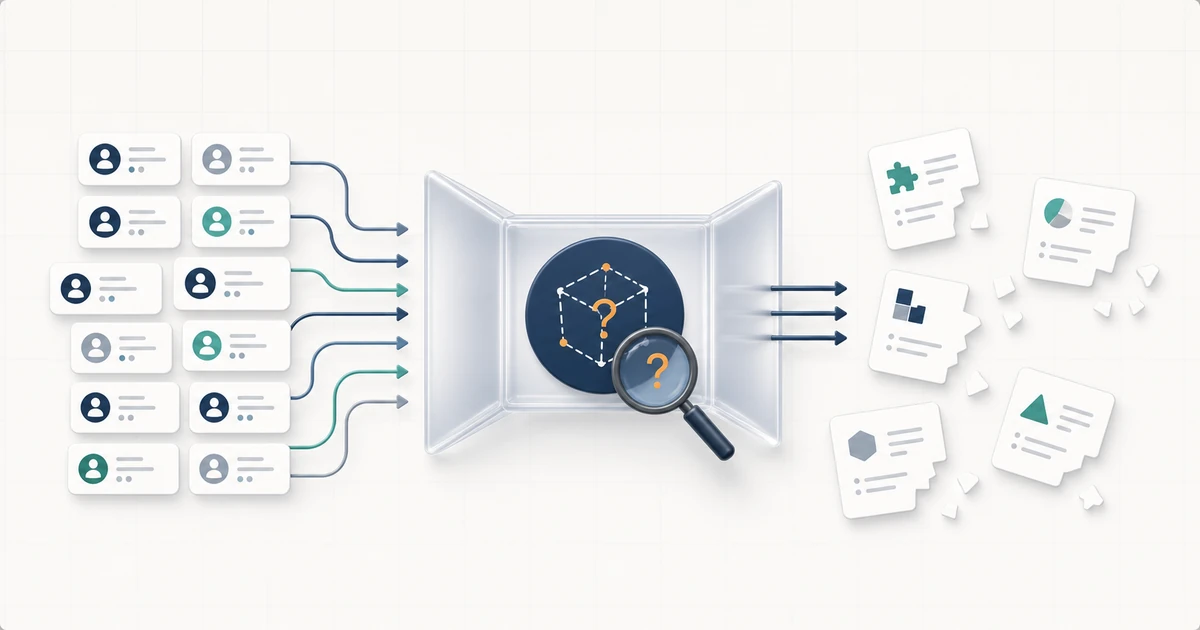
More outreach helps only when the rest of the sales system is ready.
- Diagnose the first failing stage before adding contacts or channels.
- A service menu lists capabilities, but a strong offer defines a purchase.
- Productize the core around one buyer situation, trigger, and controllable result.
- Keep necessary customization at the edge, with clear scope boundaries.
- Test a narrow offer with relevant projects before scaling lead generation.
Double the outreach volume and you may simply send the same confusion to twice as many people.
That is the uncomfortable possibility for a small Web3 service company whose prospect list, channels, and sales activity keep growing while qualified conversations do not.
The problem may be the data. It may be targeting, deliverability, proof, follow-up, pricing, or the sales process.
But if a relevant prospect still cannot answer one basic question, no lead source can answer it for them:
What exactly am I supposed to buy?
Lead generation can put your proposition in front of more project teams. It cannot turn a vague collection of capabilities into a productized Web3 service that is easy to understand, evaluate, and approve.
The right move is not to assume the offer is always guilty. It is to diagnose the first constraint, fix that stage, and scale only when the next batch of contacts can teach you something useful.
The direct answer: lead generation amplifies the system you already have
Lead generation is an amplifier. It amplifies the strengths of a clear offer and the friction inside an unclear one.
The commercial sequence is simple:
- The company defines something useful and purchasable.
- Marketing makes the right market aware of it.
- Lead generation identifies relevant project contacts.
- Sales helps those buyers evaluate the decision.
- Delivery produces the promised work.
- The company uses the result to improve retention, referrals, and future offers.
The offer sits in the middle of that sequence.
Marketing needs a concrete message. Targeting needs a reason to choose one project over another. Sales needs clear scope, proof, and a next step. Delivery needs to know what was promised before the contract was signed.
When the offer is weak, the symptoms spread:
- Outreach produces polite interest but few concrete next steps.
- Sales calls become unpaid consulting and scoping sessions.
- Every proposal starts from an empty page.
- Pricing changes because the scope is still being invented.
- Delivery receives a different version of the promise for every client.
- Margins become hard to predict because customization has no boundary.
More activity moves more prospects through that uncertainty. It does not remove the uncertainty.
If messages are delivered, the audience is correct, prospects understand the offer, proof is credible, sales follow-up is timely, and delivery remains healthy, then the active constraint may genuinely be lead volume. Diagnose first so you do not repair the wrong stage.
Diagnose the first constraint before adding volume
A weak result does not identify its own cause. Low replies can come from poor deliverability, wrong timing, irrelevant targeting, an unclear offer, weak proof, or a risky next step.
Use the matrix below before you buy another list or rebuild the entire service.
| What you observe | First constraint to investigate | Evidence to collect | Next safe test |
|---|---|---|---|
| Messages bounce or never reach the inbox | Data and deliverability | Validation status, authentication, sender reputation, bounce pattern | Stop volume and repair list hygiene or sending setup |
| Prospects reply that the service is not relevant | Targeting and trigger | Project stage, visible event, buyer role, timing | Narrow the segment and contact projects with a current reason to care |
| Prospects ask what the engagement includes | Offer clarity | Repeated scope questions, proposal rewrites, vague website copy | Write one offer specification with deliverables and exclusions |
| Prospects understand the offer but doubt it | Proof and risk | Requests for examples, references, process, or guarantees | Add a proof asset, mechanism, boundary, or smaller first step |
| Meetings happen but decisions stall | Sales and buying process | Missing owner, unclear next action, pricing or approval objections | Define the decision, owner, evidence, and next commitment |
| Deals close but delivery becomes chaotic | Productization and scope | Revision count, founder dependence, unplanned tasks, margin variance | Standardize the core and add change-control boundaries |
| Clients receive the work but do not continue | Value and account fit | Adoption, satisfaction, follow-up needs, next bottleneck | Review outcome quality before adding acquisition volume |
This matrix prevents a common mistake: rewriting the offer when deliverability is broken, or changing sending domains when buyers do not understand the purchase.
For a campaign that is already live, use the broader cold outreach funnel diagnosis to inspect list quality, inbox placement, replies, meetings, and follow-up.
If the matrix points to offer clarity, continue below.
A service menu makes the buyer design the engagement
Capabilities are ingredients. An offer is the finished decision.
A Web3 agency may have marketers, developers, community managers, exchange relationships, designers, researchers, outreach infrastructure, and partner networks.
Those resources can be valuable. They still do not tell the buyer what to purchase.
| Level | Example | What the buyer still has to decide |
|---|---|---|
| Capability | We have relationships with centralized exchanges | Almost everything |
| Service | We help token projects with exchange listings | Buyer fit, scope, process, result, and limits |
| Package | We prepare listing materials and approach selected exchanges | Trigger, target selection, responsibilities, and definition of done |
| Strong offer | An Exchange Expansion Sprint for projects already trading on one venue, with target research, listing preparation, available introductions, negotiation support, and explicit third-party limits | Whether this bounded engagement fits the current situation |
The strong offer is not stronger because it uses more words.
It is stronger because it reduces the number of design decisions the buyer must make before they can evaluate it.
That matters when a small token-project team is already coordinating product work, technical integrations, community communication, partner conversations, security, and launch operations. The vendor should not hand that team a list of departments and ask it to invent the engagement.
This is also why clearer copy cannot rescue an undefined product. Copy can explain value, urgency, proof, and risk. It cannot decide the buyer, trigger, scope, deliverables, exclusions, or delivery model on the founder's behalf.
When the underlying product is defined but the pitch still sounds abstract, use the buyer-meaning framework for crypto service offers to translate the same package for different stakeholders.
Web3 clients buy situations, not service categories
The buying moment usually begins with an event or constraint, not a department name.
A project team is more likely to recognize one of these situations:
- A token generation event is approaching and campaign work is disconnected.
- A centralized exchange listing is confirmed but communication has no owner.
- A product is ready while the founder still handles every B2B sales conversation.
- The team wants another exchange but has not prepared a realistic target process.
- A milestone was announced but partners still do not understand the product.
- A previous vendor contract ended and responsibilities are now unclear.
The situation gives the offer context.
Compare these two versions:
Generic service: KOL marketing for crypto projects.

Situation-based offer: A pre-launch creator coordination sprint for token projects with a confirmed launch window, including narrative preparation, creator selection, scheduling, content coordination, and consolidated reporting.
The second version gives the buyer more to evaluate without promising token price, trading volume, investor participation, or any result controlled by a third party.
A useful rule is:
Narrow the client situation, then solve that situation more completely.
The market becomes smaller, but relevance becomes higher. The provider can combine several capabilities around one real job instead of advertising every capability to every project.
Use nine questions to build a productized Web3 service
A clear offer is a set of commercial decisions, not a new name for the same vague service.
Answer these nine questions before you scale outreach.
1. Who is the offer for?
Define stage, project type, buyer role, and any condition that makes the work a good fit.
Crypto companies is too broad. Token projects with a confirmed exchange listing and no coordinated communication owner is testable.
2. What event creates the need now?
Choose a visible trigger such as a launch, listing, product release, ecosystem expansion, new sales hire, failed campaign, or vendor transition.
3. What specific problem is happening?
Describe the operational failure. Avoid abstractions such as growth, exposure, or awareness when you can name missing coordination, unclear ownership, weak proof, slow research, or an unbuilt outbound process.
4. What controllable result will the client receive?
Promise work and outputs the provider can deliver: a completed campaign plan, researched shortlist, prepared submission package, functioning outreach workflow, documented report, or agreed set of assets.
Do not guarantee exchange approval, token performance, publication, investor activity, or another party's decision.
5. What mechanism connects the work?
Explain why the activities belong together. A mechanism might combine milestone research, verified contact data, relevance checks, personalized outreach, and CRM-managed follow-up around one trigger.
6. What is included?
List the deliverables that remove uncertainty. Keep the list bounded and auditable.
7. What is excluded?
State third-party fees, client responsibilities, approval limits, custom work, change requests, and dependencies.
Do not hide external dependencies to make an offer sound stronger. If an exchange, publisher, creator, platform, regulator, or market condition controls part of the outcome, state that boundary before the sale.
8. Why should the buyer believe the offer?
Use relevant proof: a case study, work sample, redacted deliverable, transparent process, reference, checklist, or clear methodology. If case studies do not exist yet, mechanism and process proof are safer than invented results.
9. What is the next step?
Ask for the smallest commitment that produces a useful decision. That may be a qualification form, bounded audit, paid workshop, sample review, or pilot.
Copy this specification into your working document:
Offer specification

[ ] Buyer: one project stage, type, and responsible role
[ ] Trigger: one event that creates a current reason to act
[ ] Problem: one observable operational failure
[ ] Result: one controllable output or completed work state
[ ] Mechanism: why the selected activities belong together
[ ] Included: bounded deliverables
[ ] Excluded: third-party costs, outcomes, and custom work
[ ] Proof: evidence the buyer can inspect
[ ] Next step: the smallest useful commitment
If several boxes remain empty, use the offer-first rewrite sprint to turn the draft into a decision package before adding volume.
Standardize the core and customize the edge
Productization does not require identical delivery for every client. It requires a stable core that prevents every engagement from beginning with an empty page.
| Standardize the core | Customize at the edge |
|---|---|
| Onboarding and required inputs | Target segment |
| Research and quality-control method | Message and examples |
| Delivery stages and review gates | Geographic or ecosystem focus |
| Standard deliverables | Selected channels |
| Reporting and communication cadence | Technical details |
| Scope boundaries and change control | Optional add-ons |
This structure gives the buyer relevance while protecting the provider from unlimited custom work.
Delivery data can reveal where the core needs work. Repeated out-of-scope requests may mean exclusions are unclear. Founder dependence may mean the process is undocumented. Large differences between estimated and actual time may mean the package is under-scoped or underpriced.
Offer quality is therefore not only a sales question. It also appears in delivery time, revision patterns, margin stability, handoff quality, repeat purchases, and the number of decisions that still require the founder.
Test the offer before scaling outreach
A polished offer is still a hypothesis until relevant buyers react to it.
The U.S. Small Business Administration explains that market research can test demand and that direct research can gather specific reactions from potential customers. Its market research and competitive analysis guide is a useful external reference for separating demand questions from differentiation questions.
For a service offer, the test can stay small:
- Select one narrow buyer situation.
- Write one offer specification.
- Choose a small set of projects with a visible trigger.
- Send a relevant, respectful message with one low-risk next step.
- Include an easy opt-out and suppress anyone who declines.
- Record replies, silence patterns, objections, proof requests, and scope questions.
- Change one variable before the next test.
Do not treat every silence as proof that the offer is bad. Check delivery, role, timing, relevance, and message clarity first.
Use evidence across sales and delivery:
| Evidence | What it may reveal |
|---|---|
| Prospects ask what is included | Scope is not visible |
| Relevant buyers understand but do not care | Problem or timing is weak |
| Buyers ask for proof before a call | Trust is the active constraint |
| Calls happen but proposals stall | Price, risk, or approval path needs work |
| Deals close but delivery expands | Productization and exclusions are weak |
| Delivery is healthy but the pipeline stays thin | More relevant lead volume may now be useful |
If you are still early, the first-client validation loop shows how to learn from one real project contact at a time before building a larger system.
What you may be thinking right now
Every client is different
Yes. Standardize the parts that should be repeatable and customize the variables that make the work relevant. The goal is not identical work. It is a stable commercial starting point.
Better copy should make the offer attractive
Better copy can reveal a good offer. It cannot decide the scope, proof, price model, client responsibilities, or result. Make those decisions first.
We do not have case studies yet
Do not invent them. Use process proof, a real sample, a transparent checklist, a bounded audit, or a small paid pilot. Proof can begin with how you work, as long as it does not imply outcomes you have not produced.
A small test cannot prove demand
Correct. It produces directional evidence. Its purpose is to expose obvious problems before a larger campaign multiplies them.
A narrower offer will shrink the market
It will shrink the theoretical market. That can be useful if the remaining projects recognize the situation faster and the provider can solve it more completely.
Scale the stage that is ready
Most Web3 service companies eventually need lead generation. A strong offer cannot grow if relevant buyers never see it.
The sequence matters:
- If delivery fails, repair the work.
- If proof fails, build evidence.
- If the offer fails, define the purchase.
- If targeting fails, narrow the buyer and trigger.
- If deliverability fails, protect the sender and list.
- If those stages work and the pipeline remains thin, add relevant lead volume.
If the matrix points to offer clarity, finish the nine-question specification first. Then inspect a relevant project, test one grounded message, and learn from the response before scaling.
The LeadGenCrypto Leads documentation explains how to claim a free lead and review the project on the Leads page. If this small-test workflow fits your stage, open the Leads page, choose one relevant project, and test one clearly bounded offer rather than sending a broad service menu.
LeadGenCrypto Blog and Updates
Get the next practical offer test
Subscribe for concise notes on shaping Web3 service offers, finding relevant project moments, and testing outreach without hype.
- Fast summaries of new LeadGenCrypto articles
- Practical checklists for offer, targeting, and outreach decisions
- Useful resources for teams selling services to crypto projects
FAQ
How do I know whether I need more leads or a better offer?
Find the first observable failure. Delivery and bounce problems point upstream to data or deliverability. Irrelevant replies point to targeting. Repeated scope questions point to offer clarity. Proof objections point to trust. Healthy conversion and delivery with a thin pipeline may indicate a real volume constraint.
What is a productized Web3 service?
It is a B2B service with a defined buyer, trigger, problem, mechanism, deliverables, exclusions, proof, and next step. It can include customization, but the commercial core is clear before the sales call.
Does productization mean fixed scope for every client?
No. Standardize onboarding, delivery stages, quality control, reporting, and boundaries. Customize target segments, messages, timing, technical details, and approved add-ons where they affect relevance.
Can better copy fix a weak offer?
Copy can make a defined offer easier to understand. It cannot create missing scope, proof, responsibilities, pricing logic, or a controllable result.
What if I do not have case studies yet?
Use honest process proof: a sample deliverable, checklist, methodology, teardown, bounded audit, or small pilot. Do not imply customer outcomes you have not produced.
How many prospects should I use to test an offer?
There is no universal number. Start small enough to inspect every project and message, but large enough to see whether the same questions or objections repeat. Treat the result as directional evidence, not certainty.
Which results should a Web3 provider avoid guaranteeing?
Avoid guarantees tied to token price, trading volume, exchange approval, platform acceptance, media publication, investor activity, or another third party's decision. Promise controllable work, process, and deliverables instead.
When should I scale lead generation?
Scale when relevant buyers understand the offer, proof answers their risk questions, the next step is clear, follow-up works, and delivery can handle more demand without expanding into uncontrolled custom work.