LinkedIn Ads for crypto outreach: Founder Targeting Checklist

- Use LinkedIn Ads for crypto outreach only for B2B service offers.
- Target project contacts, not token buyers, investors, or retail users.
- Start with Classic ad sets, manual bidding, and controlled audiences.
- Build targeting with Blockchain Services, company size, and founder titles.
- Use Message or Conversation formats when inbox delivery is the goal.
- Compare forecasted cost per send with actual post-launch reporting.
LeadGenCrypto • Updates for service providers
Get practical outreach and ads notes, without the noise
Short emails for teams selling services to crypto projects. Clear tactics, lightweight checklists, and new resource drops you can use right away.
- Fast takeaways from new articles, so you can brief your team quickly
- Action ideas to improve targeting, replies, and meeting quality
- No hype, no token-buyer framing, unsubscribe anytime
Use the checklist below when you want a controlled LinkedIn Sponsored Messaging that reaches founders, co-founders, CEOs, CTOs, growth leads, BD teams, or technical roles at crypto-related companies. This guide is written for agencies and B2B service providers selling services to token projects; it is not about token promotion, retail acquisition, or fundraising. When we say leads, we mean project contacts and outreach targets, not token buyers.
LeadGenCrypto supports the surrounding workflow by delivering verified leads of newly launched token projects on a daily cadence. A lead can include website, token address, blockchain, token name, token symbol, and verified email or emails.
LinkedIn UI labels can vary by account, country, objective, rollout stage, and ad account history. Treat the screenshots and settings below as a practical setup map, then verify the final wording inside your own Campaign Manager account.
Who this founder-targeted LinkedIn test is for
Use this workflow when your buyer has a professional role, a company context, and a service need. LinkedIn can help you test paid inbox messaging to professional profiles, but it is not a database of newly launched token projects.
For service providers, the value is focus. You are not trying to reach anyone who likes crypto. You are trying to reach people who can evaluate a useful B2B service for a crypto project, such as launch marketing, smart contract audits, PR, compliance, infrastructure, listings, analytics, SEO, liquidity services, or developer tools.
| Provider type | Better outreach angle |
|---|---|
| PR and marketing agencies | Launch visibility, content, media outreach, community growth |
| Exchange and listing teams | Listing readiness, liquidity planning, market access |
| Smart contract auditors | Audit timing, risk review, code verification |
| KYC and AML providers | Onboarding, screening, compliance workflows |
| Legal and licensing firms | Jurisdiction planning, regulatory preparation, legal opinions |
| Guest post and SEO sellers | Content placements, authority building, link strategy |
| YouTube and creator teams | Reviews, explainers, AMAs, launch coverage |
| Wallet and payment providers | Integrations, payment flows, user access |
| L1 and L2 networks | Deployment, co-deployment, ecosystem onboarding |
| Analytics and voting tools | Tracking, dashboards, governance visibility |
| Blockchain developers and DevOps teams | Smart contracts, websites, infrastructure, APIs |
| Market makers and liquidity providers | Liquidity plans, market quality, trading operations |
| Long-tail Web3 vendors | Bridges, hosting, tokenization, NFT tools, data products |
A founder-targeted ad set should answer one commercial question: would this person understand why your service matters right now? If the answer is no, the audience is probably too broad or the offer is not clear enough.
Use this fit check before building the campaign:
Audience fit check
[ ] The prospect can buy, influence, or evaluate a B2B service.
[ ] The offer is useful to a crypto project, not to token buyers.
[ ] The message avoids investment, token price, and retail-user language.
[ ] The next action is simple: visit a page, request info, or book a call.
[ ] The campaign can be judged by replies, clicks, meetings, or pipeline.
For a broader discovery workflow outside LinkedIn, pair this paid test with a repeatable way to find crypto projects to pitch and build a lead pipeline.
If you are planning to scale spend, pressure-test your audience and message first with this validate-first case study for agencies.
Write one sentence that says exactly which service you sell to crypto projects and which role should care. Use that sentence to judge every targeting choice below.
LinkedIn Ads for crypto outreach setup: control delivery before scale
The first campaign should be built for clean learning, not maximum reach. Start with settings that make the result easy to read: one objective, one ad set type, clear naming, a real landing page, and no automatic targeting expansion during the first test.
Before splitting traffic, write a Web3 B2B experiment specification with an eligible audience, one decision metric, guardrails, and a stopping rule.
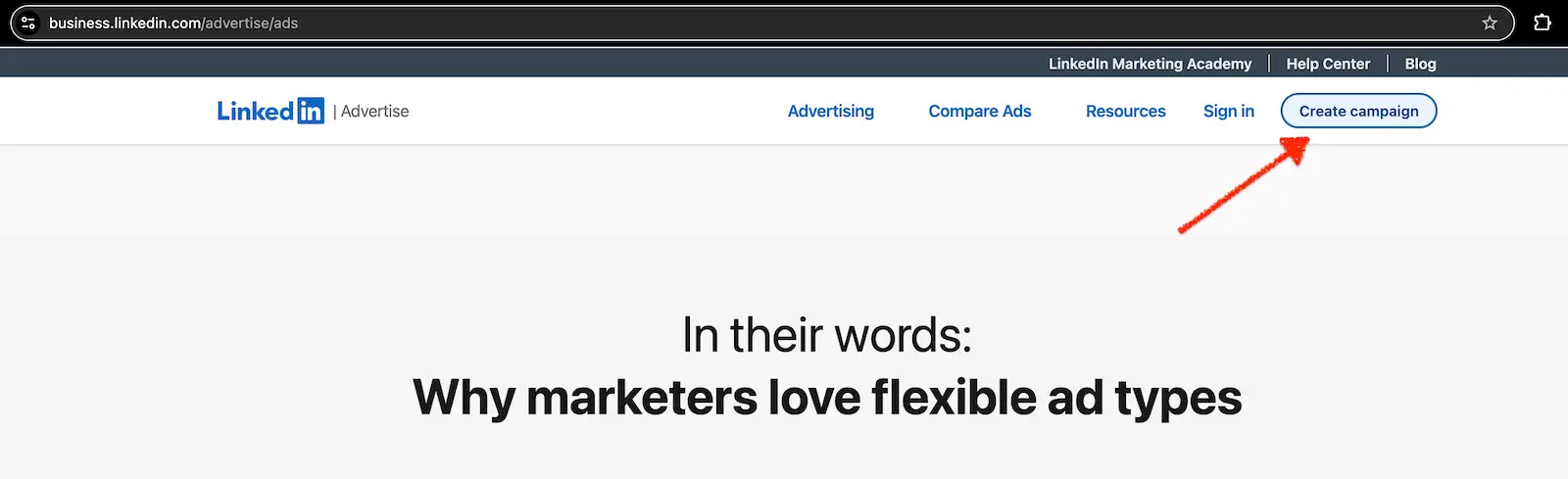
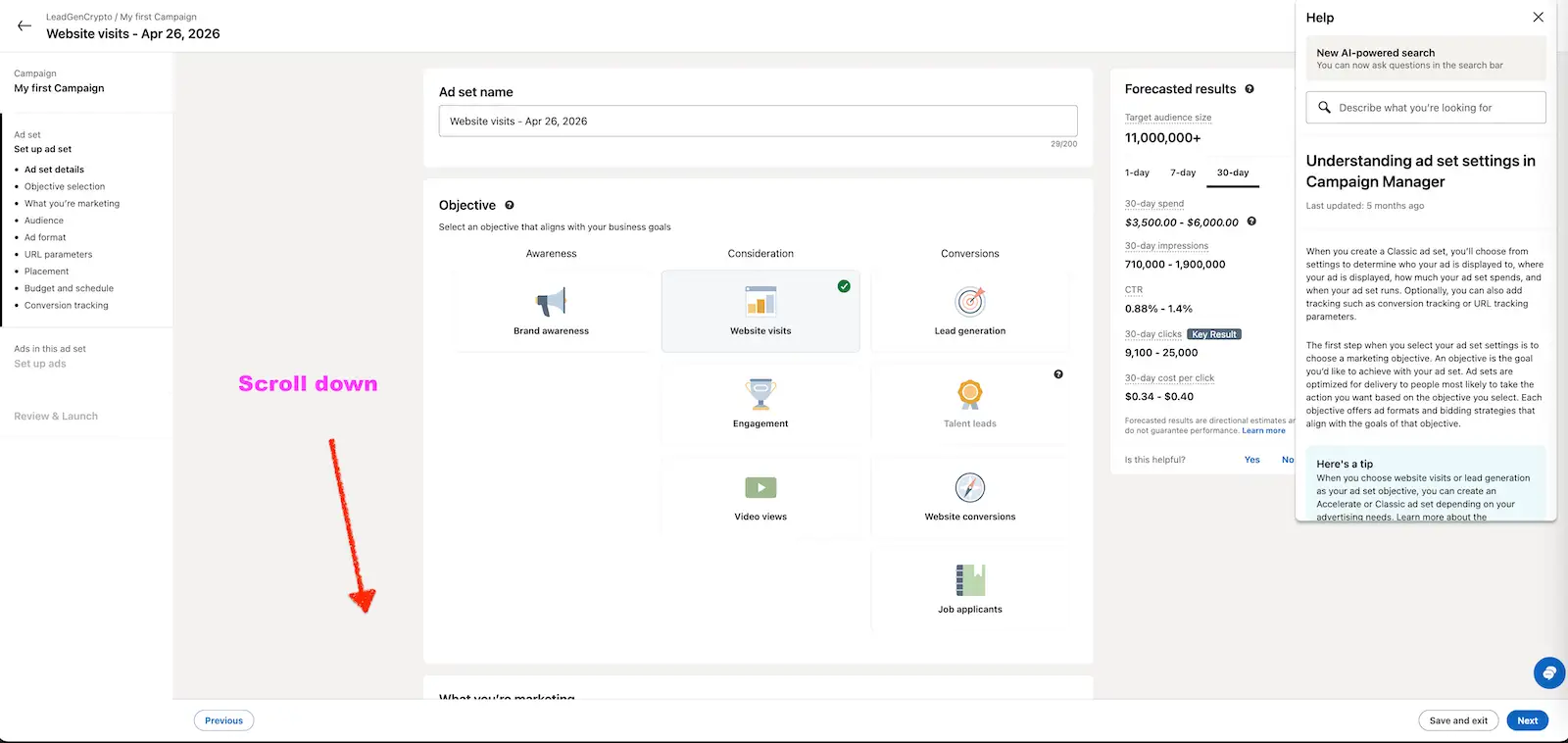
Start from LinkedIn Ads or Campaign Manager and create a campaign. Choose an objective that matches your next action. For most service providers with a landing page, Website visits is the simplest first test. Lead generation can work when you want a LinkedIn form. Website conversions is better after tracking is configured and you have enough conversion events to optimize responsibly.
If targeting still feels fuzzy, build a simple buyer definition with an ICP worksheet for service providers selling to token startups, then come back and map job titles to that shortlist.
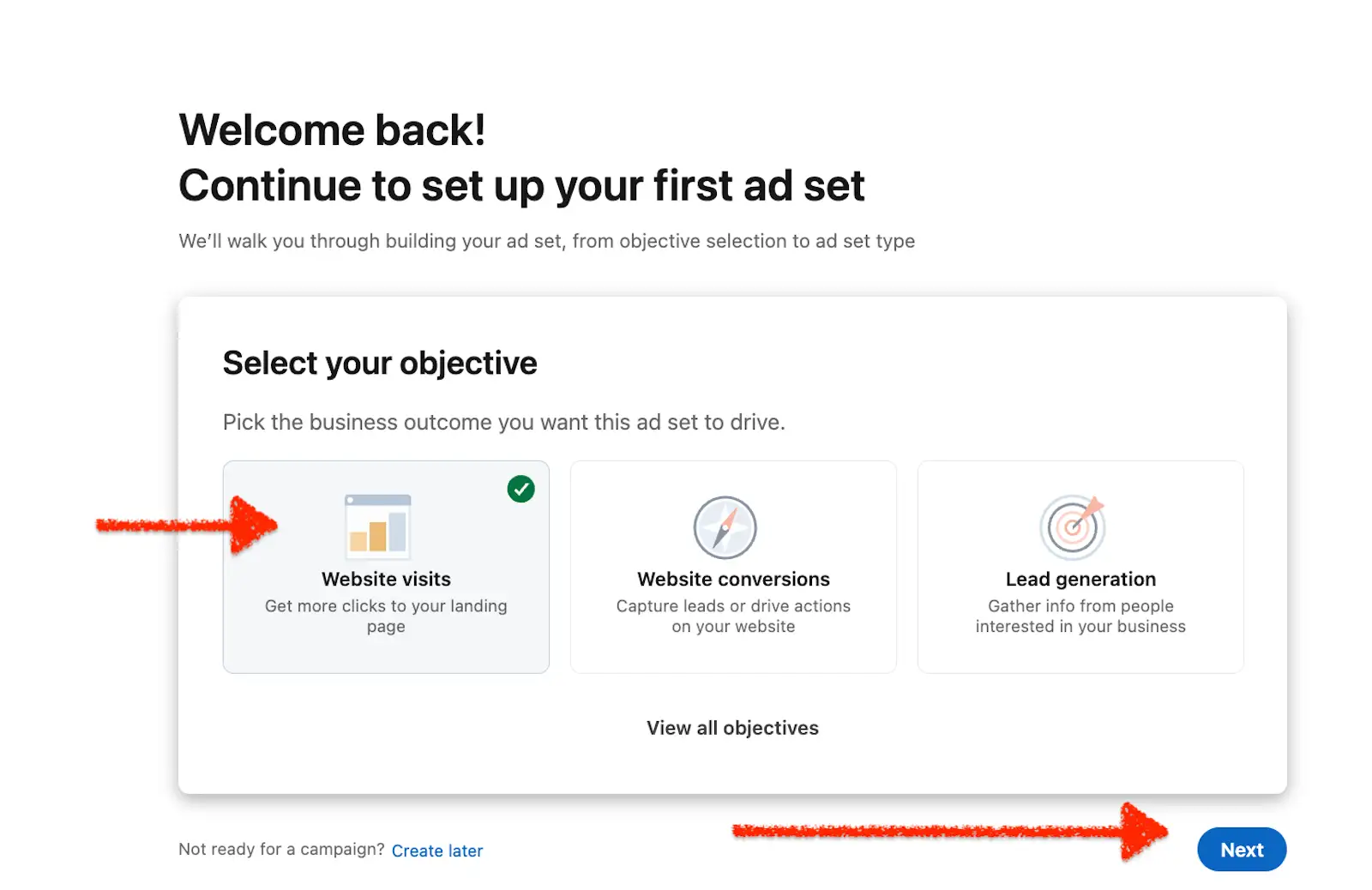
Choose Classic ad set when you need control over industry, company size, job titles, ad format, bidding, and budget. Accelerate can be useful later, but it is not the cleanest first read when you are testing a specific founder or technical-buyer segment.
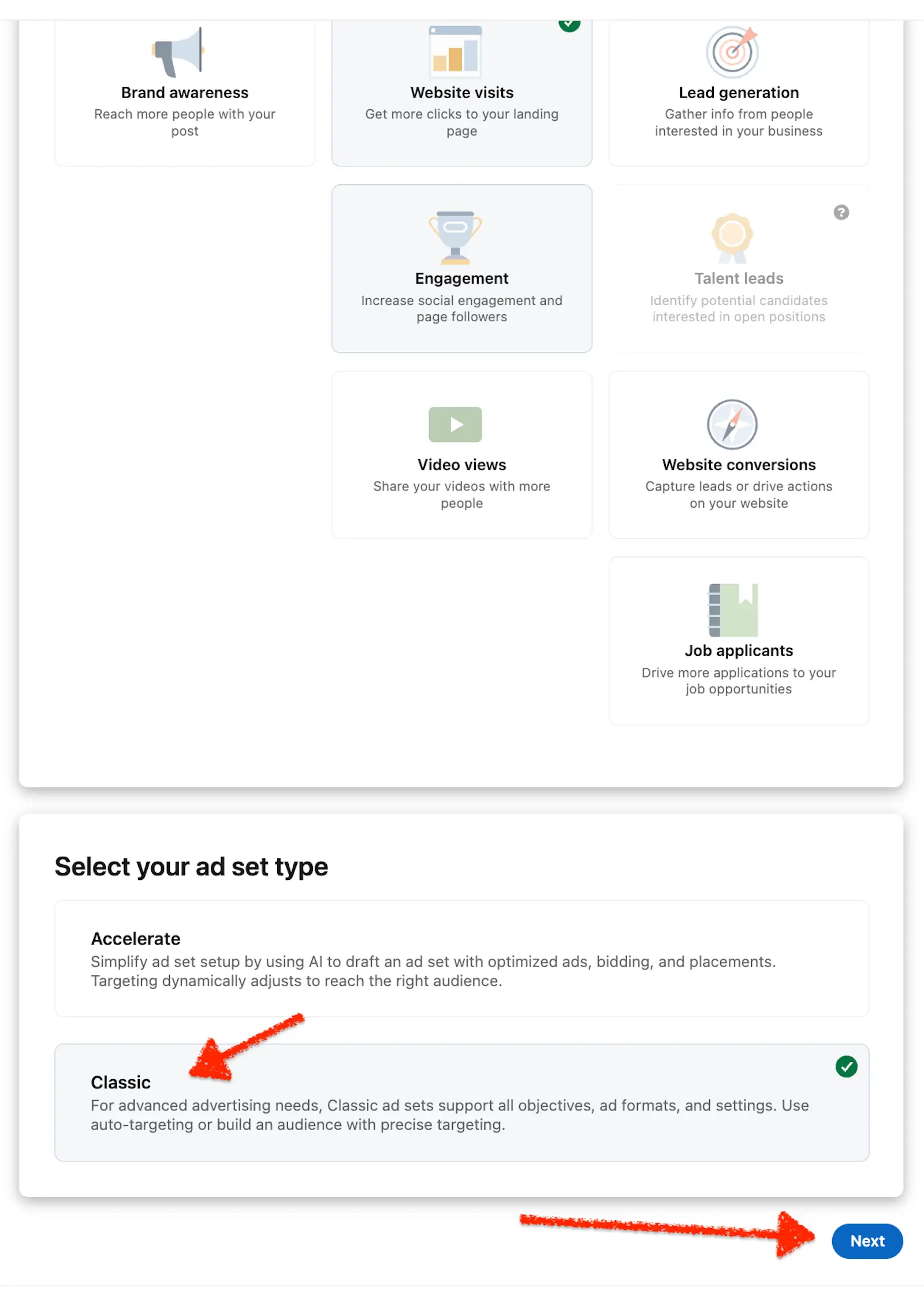
Create or select a campaign, continue, then add or edit an ad set. Use names that make reporting obvious. A clean name should include the audience, industry, company size, and format.
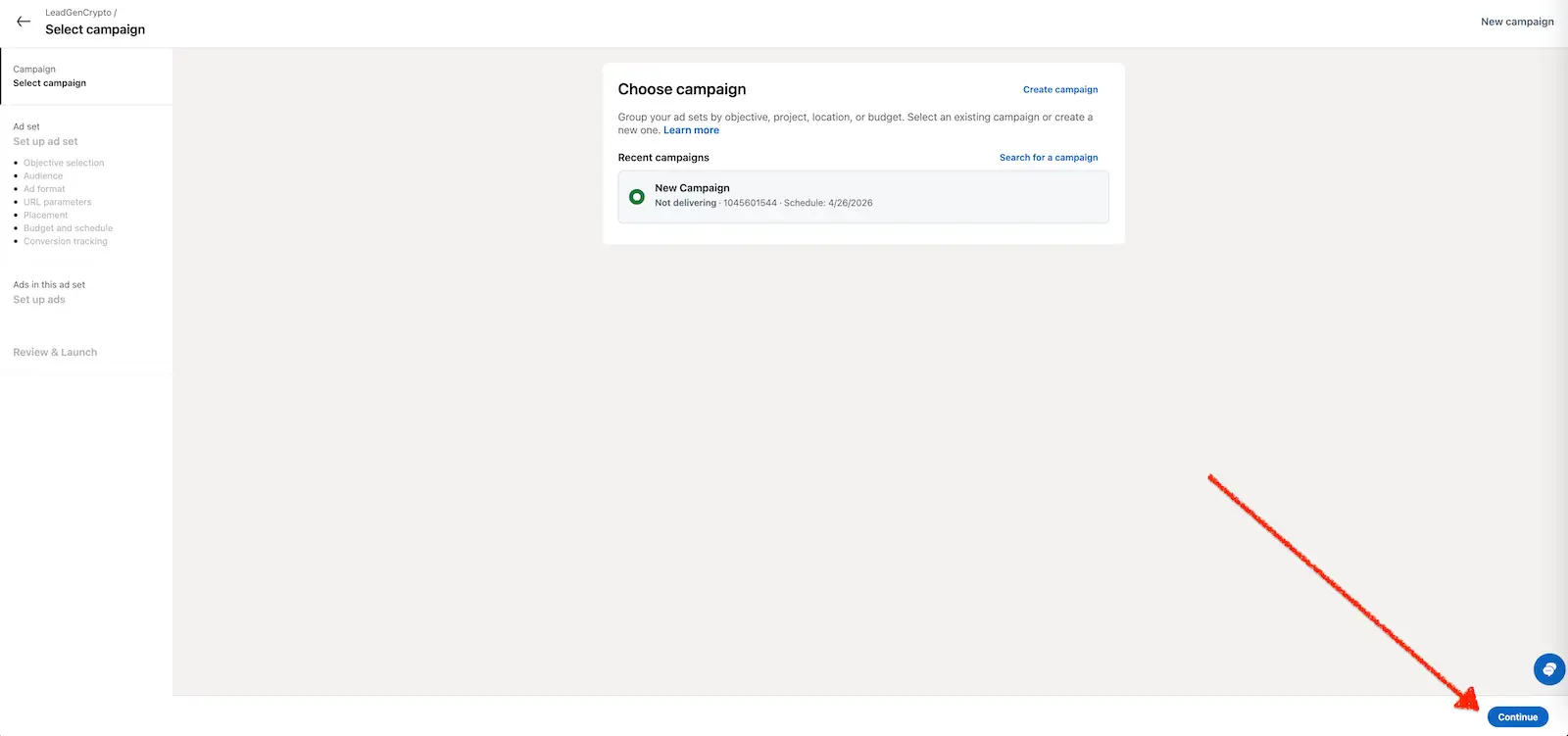
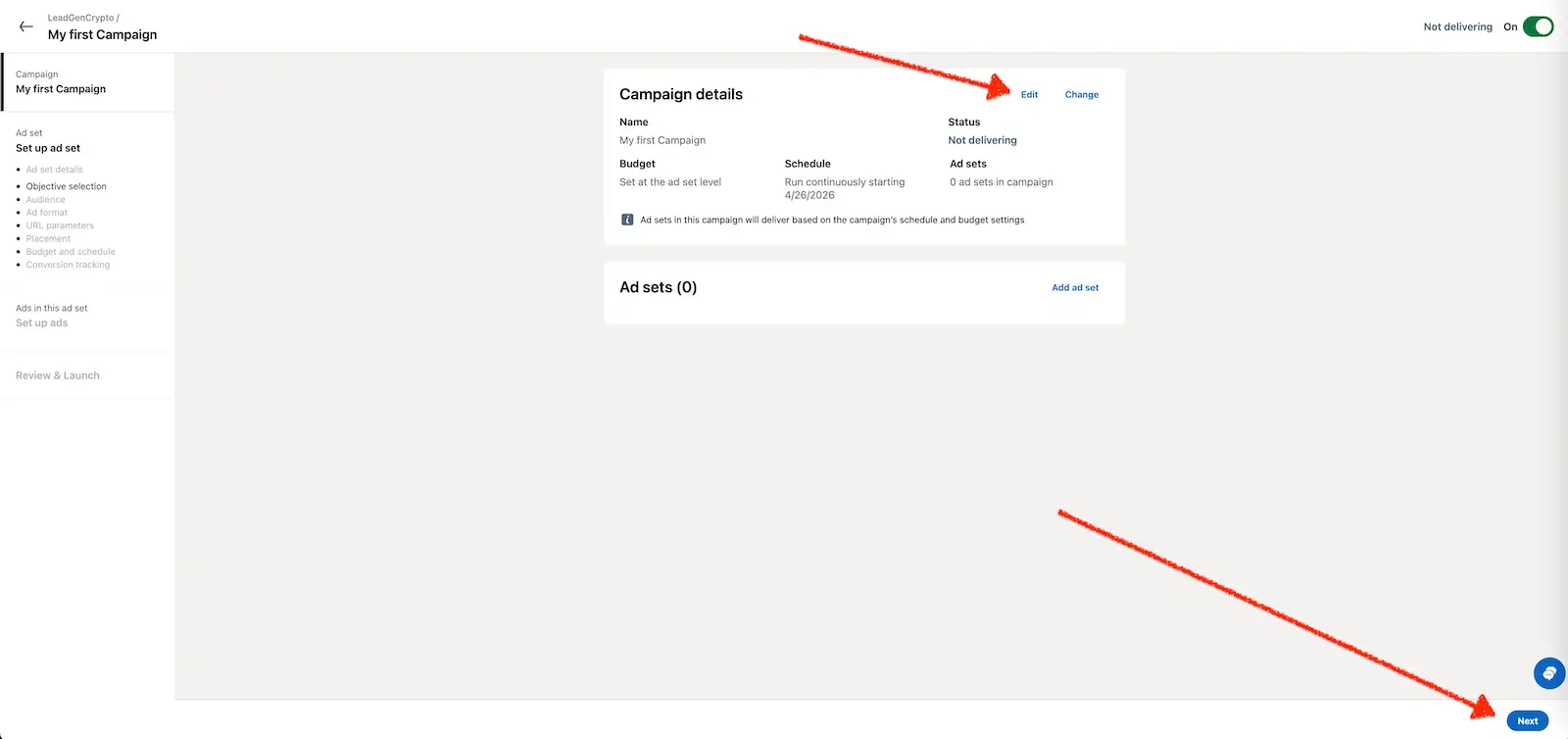
Use this naming template:
Campaign name:
Sponsored Messaging - Crypto Service Providers - Founder Test

Decision-maker ad set:
Founders - Blockchain Services - 2-200 - Conversation Ad

Technical ad set:
Technical Roles - Blockchain Services - 2-200 - Message Ad
When the setup screen asks what you are marketing, use a plain B2B service name and a relevant source URL. Avoid token-like naming, hype wording, or anything that sounds like investment promotion. If Campaign Manager offers Auto-Targeting, dismiss it for the first test so your baseline stays readable.
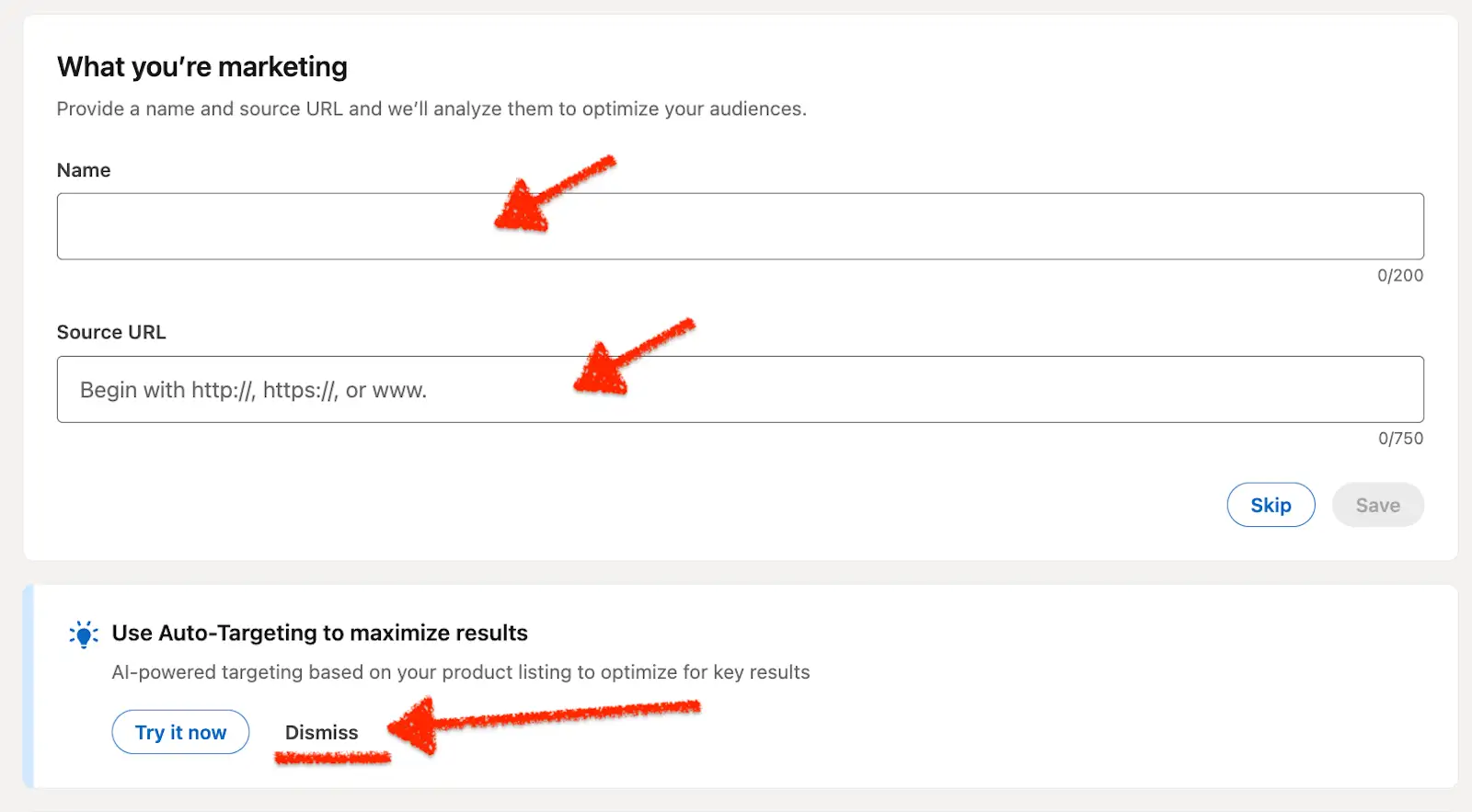
Recommended first-test settings:
| Setting | First-test recommendation | Reason |
|---|---|---|
| Objective | Website visits, Lead generation, or Website conversions | Match the next action to your funnel maturity |
| Ad set type | Classic | Keeps targeting, bidding, and format choices under control |
| Auto-Targeting | Off or dismissed | Prevents the first test from drifting away from your target |
| Audience Expansion | Off | Keeps the initial result easier to interpret |
| Locations | Markets you can legally and operationally sell into | Avoid paying for unreachable prospects |
| Profile Language | Match the ad copy language | Prevents language mismatch in Sponsored Messaging |
| Company Industry | Blockchain Services | Tighter than broad technology categories |
| Company Size | 2-10, 11-50, 51-200 | Useful starting bands for many smaller project teams |
| Ad format | Message Ad or Conversation Ad | Use inbox formats for inbox delivery |
| Optimization goal | Sends | Useful for Sponsored Messaging delivery tests |
| Bidding | Manual bidding for first price discovery | Lets you compare bid input with forecasted cost per send |
| Daily budget | $20 to $50 for early tests | Enough to learn without overcommitting |
| Schedule | 3 to 5 days for first read | Gives an initial cost and delivery signal |
| Conversion tracking | Recommended after basic setup | Needed for deeper post-click analysis |
Use this short setup checklist before moving to audience targeting:
Campaign setup checklist
[ ] Campaign objective matches the next action.
[ ] Classic ad set is selected for the first test.
[ ] Ad set names separate founders from technical roles.
[ ] Product or service name sounds like a B2B offer.
[ ] Source URL points to a live, relevant landing page.
[ ] Auto-Targeting is dismissed for baseline testing.
[ ] Budget is small enough to learn before scaling.
A clean ad setup starts with a clean offer. If the service itself is still vague, sharpen it with a positioning guide for services crypto projects actually buy before you spend on media.
Create two ad set names now: one for founders and one for technical buyers. Do not mix those audiences in the first test.
LinkedIn ads crypto targeting: use Blockchain Services without OR mistakes
The audience logic matters more than the screenshot path. Many weak campaigns fail because industry, company size, and job titles are added as broad OR logic instead of a narrow AND structure.
Start with locations where you can sell, support, and comply. A common English-language test might include the United States, United Kingdom, Canada, United Arab Emirates, Singapore, Australia, and Switzerland. Do not copy this list blindly. Legal, listing, investment, OTC, payments, and compliance providers should verify market restrictions before launch.
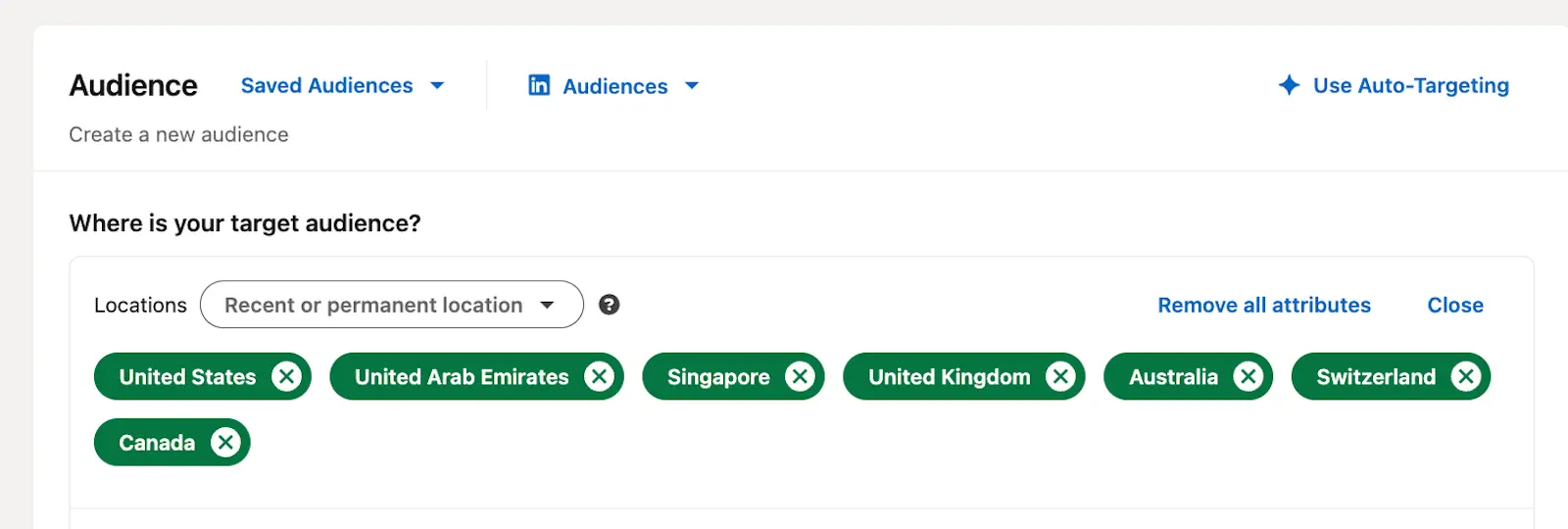
Then open Audience attributes. Keep Audience Expansion off during the first test. Expansion can be useful later, but it makes your baseline harder to interpret because LinkedIn may move beyond the exact audience you intended.
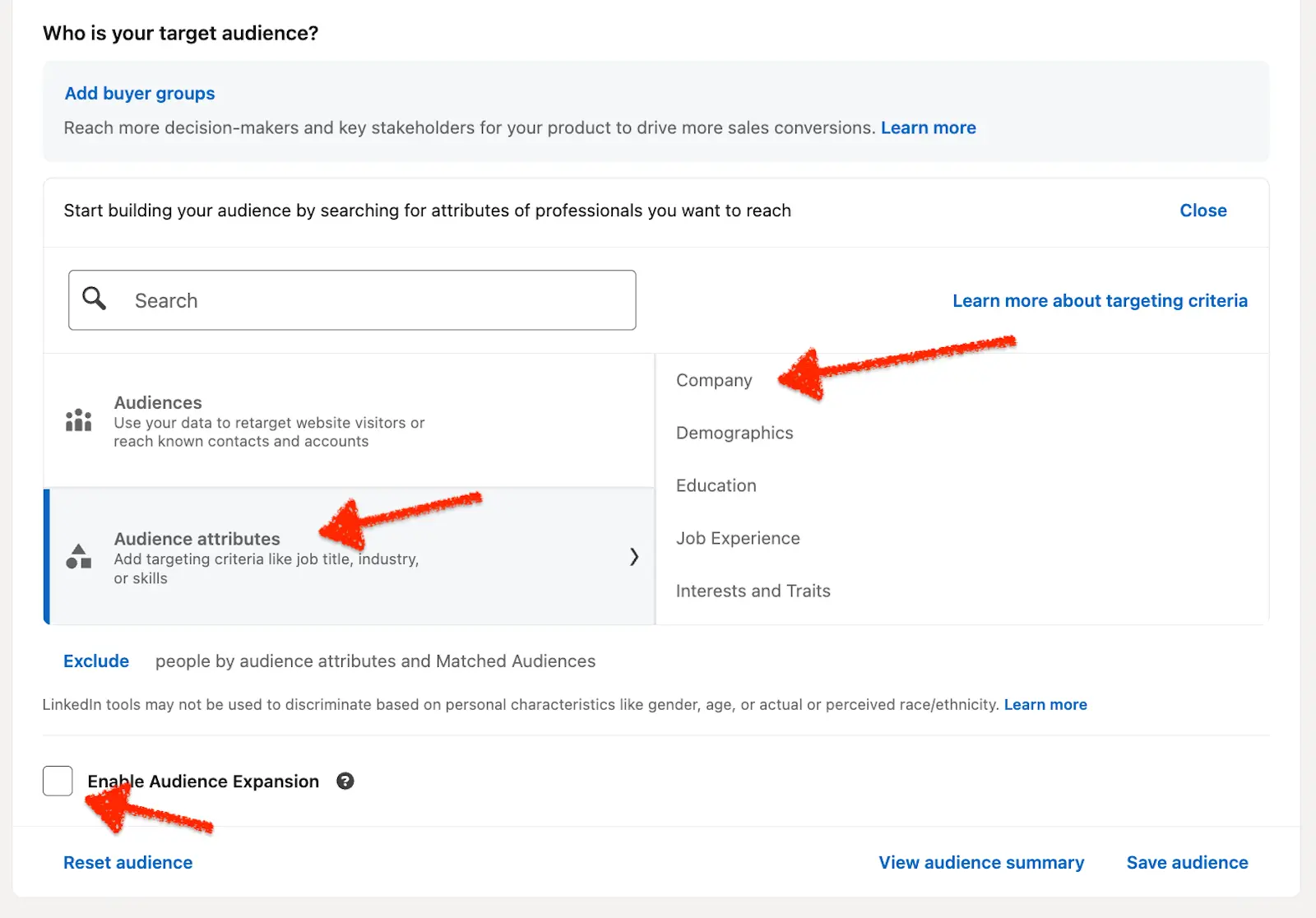
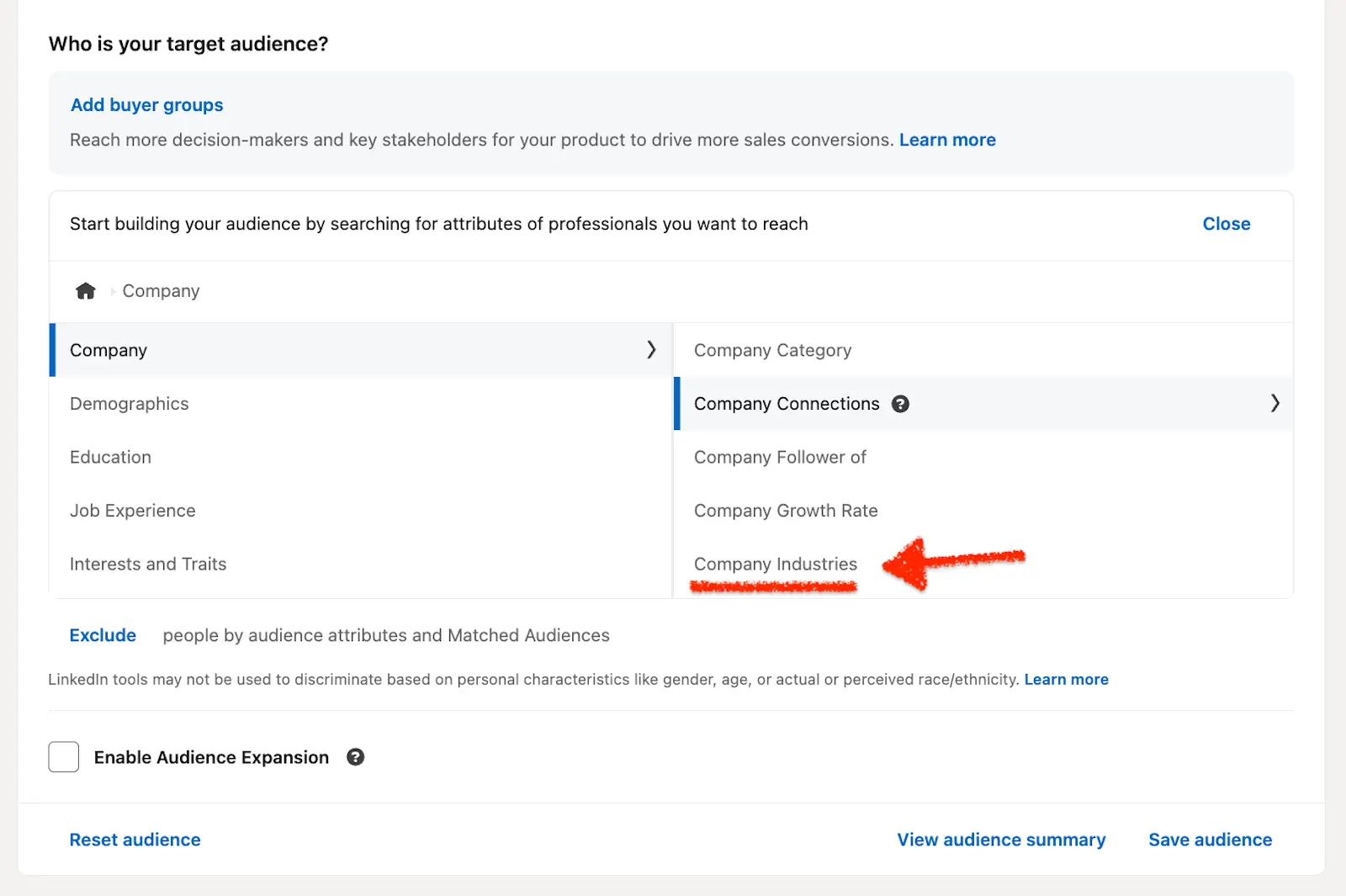
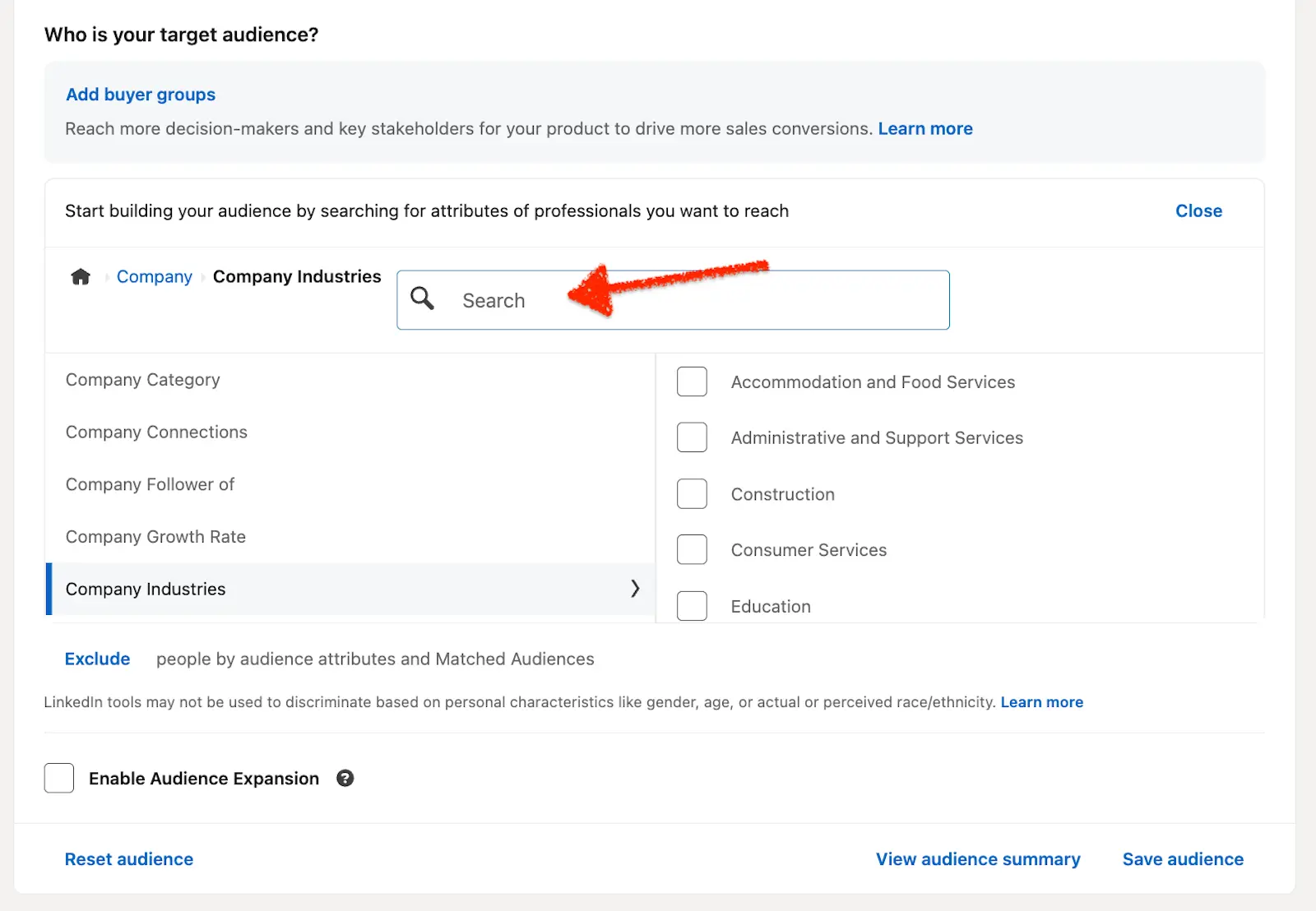
For Blockchain Services LinkedIn targeting, open Company, then Company Industries. Search for Blockchain and select Blockchain Services. This is usually more focused than using a broad parent category such as Technology, Information and Internet.
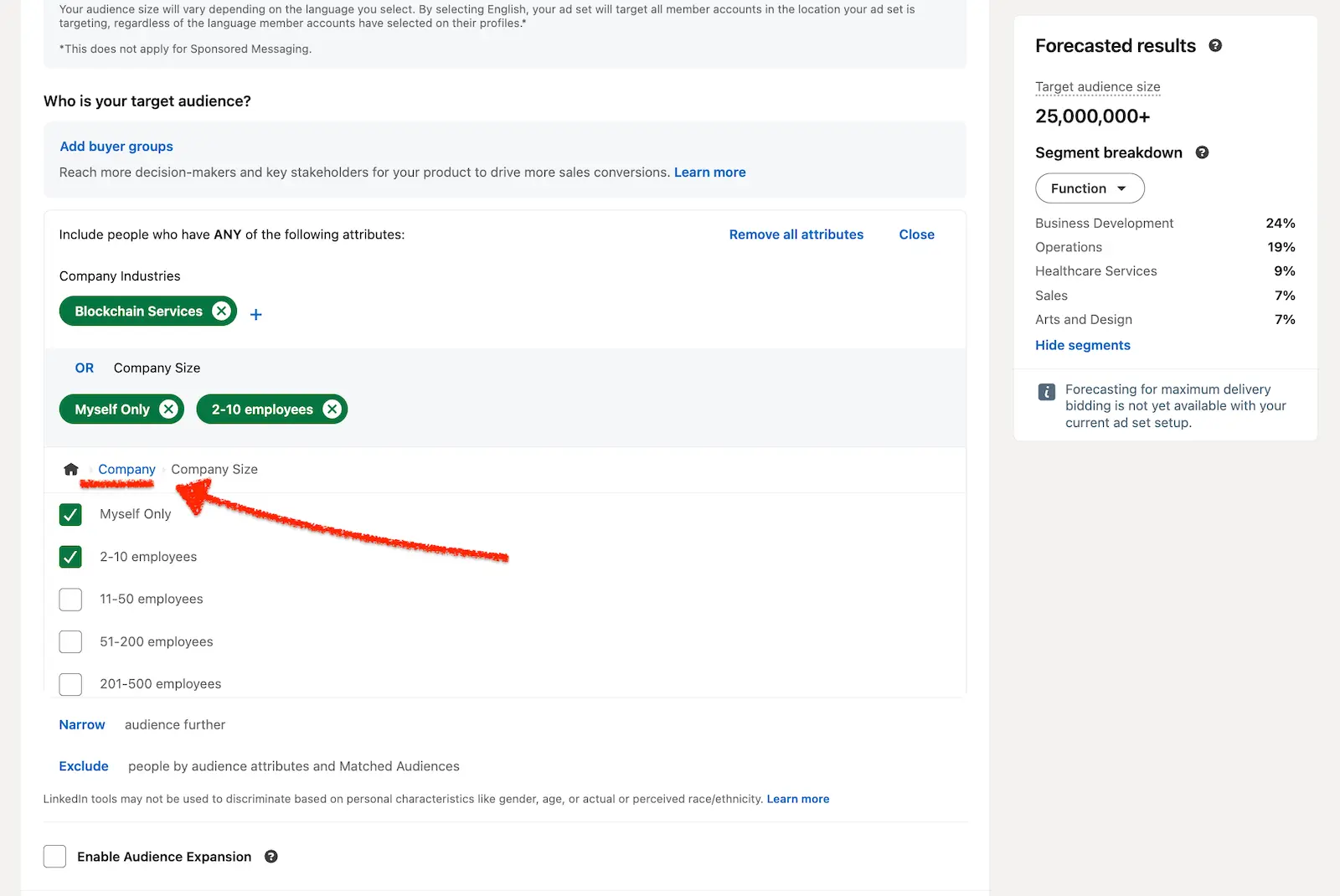
Next, add company size. Small and mid-sized company bands often fit early project teams better than enterprise bands, but keep the segment readable. Test Myself Only separately or avoid it in the first test because it can include solo consultants, side projects, inactive company pages, and unrelated one-person businesses.
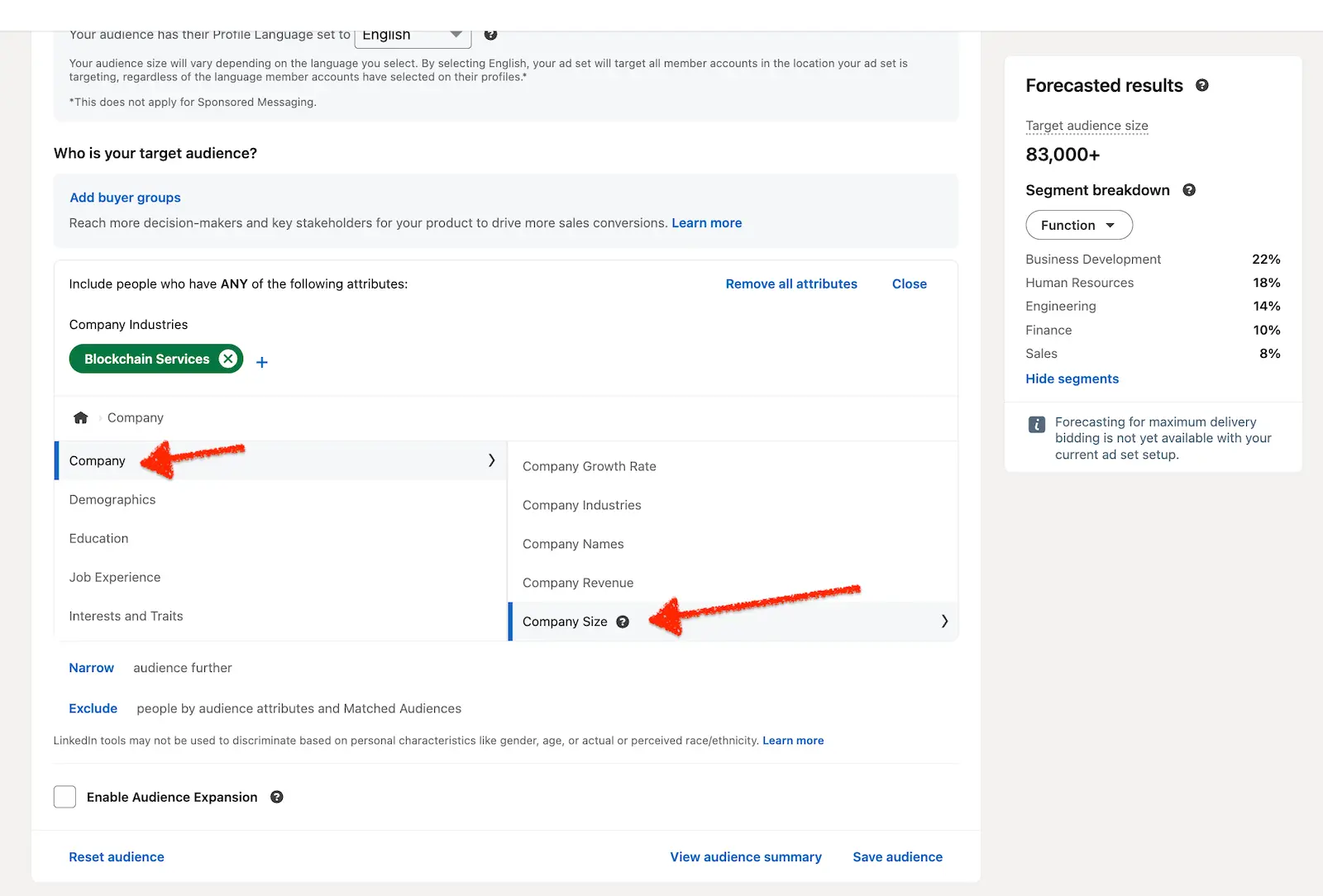
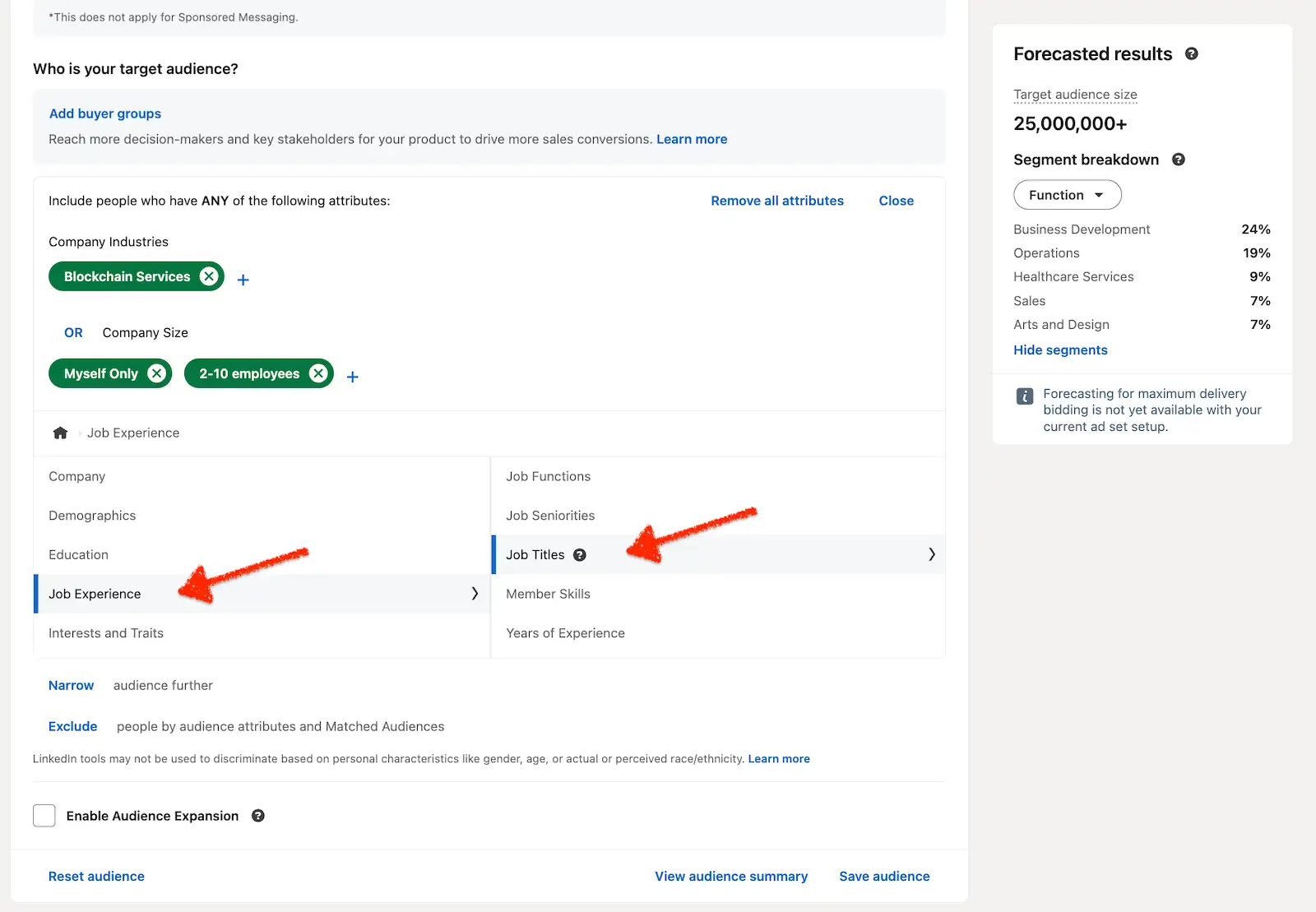
Now add job titles under Job Experience. For a founder-focused ad set, use decision-maker titles such as Founder, Co-Founder, Chief Executive Officer, Chief Technology Officer, Chief Marketing Officer, Head of Marketing, Head of Growth, Head of Business Development, Business Development Manager, and Product Manager.
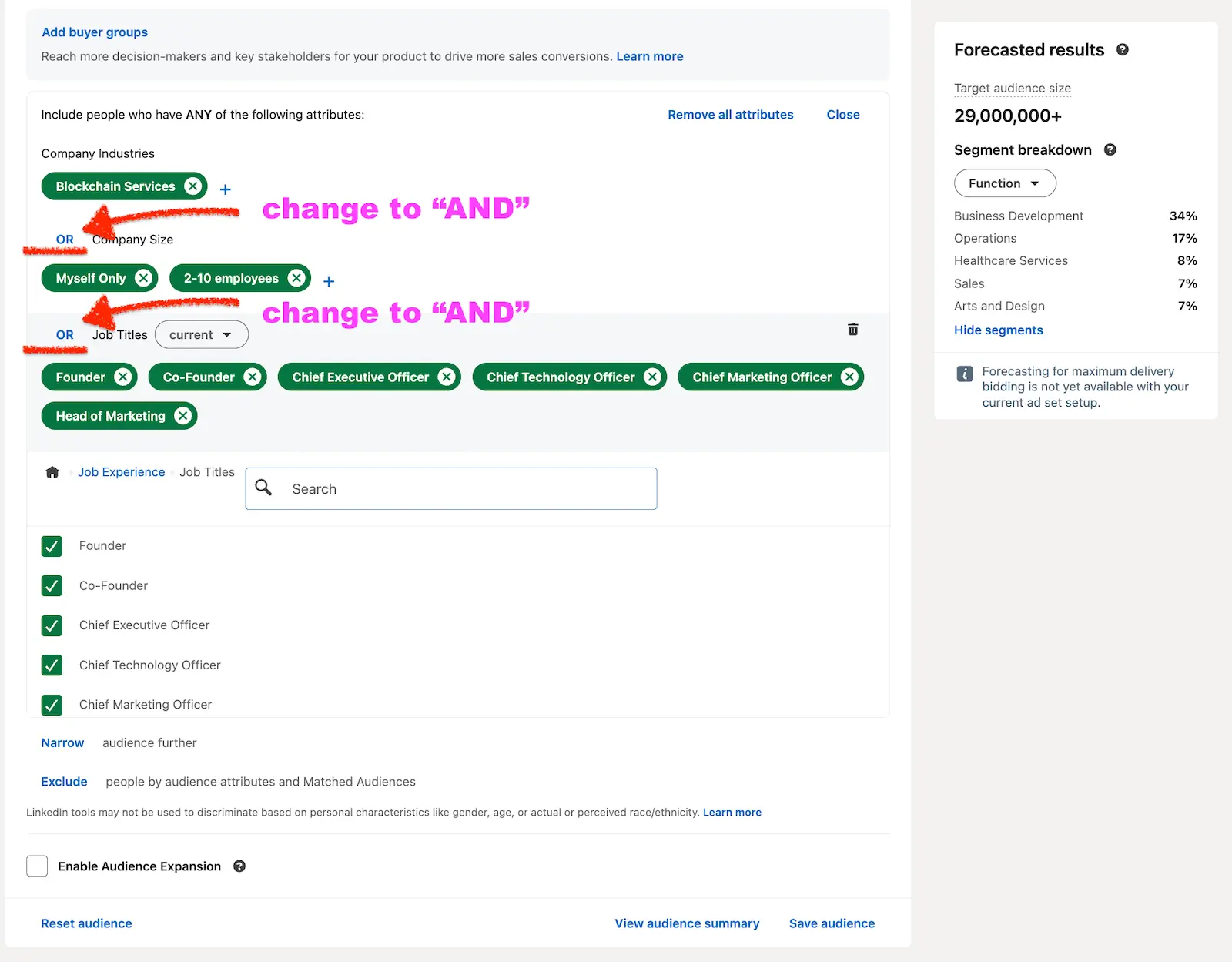
The clean logic should look like this:
Locations
AND Profile Language
AND Company Industry: Blockchain Services
AND Company Size: 2-10 OR 11-50 OR 51-200
AND Job Titles: Founder OR Co-Founder OR CEO OR CTO OR CMO OR Head of Growth
For technical buyers, build a second ad set with the same base audience and a different title group:
Locations
AND Profile Language
AND Company Industry: Blockchain Services
AND Company Size: 2-10 OR 11-50 OR 51-200
AND Job Titles: Blockchain Developer OR Smart Contract Developer OR Solidity Developer OR Web3 Developer OR Protocol Engineer OR DevOps Engineer OR Technical Lead
Avoid this loose structure:
Blockchain Services OR small company OR founder title
Use this controlled structure instead:
Blockchain Services AND selected company size AND selected job title
If Campaign Manager warns that the audience is too small, broaden carefully. Add a nearby company-size band, test a small set of additional titles, or split the campaign by role instead of turning on broad expansion immediately.
Targeting QA checklist
[ ] Locations match markets you can serve.
[ ] Profile language matches the ad copy.
[ ] Audience Expansion is off for the baseline test.
[ ] Blockchain Services is selected under Company Industries.
[ ] Company size is added as a narrowing layer.
[ ] Founder titles and technical titles are in separate ad sets.
[ ] Narrow audience further is used to create AND logic across groups.
[ ] Myself Only is excluded or tested in its own ad set.
Open the audience summary before launch and read it aloud as a sentence. It should say Blockchain Services AND company size AND title, not Blockchain Services OR company size OR title.
LinkedIn Sponsored Messaging crypto founders can respond to
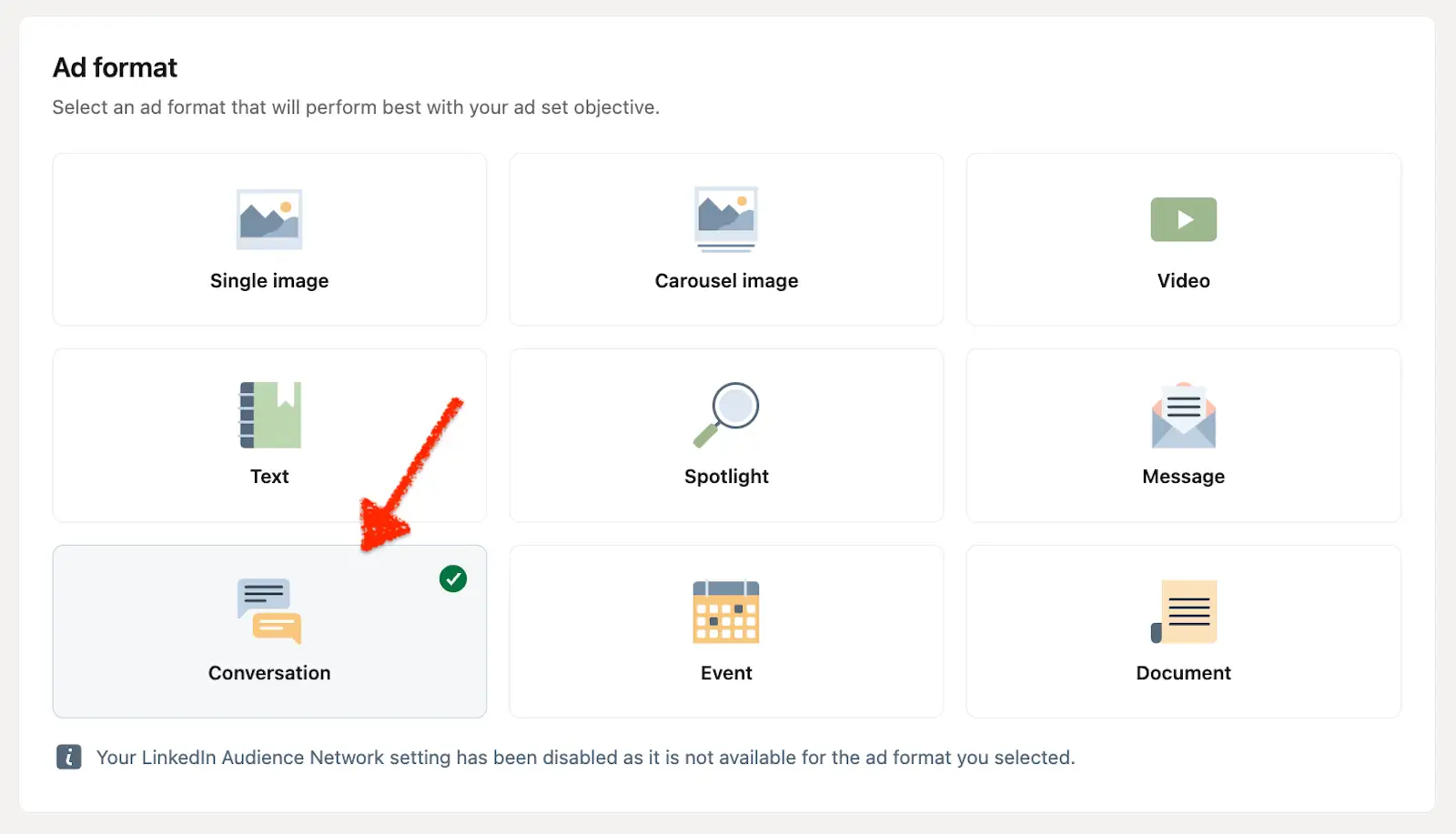
Use the ad format that matches the decision you want the recipient to make. If the goal is inbox delivery, choose Message or Conversation, not Single Image.
Message Ads are better when you have one clear offer and one primary call to action. Conversation Ads are better when you want multiple CTA buttons, such as see how it works, request a sample, view pricing, book a call, or not relevant. The screenshot below shows Conversation selected, and Campaign Manager notes that LinkedIn Audience Network may be disabled for this format.
| Decision point | Message Ad | Conversation Ad |
|---|---|---|
| One simple offer | Strong fit | Possible |
| Multiple CTA buttons | Limited | Strong fit |
| Fastest setup | Strong fit | More setup work |
| Route to different pages | Limited | Strong fit |
| Compare CTA intent paths | Limited | Strong fit |
| Include a not relevant path | Less useful | Useful |
For founder audiences, write toward commercial timing: launch budget, visibility, sales pipeline, listing readiness, compliance work, or service procurement. For technical audiences, write toward audits, infrastructure, documentation, integration speed, security, API quality, monitoring, or engineering workload.
A founder message can be simple (service provider pitching a service, not a tool):
Subject: Quick idea for your next growth window

Hi team,

I noticed your recent launch activity and wanted to share a small idea that tends to work well right after a milestone: a 7-day post-launch growth teardown that spots the top 3 leaks in onboarding and activation.

We do this for token projects that need fast, measurable improvements without a long strategy cycle.

If it is useful, I can send a 1-page teardown outline tailored to your current funnel and timelines.

CTA buttons:
- Send the outline
- Share pricing range
- Book a quick call
- Not relevant
A technical-buyer version should change the angle, not just the title targeting:
Subject: Quick question about your reliability stack

Hi team,

If you are in a busy shipping window, small reliability issues can turn into noisy incidents after launch (alerts, RPC timeouts, flaky indexers, missing dashboards).

We help token projects ship a clean observability baseline in 10 to 14 days: dashboards, alerting, and runbooks scoped to your chain and infra setup.

Would it be helpful if I shared a short "minimum viable monitoring" checklist we use for similar teams?

CTA buttons:
- Send the checklist
- Share a sample dashboard
- Talk scope and timeline
- Not relevant
Adapt the copy by service type (examples of angles that stay specific and non-promotional):
Service angle prompts
PR agency: offer a 1-page launch narrative cleanup plus a distribution checklist for the next announcement.
Listing support: offer a "listing readiness" pack (materials checklist plus gaps to fix before outreach).
Auditor: offer a scoped pre-launch review with a clear timeline, plus remediation support expectations.
KYC or compliance vendor: offer a jurisdiction-first onboarding plan and a compliance requirements checklist.
SEO team: offer a content gap list tied to product intent, plus a realistic publishing cadence for 30 days.
Dev or infra studio: offer a 2-week implementation plan for one bottleneck (indexer, dashboards, docs, integration tests).
Market maker: offer a lightweight liquidity sanity check and the data you need before you quote anything.
Wallet or payments vendor: offer an integration plan with success criteria and a safe rollout checklist.
Do not write copy that sounds like token promotion. Keep it service-led, specific, and useful.
Write two different Sponsored Messaging drafts: one for founders and one for technical teams. Change the pain point, not just the greeting.
Estimate cost per send before launch and compare it after launch
The manual bid is not the same as expected cost per send. In the screenshot, the manual bid input is $0.80 per ad sent, while the forecasted 30-day cost per message send is $0.29 to $0.35.
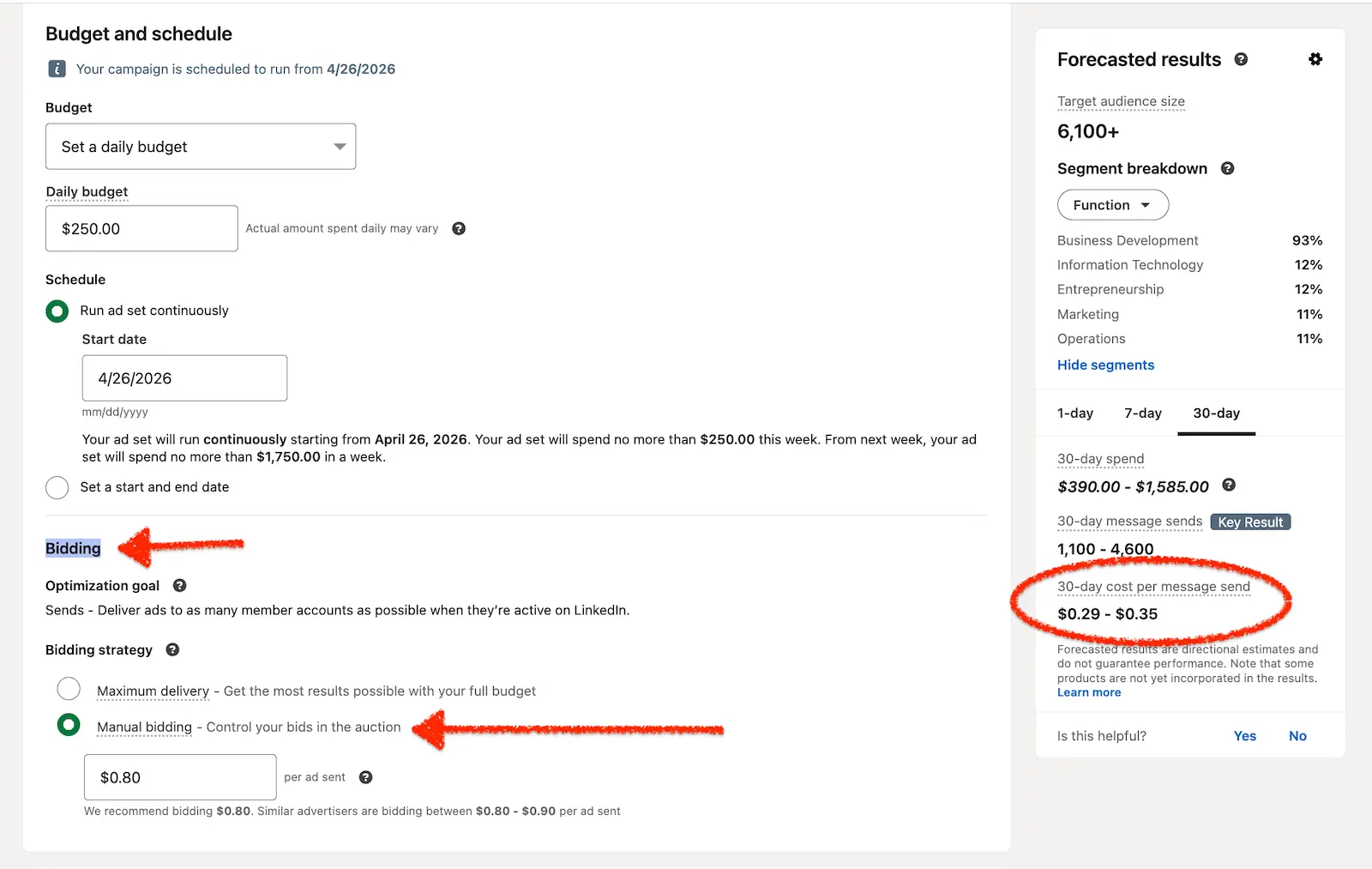
Use the forecast as a planning estimate, not a promise. If Campaign Manager says forecasting for maximum delivery bidding is not available, use manual bidding for the first cost read. Campaign Manager forecasts are directional, and delivery can change based on audience size, competition, sender, creative quality, budget, bid, schedule, and account setup. After launch, actual Cost per Send becomes the number to trust.
Use this calculator before launch:
Estimated sent messages = test budget / forecasted cost per message send
Example using the screenshot forecast:
Daily budget: $50
Test length: 3 days
Total test budget: $150

Forecast low: $0.29 per send
Forecast high: $0.35 per send

Estimated sends at $0.29: about 517
Estimated sends at $0.35: about 429
A small first test can use:
Budget and bidding plan
Daily budget: $20 to $50
Test duration: 3 to 5 days
Bidding strategy: Manual bidding
Optimization goal: Sends
Starting bid: near the recommended bid range shown in Campaign Manager
Audience Expansion: off
Auto-Targeting: off
Creative versions: 1 to 2 per ad set
After launch, review the practical metrics:
Sponsored Messaging metrics to review
Sends: message deliveries.
Opens: first message opens.
Open rate: opens divided by sends.
Clicks: button, body link, or banner clicks.
Cost per Send: spend divided by sends.
Cost per Open: spend divided by opens.
Click to Open Rate: clicks divided by opens.
Connect those metrics to sales outcomes. A higher Cost per Send can still be acceptable if it produces more relevant replies, demo requests, qualified opportunities, or closed revenue. A cheap send is not useful if the audience is wrong.
Use these decision rules after the first read:
Post-launch decision rules
Cost per Send near forecast: keep bidding stable and test copy.
Cost per Send much higher than forecast: check audience size and bid pressure.
Low sends: audience may be too narrow or bid may be too low.
Low opens: sender, subject, or relevance may be weak.
Good opens with weak clicks: message body or CTA needs work.
Good clicks with weak conversions: landing page and offer may not match.
Founder ad set wins: scale that segment separately.
Technical ad set wins: rewrite the founder message or prioritize technical buyers.
Record the forecasted cost per message send before launch. Compare it with actual Cost per Send after the first 3 to 5 days.
Track results from ad set to CRM, CSV, and Public API
Paid inbox messaging is only one channel in the sales system. The useful question is not whether LinkedIn delivered a message. The useful question is whether the contact, channel, offer, and follow-up produced a real commercial conversation.
Use UTM parameters on every destination URL so you can separate founder audiences, technical audiences, Message Ads, Conversation Ads, and copy versions.
UTM starter pattern
utm_source=linkedin
utm_medium=paid_social
utm_campaign=sponsored_messaging_crypto_founders
utm_content=conversation_ad_founders_v1

Variant examples
conversation_ad_founders_v2
message_ad_technical_v1
message_ad_technical_v2
Track both platform metrics and CRM outcomes:
Tracking checklist
[ ] Campaign Manager shows Sends, Opens, Open rate, clicks, Cost per Send, and Cost per Open.
[ ] Analytics captures landing page visits by campaign and ad set.
[ ] CRM records source, audience segment, ad format, and UTM content.
[ ] Replies are tagged as positive, neutral, not relevant, or no fit.
[ ] Demo requests, form submissions, and booked calls are connected to source.
[ ] Sales-qualified opportunities are reviewed by channel, not only by clicks.
[ ] Closed revenue is compared with campaign spend after enough time passes.
LeadGenCrypto can support the data side of this workflow outside LinkedIn. It delivers verified leads of newly launched token projects daily. The verified lead fields in LeadGenCrypto can include website, token address, blockchain, token name, token symbol, and verified email or emails.
Use CSV export for manual sales workflows. Use the Public API quick reference when you want actions such as viewRecentLeads and viewLatestLeads to feed CRM or automation workflows, and set up access in the API keys guide before you build anything. Use the filters and exceptions workflow to apply blockchain network filters and upload email or token URL exceptions so you avoid duplicates and protect budget.
You can also connect project contacts to a CRM integration pattern for outreach operations. Treat LinkedIn Matched Audiences as a test, not a certainty. Matching depends on available LinkedIn accounts, company pages, account settings, data quality, and platform rules.
Channel mix workflow
1. Use LinkedIn Sponsored Messaging to test paid inbox positioning.
2. Use LeadGenCrypto to receive fresh token-project contacts daily.
3. Export to CSV when a human team is still validating the process.
4. Pull via Public API when CRM intake needs to be repeatable.
5. Apply filters and exceptions to suppress duplicates and unwanted rows.
6. Compare LinkedIn, email, and CRM outcomes by audience segment.
Add one CRM field named audience segment before launch. Use values like founder, technical, growth, compliance, or listing so you can compare response quality later.
Keep the copy compliant and useful for service-provider outreach
This campaign should sell a legitimate B2B service, not promote a token. Crypto advertising is sensitive, so write like an operator, not a promoter.
Do not assume that every crypto-adjacent campaign is acceptable just because it targets professionals. Review current platform policies, your own local obligations, and any restrictions for your service category before launch. This matters most for legal, investment, trading, OTC, payments, lending, market making, KYC, AML, and listing-related services.
For outreach hygiene and compliance guardrails, use this practical privacy and anti-spam guide for contacting token projects.
Avoid wording like this:
Risky wording patterns
Buy this token.
Invest before launch.
Profit from this coin.
Pump the market.
Certain listing outcome.
Certain buyer interest.
No downside crypto opportunity.
Use service language instead:
Safer B2B service wording
Improve launch outreach workflow.
Find verified token-project contacts.
Reduce manual prospect research.
Prepare for audit review.
Plan compliance onboarding.
Support listing readiness.
Improve project qualification.
Reach newly launched token projects with a service offer.
Respect relevance. If your offer is not useful to the title or company type you selected, do not send it. Include a clear not relevant path when Conversation Ads make that practical. If you later combine LinkedIn with cold email, review a spam trigger word checklist for crypto outreach before writing the final sequence.
If you want a full outbound QA pass, run this cold outreach pre-flight checklist for agencies selling to token projects before you scale volume.
Compliance QA checklist
[ ] The ad is about a B2B service, not token buying.
[ ] The copy avoids price, profit, or investment language.
[ ] The message does not imply certain outcomes.
[ ] Regulated-service claims have been reviewed internally.
[ ] The recipient role reasonably matches the service offered.
[ ] The CTA is transparent and not misleading.
[ ] Follow-up channels have opt-out and suppression handling.
Do not frame this as investor acquisition, token promotion, or retail-user growth. Keep the campaign focused on service-provider outreach to project contacts.
Copy and paste launch checklist
Use this checklist as the final gate before spending. It summarizes the full framework so a founder, agency operator, or sales lead can review the campaign without reopening every setup screen.
Paste this into your internal launch doc:
LinkedIn founder targeting launch checklist

Commercial fit
[ ] We sell a B2B service to token projects.
[ ] The campaign is not trying to find token buyers or investors.
[ ] Leads means project contacts and outreach targets.
[ ] The offer has one clear next action.
[ ] Regulated-service language has been reviewed.

Campaign setup
[ ] Objective is Website visits, Lead generation, or Website conversions.
[ ] Classic ad set is selected.
[ ] Auto-Targeting is dismissed or off for the first test.
[ ] Product or service name is plain and B2B.
[ ] Source URL points to a relevant landing page.
[ ] Founder and technical audiences are separated.

Audience targeting
[ ] Locations match markets we can sell into.
[ ] Profile Language matches ad copy.
[ ] Audience Expansion is off for the first test.
[ ] Company Industry is Blockchain Services.
[ ] Company Size is selected intentionally.
[ ] Myself Only is excluded or tested separately.
[ ] Job Titles are grouped by buyer type.
[ ] Narrow audience further creates AND logic across groups.

Ad format and copy
[ ] Message or Conversation format is selected for inbox delivery.
[ ] Single Image is not used for an inbox-message test.
[ ] CTA buttons match the recipient's likely decision.
[ ] A not relevant option is included when useful.
[ ] Founder copy and technical copy use different pain points.
[ ] No investment, token-price, or promotion language appears.

Budget and bidding
[ ] Daily test budget is $20 to $50.
[ ] Test duration is 3 to 5 days for the first read.
[ ] Manual bidding is selected for price discovery.
[ ] Bid starts near the recommended bid range.
[ ] Forecasted cost per message send is recorded.
[ ] Manual bid is not mistaken for actual Cost per Send.

Tracking and operations
[ ] UTM parameters are added to every destination URL.
[ ] CRM source and audience segment fields are ready.
[ ] Sends, Opens, Open rate, clicks, Cost per Send, and Cost per Open will be reviewed.
[ ] Landing page visits, forms, demos, replies, and opportunities are tracked.
[ ] CSV or API workflow is ready if project contacts need to enter CRM.
[ ] Filters and exceptions are ready to suppress duplicates.
Use this mistake scan before publishing:
Common mistakes to catch
Broad technology targeting instead of Blockchain Services.
Industry, company size, and titles added with loose OR logic.
Audience Expansion left on during a clean baseline test.
Accelerate used when precise targeting is required.
Single Image selected when inbox delivery is the goal.
A large daily budget used before cost and response quality are known.
Founders and developers mixed in one ad set.
Manual bid read as the expected average cost.
UTM parameters forgotten.
Investment or token-promotion wording left in the copy.
If you sell services to token projects and want more qualified outreach conversations, claim one free verified lead and start building your next list today.
Before launch, send the checklist to one person who did not build the ad set. Ask them to verify audience logic and copy risk.
Frequently Asked Questions (FAQ)
Is LinkedIn Sponsored Messaging useful for crypto B2B sales?
It can be useful when your buyer has a professional LinkedIn presence and your offer is a legitimate B2B service. It works best as one channel inside a wider outreach system that also tracks project contacts, replies, CRM stages, and sales outcomes.
Should I choose Website visits, Lead generation, or Website conversions?
Use Website visits when you have a landing page and want the simplest first test. Use Lead generation when a LinkedIn form is the desired next action. Use Website conversions after tracking is configured and there is enough conversion data to optimize responsibly.
Is a Single Image Ad the same as a Sponsored Message?
No. Single Image is a feed format. When the goal is inbox delivery, choose Message Ad or Conversation Ad.
Why start with Classic instead of Accelerate?
Classic gives more control over targeting, bidding, ad format, and interpretation. Use it for the first baseline test when you need to understand whether the Blockchain Services, company size, and job title combination is working.
What does Blockchain Services LinkedIn targeting miss?
It is a useful starting filter, not a perfect token-project detector. It can include service firms, infrastructure companies, consultancies, and other crypto-related businesses. Narrow it with company size, job titles, location, and campaign results.
How should I use company size for founder targeting?
Start with smaller bands such as 2-10, 11-50, and 51-200 when you are testing early or mid-sized project teams. Treat Myself Only separately because it can be noisy.
Why should founders and developers be separated?
They respond to different problems. Founders may care about timing, budget, visibility, listings, compliance, or sales pipeline. Developers may care about audits, infrastructure, security, API quality, integration speed, and engineering workload.
What is the expected cost if the manual bid is $0.80 and the forecast is $0.29 to $0.35?
Use the forecasted $0.29 to $0.35 as the planning estimate for average cost per sent message. The $0.80 value is the manual bid input. Actual Cost per Send after launch can differ.
Why turn Audience Expansion off at first?
The first test should show whether your intended audience works. Expansion can add similar members outside your exact targeting, which may be useful later but makes the baseline less clear.
Can LeadGenCrypto replace LinkedIn targeting?
No. They solve different jobs. LinkedIn tests paid inbox messaging to professional profiles. LeadGenCrypto delivers verified leads of newly launched token projects for outreach workflows, CSV export, Public API pulls, CRM sync, blockchain filters, and exception handling.
Can I upload LeadGenCrypto project contacts into LinkedIn Matched Audiences?
You can test matched-audience workflows where appropriate, but matching is not guaranteed. Match rate depends on available LinkedIn accounts, company pages, settings, data quality, and platform rules.
How do I avoid the wrong traffic and compliance risk?
Keep the article, ad copy, CTA, and follow-up focused on B2B services for project teams. Do not mention token buying, investor acquisition, retail growth, profit language, or certain outcomes.