How to Handle NDAs with Crypto Projects: A Practical Guide for Service Providers

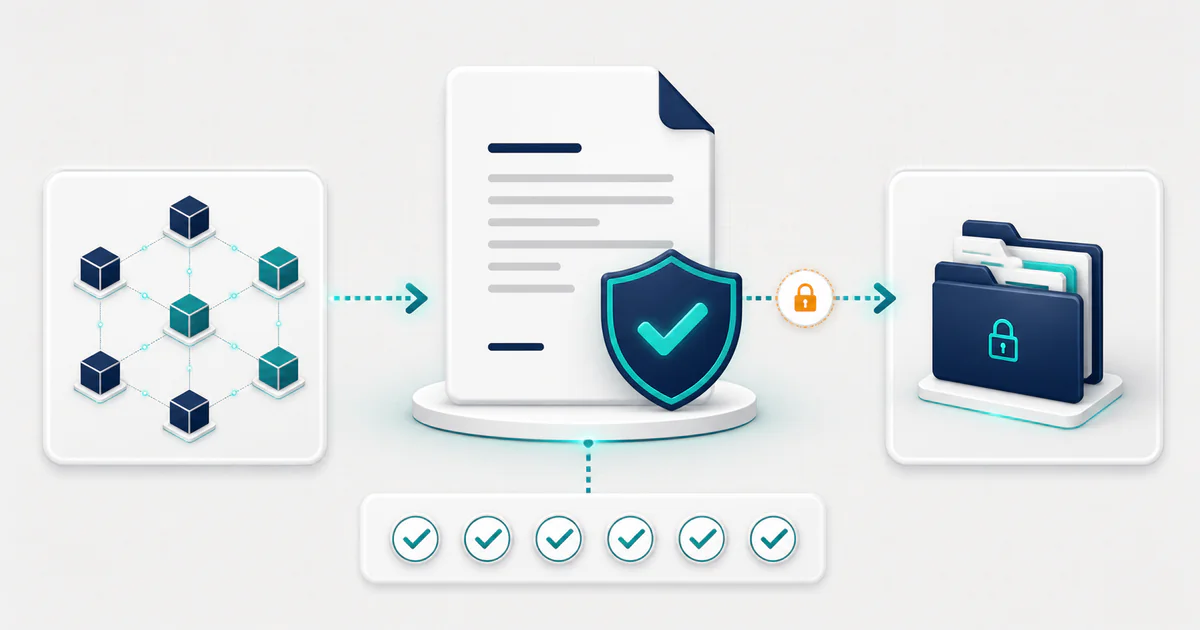
- Sign before defined non-public information crosses the business boundary.
- Verify the legal party and the signer's authority first.
- Match confidentiality terms to your real team, tools, and access.
- Exclude public on-chain data, open-source code, and independent work.
- Never treat an NDA as permission to share wallet secrets.
- Use VERIFY to decide whether to sign, revise, or pause.
The NDA arrives before the prospect will explain the secret.
Tomorrow's discovery call depends on a signature today. The document is described as standard. Yet it covers every fact about the project forever, allows no contractors, and says nothing about the cloud and artificial intelligence tools your team actually uses.
Signing immediately feels like the professional move. An NDA with a crypto project can be the moment a simple sales step becomes an operational promise the business cannot keep.
The practical answer is not “never sign.” It is to map the information flow, verify the party, and run six checks before non-public information moves. This guide calls that review VERIFY.
NDA enforceability, remedies, electronic signatures, trade secrets, privacy duties, market-conduct rules, and protected disclosures depend on the facts and jurisdiction. Obtain qualified legal advice for high-value, cross-border, regulated, security-sensitive, or disputed work.
Sign only when defined non-public information must cross the boundary
An NDA should solve a specific disclosure problem, not act as a ritual trust badge.
You probably do not need one to review a public website, inspect a public repository, analyze on-chain activity, discuss a public service menu, or hold a high-level qualification call.
You may need one before the project shares an unreleased launch plan, private tokenomics, draft exchange materials, an unpatched vulnerability, proprietary code, non-public partner negotiations, personal data, or internal campaign results.
The UK Intellectual Property Office guidance describes an NDA as a legal contract for sharing information in confidence. It also recommends defining the permitted purpose precisely and choosing a one-way or mutual structure based on who will disclose.
NDA decision matrix for crypto service providers
| Situation | Decision | Reason |
|---|---|---|
| Research uses only public pages, explorers, and repositories | Go without an NDA | No confidential information is moving |
| First call covers public facts, goals, and a rough budget | Usually go without an NDA | Keep qualification high level |
| The project must reveal private launch, listing, partner, code, or security information | Sign or revise before disclosure | A defined confidentiality need exists |
| Both sides will share pricing logic, code, methods, or proprietary processes | Prefer a balanced mutual NDA | Both parties need protection |
| A services agreement already has complete confidentiality terms | Check whether a second NDA is necessary | Duplicated terms can conflict |
| The work involves personal data | Add the required privacy agreement | Confidentiality alone may not satisfy data-protection duties |
| The client wants to send a seed phrase, raw private key, or unrestricted signing credential | Pause and refuse that access method | Contract text cannot make catastrophic access safe |
| No legal entity or authorized signer can be identified | Pause | Accountability and enforcement are unclear |
| The NDA contains non-compete, IP assignment, exclusivity, or unlimited liability | Revise and escalate | Those are broader commercial terms |
Use the NDA after a prospect is real, not before every cold email. If your team is still sourcing and qualifying accounts, start with a process for finding crypto projects worth pitching and move to contract intake only when a genuine conversation requires non-public detail.
No sensitive information means no NDA yet. Defined sensitive information, a verified counterparty, and a clear purpose mean the right NDA should be signed before disclosure.
Define the information before negotiating the document
“Everything about the project is confidential” sounds strong because it avoids hard choices. That is exactly why it is hard to follow.
A workable definition names categories and ties them to a permitted purpose.
Information that may reasonably need protection includes:
- unreleased launch, migration, listing, or partner plans;
- private tokenomics, allocation, treasury, or liquidity plans;
- proprietary code, architecture, deployment processes, and audit findings;
- unpatched vulnerabilities and incident-response material;
- non-public budgets, pricing, forecasts, campaign data, and negotiation positions;
- customer, employee, community, know-your-customer, or investigation data;
- proprietary methods, research, and work product supplied by either side.
Normal exclusions often cover information that:
- is already public without a breach;
- appears on a public blockchain, explorer, website, filing, or social channel;
- is already published in a public repository under its applicable license;
- was already known lawfully by the receiving party;
- arrives lawfully from an independent third party;
- is developed independently without using the confidential material;
- is approved for release in writing.
Public inputs do not make every output public. A private roadmap, ranking, analysis, or combined dataset built from public facts may still have confidential value. The agreement should describe that distinction instead of trying to privatize the blockchain itself.
The WIPO Guide to Trade Secrets and Innovation explains that reasonable secrecy measures can include need-to-know access, information-technology controls, training, and confidentiality agreements. The paper is one control inside a system.
The hard boundary: never share wallet-control secrets
An NDA should never normalize disclosure of:
- a seed phrase;
- a raw private key;
- two-factor authentication recovery codes;
- an unrestricted production credential;
- a single-person treasury or deployment signing account.
Use role-based access, separate accounts, test environments, allowlists, multisignature approval, hardware signing, transaction simulation, time-limited credentials, and access logs instead.
Next action: write a one-page information map with four columns: information, owner, approved recipient, and approved system.
Verify the crypto project counterparty before you sign
A beautifully drafted NDA is weak protection if “the client” is only a Telegram handle and token ticker.
Ask for:
- the full legal name of the contracting entity;
- jurisdiction of formation and registration number, where applicable;
- registered or business address;
- official website and domain email;
- full name and title of the signer;
- evidence that the signer has authority;
- the relationship between the entity, project brand, and token;
- governing law and dispute forum;
- a reliable notice email and physical address.
A wallet signature can help show that someone controls an address. It does not, by itself, prove the person's legal identity, the address's relationship to the project, or authority to bind a company.
What changes for a DAO?
“DAO” is a governance description, not one universal legal form.
The contracting party might be a foundation, development company, association, protocol company, service company, or another wrapper. Multisignature participants may act under a documented resolution, but the agreement should still identify who is bound, who pays, who receives notices, and which law and forum apply.
If nobody can answer those questions, do not solve the problem by putting a token symbol in the signature block.
What if the public team is anonymous?
An anonymous public persona may still represent a real legal entity. Verify that entity behind the persona.
For a small diagnostic, you might reduce exposure through prepayment, narrow scope, no sensitive access, and milestone delivery. For audit, treasury, custody, KYC, exchange, infrastructure, or production-system work, an unverifiable counterparty deserves a much higher review threshold.
Next action: resolve identity mismatches before negotiating clause language.
Review an NDA with a crypto project using VERIFY
Most NDA reviews begin at clause one and drift into wordsmithing. VERIFY turns the document into six business questions.
| Check | Core question | Common red flag | Next action |
|---|---|---|---|
| V: Verify | Are the legal parties and signers correct? | Project brand, undefined ecosystem, or unauthorized signer | Resolve identity and authority |
| E: Establish | What exact purpose permits use? | “Any business relationship” | Write one concrete evaluation or service sentence |
| R: Restrict | Is confidential information defined with normal exclusions? | Public facts and all future ideas are captured | Add public, prior, third-party, and independent-work exclusions |
| I: Identify | Who and which tools may receive information? | No contractors, advisers, cloud systems, or approved AI workflow | Match the clause to the real delivery map |
| F: Fix | Are duration, law, forum, liability, and remedies workable? | Every category lasts forever with unlimited exposure | Separate categories and escalate disproportionate terms |
| Y: Your operations | Can the team keep the promise after signature? | No owner for access, offboarding, deletion, or case-study approval | Assign owners and record the controls |
V: Verify parties and authority
Compare the NDA, proposal, invoice, official website, and payment request. Different company names are not a formatting issue. They are an identity problem.
Pay special attention to undefined affiliates that can disclose information without being named. If the provider must protect information from a large group, it should understand who belongs to that group.
E: Establish the permitted purpose
Weak purpose:
For any business relationship between the parties.
Better purpose:
To evaluate, negotiate, and, if agreed in a separate services contract, perform marketing analytics services for the project.
The purpose should permit the real work without authorizing unrelated use.
R: Restrict the definition and add exclusions
Test the definition against three items:
- a public token page;
- a private security report;
- your pre-existing method or know-how.
If all three receive the same treatment, the definition needs work.
I: Identify recipients, tools, and security
The document should answer:
- May employees and contractors receive information on a need-to-know basis?
- May lawyers, accountants, insurers, and auditors see it?
- Are subcontractors allowed?
- May information enter cloud storage, code hosting, ticketing, analytics, or approved AI systems?
- Which controls are reasonable for each category?
- How quickly should an unauthorized disclosure be reported?
Do not promise that no incident can ever happen. Promise concrete controls your business can follow.
F: Fix duration, law, liability, and remedies
Different information loses sensitivity at different speeds. A launch date may expire after publication. Pricing and negotiation positions may remain sensitive for years. A trade secret may require protection while it continues to qualify under applicable law.
The UK IPO notes that three or five years are common in some commercial NDAs. That is a discussion reference, not a rule for every category or country.
Review the governing law, court or arbitration forum, notice process, urgent-relief language, liquidated damages, legal fees, liability caps, and conflict with the future services agreement.
Y: Make your operations keep the promise
Assign an owner to:
- store the executed agreement;
- record the effective date and survival period;
- control restricted folders;
- approve people and tools;
- log important oral disclosures;
- remove access when someone leaves;
- return or delete material at offboarding;
- preserve only required backups;
- approve a logo, testimonial, or case study in writing.
Next action: mark each VERIFY letter green, amber, or red. Sign only when red items are resolved and amber items have an owner.
Ten red flags hidden inside a “standard” NDA
The dangerous part is often the clause that is not really about confidentiality.
| Red flag | Why it matters | Better response |
|---|---|---|
| All project information is confidential, even if public | Creates impossible duties and tries to privatize public facts | Add normal exclusions and name public on-chain and repository content |
| Every category remains confidential forever | Routine information may not justify perpetual restriction | Separate time-limited information from qualifying trade secrets |
| You may not work with competing crypto projects | This is a non-compete | Remove it or negotiate conflicts separately |
| Every idea or improvement belongs to the client | May assign background methods and future IP | Put ownership and licensing in the services agreement |
| Liability is unlimited or penalties are automatic | Exposure may have no relationship to harm or deal value | Escalate and negotiate proportionate terms |
| No employee, contractor, insurer, or adviser may see anything | Normal delivery may become a breach | Permit need-to-know access for bound representatives |
| Client permission is required before contacting a regulator | May conflict with protected reporting rules | Add lawful-disclosure and whistleblower carveouts |
| The relationship can never be mentioned | Removes portfolio and case-study rights | Use a separate written approval process |
| The client may demand any credential needed for the work | Normalizes unsafe wallet or system access | Define least privilege and exclude wallet-control secrets |
| A distant court has exclusive jurisdiction and the client has no clear assets | A theoretical remedy may be commercially useless | Assess cost, enforceability, and realistic dispute options |
The US Securities and Exchange Commission explains that Rule 21F-17(a) addresses actions that impede direct reporting of possible securities-law violations, including through confidentiality agreements. Review the SEC whistleblower protection guidance for that US-specific rule, and obtain advice for every other applicable jurisdiction.
A clean NDA should protect legitimate secrets without becoming a tool to hide fraud, sanctions issues, security incidents, consumer harm, harassment, or regulatory violations.
An NDA is not a services agreement, data processing agreement, or security schedule
One document can contain several functions, but your team should know which problem each clause solves.
Use a stand-alone NDA when confidential information must be exchanged before the full engagement is ready. Use a confidentiality section in the master services agreement when the commercial relationship can be signed as one package. If both documents exist, say which controls when they conflict.
Keep these separate functions visible:
- Statement of work: deliverables, milestones, dependencies, acceptance, timeline, fees, revisions, change control, and approvals.
- IP terms: client materials, provider background IP, new deliverables, third-party components, licenses, ownership transfer, and portfolio rights.
- Data processing agreement: privacy roles, documented instructions, subprocessors, security, assistance, retention, deletion, and audits where required.
- Security schedule: account controls, encryption, logging, vulnerability handling, incident notice, backups, testing, and subcontractors.
- Market-information controls: access lists, trading restrictions, escalation, and advice for information that could affect a covered market.
The European Commission explains that a processor handling personal data on another organization's behalf needs a contract or other legal act with specified protections. Its controller and processor guidance is a useful starting point for European Union obligations. The actual roles and law still need review.
For the earlier question of how business contact data is sourced and used, keep this contract workflow separate from the legal and compliance basics for crypto B2B outreach. Relevance, opt-out handling, suppression, and list hygiene still apply to later outreach.
Handle market-sensitive information as a separate risk
Confidentiality is not permission to trade or tip another person.
A provider may learn about a listing, exploit, treasury action, migration, partnership, buyback, unlock, or regulatory event before the public does. Restrict access, record receipt, pause conflicting activity, and obtain advice.
The EUR-Lex summary of MiCA describes measures concerning insider dealing, unlawful disclosure of inside information, and market manipulation for covered crypto-assets. Do not generalize those rules to every token, person, or country.
Next action: place every non-confidentiality issue into the contract or policy that actually owns it.
Negotiate the NDA without slowing the deal
A calm, specific response creates more trust than an instant signature or a dramatic legal memo.
Sort each issue into three buckets:
- Accept: normal confidentiality mechanics your business can follow.
- Clarify: identity, purpose, information categories, recipients, tools, duration, law, and forum.
- Escalate: IP assignment, non-compete, exclusivity, unusual penalties, unlimited liability, personal data, production access, or regulated information.
Send factual questions first. They often resolve the problem before anyone debates wording.
Copy-paste email for missing details
Delete the paragraph about IP assignment, non-compete, and liability if those terms are not in the draft you received.
Subject: NDA details before signature

Thanks. We are comfortable signing a focused mutual NDA before either side shares non-public information.

Before signature, please confirm:

1. The full legal name and jurisdiction of the contracting entity.
2. The signer's name, title, and authority.
3. The purpose of the disclosure and expected information categories.
4. Whether bound employees, contractors, and professional advisers may receive information on a need-to-know basis.
5. The proposed governing law and dispute forum.

We also propose that public blockchain data, public repository content, previously known information, lawful third-party information, and independently developed work remain outside Confidential Information.

The current draft also includes IP assignment, a non-compete, and unlimited liability. Those points should be handled in the services agreement rather than the confidentiality step.

Once the factual points are clear, we can finalize the document and use the discovery call for the sensitive detail.

Best,
Agency team
Electronic-signature rules depend on the governing law and required form. Current European Commission trust-services guidance explains the European Union's non-discrimination principle for electronic documents and the special cross-border effect of qualified electronic signatures.
Next action: send the identity and purpose questions before proposing a complete rewrite.
Use this short-form mutual NDA clause worksheet
The following is a discussion aid, not a ready-to-sign agreement. It helps you identify the decisions that counsel or the contract owner must convert into language for the chosen law.
Replace every bracketed item, remove inapplicable clauses, check how this worksheet interacts with the services agreement, and obtain legal review appropriate to the risk.
MUTUAL NDA CLAUSE WORKSHEET

PARTIES
Project legal entity: [full legal name, form, jurisdiction, number, address]
Provider legal entity: [full legal name, form, jurisdiction, number, address]
Authorized signers: [names, titles, and authority evidence]

PURPOSE
The parties may use Confidential Information only to evaluate, negotiate, and, if separately agreed in writing, perform [specific services].

CONFIDENTIAL INFORMATION
Cover non-public information that is marked confidential or should reasonably be understood as confidential from its nature and disclosure context.

EXCLUSIONS
Exclude information that is public without breach, lawfully known before disclosure, lawfully received from another source, independently developed, or approved for release. State how public blockchain and public repository information is treated.

REPRESENTATIVES AND TOOLS
List need-to-know employees, contractors, professional advisers, approved subprocessors, and approved systems. State whether confidential material may enter cloud, analytics, code-hosting, ticketing, or generative AI tools.

ACCESS AND WALLET SECURITY
No party must disclose a seed phrase, raw private key, recovery code, or unrestricted signing credential. Put production access, transaction approval, custody, and security duties in the services agreement or security schedule.

LAWFUL DISCLOSURE
Permit disclosures required by law and preserve protected reporting, regulator contact, law-enforcement cooperation, and professional advice to the extent applicable.

PERSONAL AND REGULATED DATA
State that the NDA does not replace a required processor agreement, transfer mechanism, know-your-customer or anti-money-laundering agreement, security schedule, or other regulated-data terms.

OWNERSHIP
Confidential disclosure creates no implied license or assignment. Define background IP, deliverables, third-party components, and client materials in the services agreement.

RETURN, DELETION, AND BACKUPS
Set a practical request process, deadline, legal-retention exception, and treatment of routine backups.

PUBLICITY
Require written approval for names, logos, token tickers, quotations, testimonials, screenshots, and case studies.

TERM, LAW, AND DISPUTES
Choose category-appropriate confidentiality periods, governing law, forum, notice mechanics, and urgent-relief language after legal review.

DOCUMENT CONFLICT
State whether this NDA or a later services agreement controls if they cover the same confidentiality issue differently.
Next action: use the worksheet to prepare questions, not to bypass legal review.
Copy-paste crypto client NDA intake checklist
This is the primary tool in the article. Add it to the qualified-discovery stage of your client workflow.
CRYPTO CLIENT NDA INTAKE CHECKLIST

COUNTERPARTY
[ ] Full legal entity name confirmed
[ ] Jurisdiction and registration number confirmed
[ ] Business and notice addresses confirmed
[ ] Official domain email confirmed
[ ] Signer's name, title, and authority confirmed
[ ] Entity's relationship to the project and token confirmed

PURPOSE AND SCOPE
[ ] Permitted purpose is specific
[ ] Information categories are listed
[ ] Public blockchain information is handled explicitly
[ ] Public repository and open-source content are handled explicitly
[ ] Prior knowledge, lawful third-party receipt, and independent work are protected
[ ] Oral disclosures have a workable confirmation rule

PEOPLE, TOOLS, AND SECURITY
[ ] Need-to-know representatives are allowed
[ ] Contractors and advisers have confidentiality duties
[ ] Approved tools and storage locations are recorded
[ ] Generative AI use is prohibited or expressly approved
[ ] Least-privilege access is defined
[ ] No seed phrase, raw private key, or recovery secret will be shared
[ ] Incident notice and response owners are defined

OTHER AGREEMENTS
[ ] Scope and payment sit in the SOW or services agreement
[ ] Background IP and deliverable ownership are handled separately
[ ] Privacy terms are added if personal data is processed
[ ] A security schedule is added for production access
[ ] Market-sensitive information controls are considered

LEGAL AND COMMERCIAL TERMS
[ ] Duration is proportionate to each information category
[ ] Return, deletion, backup, and legal-retention rules are workable
[ ] Lawful-disclosure and protected-reporting carveouts are present
[ ] Portfolio and publicity rules are clear
[ ] Governing law and forum are practical
[ ] Hidden non-compete, exclusivity, and IP assignment terms are removed or escalated
[ ] Liability and remedies have been reviewed

OFFBOARDING
[ ] Executed agreement and dates are stored
[ ] Access-removal owner is assigned
[ ] Return or deletion date is recorded
[ ] Retained backups remain restricted
[ ] Case-study permission is documented separately
If your CRM already controls discovery and onboarding, add this checklist as a gate instead of creating a separate legal inbox. The six-step CRM pipeline for selling services to crypto projects provides the wider stage and handoff model.
Common objections before you adopt the process
The process should make ordinary deals faster and unusual deals more visible. It should not send every two-page NDA into a month-long review.
“Will this scare off the prospect?”
Five factual questions about identity, purpose, recipients, law, and forum are not an accusation. They show that your team understands confidential work. A prospect that refuses to identify the contracting party or describe the information need is giving you decision-useful evidence.
“Do I need a lawyer for every NDA?”
Create a fast path for an approved, balanced template and an escalation path for client drafts or triggers such as unfamiliar law, non-compete, IP assignment, unusual penalties, unlimited liability, regulated data, production access, or a dispute.
The threshold should reflect deal value and risk. The article cannot set that threshold for your business.
“What if freelancers or AI tools are part of delivery?”
Do not hide the workflow. The document should permit bound representatives and approved systems, or the delivery model must change. Check vendor terms and data settings before confidential information enters any third-party tool.
“Can we still use the work in our portfolio?”
Only if the agreement permits it or the client gives written approval. Define what can be shown, when, in which channel, and with which redactions.
“What if the services agreement already has confidentiality terms?”
One complete, consistent confidentiality section may be enough. If both documents exist, define precedence and remove conflicting definitions, durations, and forums.
“Can a wallet signature replace the company check?”
No automatic equivalence should be assumed. It may support evidence of wallet control, but identity, entity relationship, and authority still need verification.
Turn NDA review into one CRM gate, not a legal fire drill
The useful outcome is not a perfect document library. It is a reliable decision at the moment a qualified prospect enters confidential discovery.
Use one CRM rule:
Sensitive discovery cannot begin until the counterparty, purpose, information categories, recipients, tools, access method, and escalation status are recorded.
Once that gate exists, the next prospect does not need to recreate the process. If you need a suitable account to test the handoff, get a free verified lead and review the data quality, then trigger NDA intake only if the relationship reaches confidential discovery.
LeadGenCrypto Blog and Updates
Make the next client handoff easier
Subscribe for concise notes on qualifying crypto projects, improving service sales, and building safer client workflows.
- Fast summaries of new LeadGenCrypto guides
- Practical checklists for agencies and service providers
- Useful sales and outreach ideas without hype
Frequently asked questions about NDAs with crypto projects
Should I sign every NDA a crypto project sends?
No. First check the party, authority, purpose, definition, exclusions, permitted recipients, tools, duration, law, forum, liability, and hidden commercial terms. A legitimate confidentiality need does not make every draft balanced.
Is a mutual NDA better than a one-way NDA?
Use mutual terms when both sides will disclose confidential information. Use one-way terms when only one side discloses. Mutual wording can still contain one-sided IP, liability, publicity, or forum provisions.
Do I need an NDA before the first call?
Not always. Keep an initial qualification call to public facts and high-level goals. Sign before the conversation requires genuinely non-public information.
Can public blockchain information be confidential?
Information already public on-chain should normally be addressed as an exclusion. A private analysis, prioritization, or combination built from public facts may still have confidential value, depending on the agreement and applicable law.
Can I share confidential information with freelancers or AI tools?
Only when the agreement permits the recipient or system, the person is bound by appropriate duties, the tool is approved, and the access is necessary. Do not assume a standard employee clause covers freelancers, subprocessors, or generative AI.
Is an NDA enough if I process know-your-customer or community-member data?
No. Privacy law may require processor terms, documented instructions, security measures, subprocessor controls, assistance, retention, deletion, and data-transfer mechanisms. The parties' roles and jurisdiction control the answer.
How long should a crypto project NDA last?
There is no universal period. Match the duration to the information and law. Launch timing may expire quickly. Commercial information may justify years. Trade-secret obligations may depend on continued secrecy and local rules.
Can I show the work in my portfolio later?
Only if the contract permits it or the client later gives specific written approval. Cover the name, logo, token ticker, screenshots, results, quotations, and timing.
Should I accept a private key if the NDA covers it?
No. Use least-privilege accounts, multisignature procedures, test environments, allowlists, hardware signing, and explicit transaction approval. An NDA cannot reverse an unauthorized on-chain action.
What if the client is a DAO or an anonymous team?
Identify the legal party, signer's authority, notice details, payment obligation, law, and forum. A DAO label, handle, token ticker, or wallet address alone is not a complete contracting identity.
Can an electronic or wallet signature bind the project?
Electronic-signature validity depends on the law and required form. A wallet signature may show address control, but it may not prove identity or authority. Use a signing process appropriate to the party, jurisdiction, and deal risk.
Do we need a separate NDA if the services agreement has confidentiality terms?
Not necessarily. A complete confidentiality section may be sufficient. A stand-alone NDA is most useful before the main commercial contract is ready. If both exist, define which controls when they conflict.