Email-to-Telegram Follow-Up for Crypto Outreach

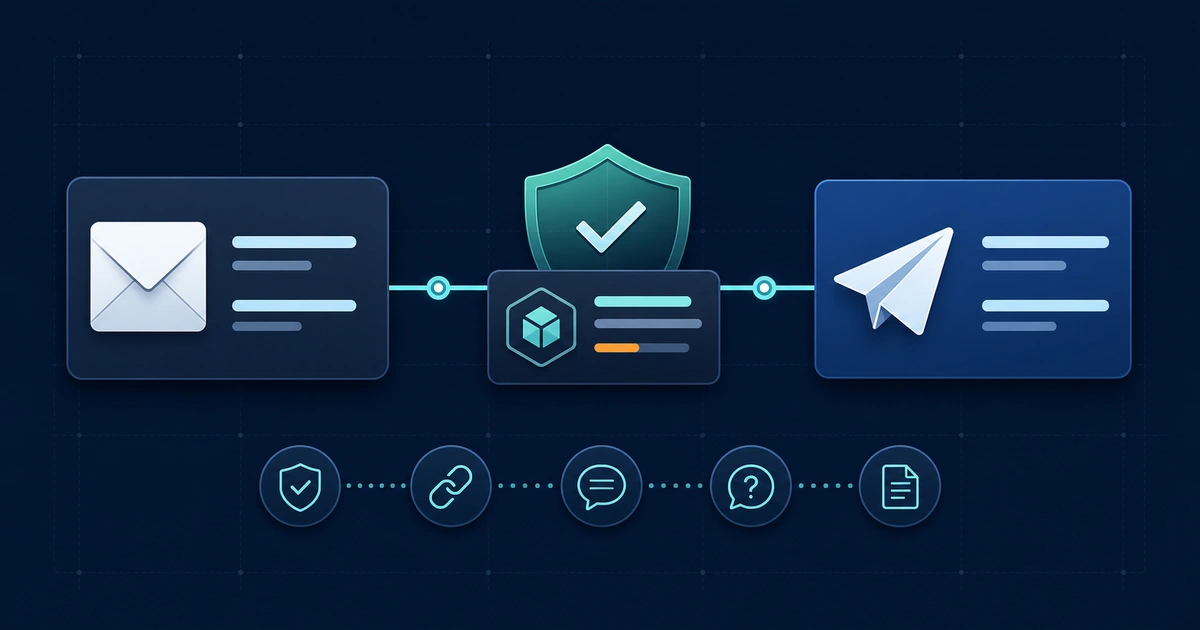
Email has the context. Telegram may have the reachable project route. A careless switch between them creates a second cold pitch, often from a teammate who cannot see what already happened.
The safer rule is simple: move only after a direct request, a trusted referral, or an independently verified official business route with a specific reason to use it. Then carry the email context, ask one smaller question, assign one owner, and make every stop state apply to both channels.
- Treat a channel switch as a controlled handoff, not another cold pitch.
- Move only after a direct request, trusted referral, or verified official business route.
- Do not treat silence, opens, clicks, or bounces as permission.
- Carry the email context, ask one small question, and keep one owner.
- Apply every reply, decline, and opt-out across both channels.
This guide gives agencies pitching token projects a decision table, three short messages, an event-driven state model, a CRM record, and the CLEAR handoff checklist.
This workflow starts after a relevant first email. For the wider campaign, use the cold-outreach tactics for crypto projects and the token-project outreach sequence guide.
It does not cover contact scraping, investor outreach, token promotion, or tactics for bypassing a recipient's stated preference.
Decide whether the channel switch is justified
A Telegram route tells you where a conversation might happen. It does not tell you that a particular message is wanted. The switch needs both a signal and a business purpose narrower than the original email.
| Situation | Decision | Appropriate purpose | Guardrail |
|---|---|---|---|
| The recipient asks you to continue on Telegram | Move | Continue the same conversation | Use the requested account and preserve context |
| A known contact refers you to a named project owner on Telegram | Move carefully | Introduce yourself through the referral | Name the referrer and verify the recipient |
| An official project page directs relevant business inquiries to Telegram | Verify, then decide | Ask a short routing or relevance question | Confirm the route is official and suited to your inquiry |
| The email is silent, opened, clicked, or bounced | Stay or re-verify | None created by that event | Telemetry and delivery failure are not permission |
Telegram explains that users can report unwanted messages and that accounts may be restricted after confirmed reports. Its official Spam FAQ recommends contacting people only when they expect the message. Treat that as a minimum operating boundary, then apply your own policy and the rules relevant to your market. For the wider framework, review crypto B2B lead generation, privacy, and outreach compliance.
Three common assumptions fail this test:
- "They opened the email." Opens can be generated by privacy tools, forwarding, or repeated loading. Even an accurate open does not request another channel.
- "The account is important." Account value changes review priority, not permission.
- "The email bounced." A bounce tells you that delivery failed. It does not authorize a message elsewhere.
If the only reason to switch is that email did not work, do not switch. Re-verify the project, the role, and the route first. If contact details conflict, document the official route and its business purpose before revisiting the handoff decision.
Carry the email context into Telegram
The first Telegram note should make sense without forcing the recipient to reconstruct your email. Name the connection, explain why Telegram is appropriate, and ask one low-effort question. Do not paste the original pitch.
If the email thread itself still needs a better no-response message, use the cold-email follow-up templates for Web3 service providers before adding another channel.
Template 1: the recipient requested the move
Hi Maya, moving this here as you suggested.

I emailed about Nova's launch media kit. The short version: the press page is missing three items journalists usually need to verify the project quickly.

Would it help if I sent the three-point check here, or is email better for the detail?
Template 2: a trusted contact made the referral
Hi Sam, Jordan suggested I contact you here about Nova's launch communications.

I sent a short email to the partnerships address with a media-kit observation. Are you the right person for that, or should I close the loop elsewhere?
Template 3: a verified official route invites business inquiries
Hi, I found this account on Nova's website, where it is listed for partnership inquiries.

I emailed the partnerships team about the public launch calendar. Is this an appropriate place to send a two-line summary, or should I keep it to email?
These are routing messages, not compressed decks. Each one gives the recipient a quick way to redirect or decline.
Use events, not arbitrary waiting periods
Waiting five or seven days does not make an unjustified switch become justified. Time can govern an email sequence, but the channel state should change only when an event supports it.
| Recorded event | Channel state | Next action |
|---|---|---|
| Relevant first email sent | Email active | Continue the approved email sequence |
| Recipient requests Telegram | Handoff approved | Confirm the account, then continue the same thread |
| Trusted referral received | Handoff review | Verify the person and record the referral |
| Official business route verified | Routing question allowed if appropriate | Ask whether this is the right route |
| Email opened or clicked | No state change | Do not infer channel permission |
| Email bounced | Verification required | Correct the record before any new outreach |
| Recipient replies, declines, or opts out | Global state update | Route, pause, or suppress across every channel |
| No response | No state change | Follow the existing sequence or stop |
This event model fits inside the wider outreach sequence. The sequence decides when a touch can occur. The handoff policy decides whether the channel is appropriate.
The distinction matters because a calendar is easy to automate and easy to misuse. A state change needs evidence in the project record.
Keep the handoff message smaller than the email
The first Telegram message has three jobs:
- Identify the context. Name the project and the earlier email topic.
- Explain the route. Mention the request, referral, or official source that brought you there.
- Ask one small question. Ask whether this is the right place or whether the recipient wants one specific asset.
Compare the difference.
Too large
Hi, we are a full-service growth agency. Here are our services, case studies,
calendar, deck, audit offer, and pricing. Did you see my email?
Small enough to route
Hi, Alex referred me here about the launch-readiness note I sent for Project X.
Are you the right owner for a three-point media-kit check, or should I close it?
The better version does not hide the commercial context. It reduces the work needed to answer.
Use the CLEAR handoff workflow
- Confirm the project identity and the switch signal.
- Link the Telegram note to the prior email context.
- Explain why this route is appropriate.
- Ask one smaller question.
- Record the outcome everywhere.
Confirm the project identity
Check the project name, website, token address when relevant, official route, recipient role, and source. Similar names, community-run groups, and impersonation make casual matching risky.
Link the prior context
Record the email address or role contacted, the subject, the date, and the one-sentence reason for relevance. The recipient should not have to hunt through an inbox to understand your Telegram note.
Explain why Telegram is appropriate
Use the actual signal. "You asked me to continue here" is clear. "Jordan referred me" is clear. "I found your public group" is not enough on its own.
Ask one smaller question
The ask should be answerable without opening a deck or booking a meeting. Useful first questions include:
- Are you the right owner for this?
- Should I send the short checklist here?
- Is email the better route for this topic?
- Should I close the loop?
Record the outcome everywhere
Keep one project-level source of truth. A useful record contains:
Project:
Website or token identifier:
Email owner and address or role:
Email topic and sent date:
Telegram route and verification source:
Handoff signal:
Current outreach owner:
Last outcome:
Next allowed action:
Suppression or opt-out state:
Map these fields into the system your team already uses. The LeadGenCrypto CRM integration guide explains the product's field-mapping and duplicate-handling workflow.
One owner does not mean one person must send every message. It means one person is accountable for the current state and can stop parallel outreach.
Resolve the objections that cause bad switches
"This account is important, so we should add Telegram"
Importance justifies manual review and better research. It does not justify more channels. If there is no valid signal, improve the email path or stop.
"The email bounced, so Telegram is our fallback"
A bounce starts verification, not a Telegram follow-up. Check the address, domain, project status, and recipient role. If you later find an official route for relevant business inquiries, begin with a routing question and record the source.
"The project publishes a Telegram group, so it is fair to pitch there"
Public access and appropriate business use are different questions. Verify who operates the route, what the route is for, whether direct business inquiries are expected, and whether your message is relevant. A community chat for token holders is not an agency sales queue.
"Two teammates found different contacts"
Do not let both continue. Assign a project owner, merge the evidence, select one appropriate route, and suppress the other path until the state changes. A decline or opt-out on either route must update the shared record.
"The project never replied, but the offer is a strong fit"
Fit earns a useful first message and a disciplined sequence. It does not earn unlimited attempts. Follow your stop policy. Silence does not create a new channel state.
Where LeadGenCrypto fits
LeadGenCrypto can support project research with fields such as website, token address, blockchain, token name or symbol, verified emails, and other information. That context helps an agency decide whether the project fits before any outreach begins.
If a project record or your own research surfaces a Telegram route, treat it as a routing clue and independently verify it before use. The product record is not consent, and it does not replace your suppression or compliance process.
Use LeadGenCrypto for relevant project discovery and an orderly list-building workflow. Use your own policy for channel permission, ownership, message review, and opt-outs. The filters and exceptions guide shows how to exclude known records before another batch enters the workflow.
If the handoff process is sound but project research still depends on scattered tabs, review the LeadGenCrypto leads workflow to see whether its records, exports, and delivery options fit your team.
Email-to-Telegram handoff checklist
Before any Telegram follow-up, confirm every item:
- The project identity and official route are verified.
- The direct request, referral, or routing reason is recorded.
- The message names the prior email context.
- The message asks one low-effort question.
- One person owns the project-level outreach state.
- No teammate is running a parallel pitch.
- A decline or opt-out will suppress both channels.
- The next allowed action and stop condition are explicit.
- The outcome will be recorded after the message.
If one of the first four boxes is empty, the handoff is not ready. If ownership or suppression is missing, the team is not ready to scale it.
LeadGenCrypto • Blog & Newsletter
The Operator's Field Notes
Get practical outreach workflows, compact checklists, and new resource notes for teams selling services to crypto projects.
- Brief digests of new articles and their useful assets
- Actionable prompts for campaign reviews and team standups
- Calm tone, no pump language. Unsubscribe in one click.
Frequently asked questions
When should I move a token-project conversation from email to Telegram?
Move after a direct request, a trusted referral, or an independently verified official business route that is appropriate for the inquiry. Record the signal before sending. Silence alone is not a switch signal.
Does an email open or link click justify a Telegram follow-up?
No. Opens and clicks are engagement telemetry, not channel permission. They can help a team evaluate email content, but they should not change the allowed contact route.
Does an email bounce justify messaging the project on Telegram?
No. A bounce is a delivery and data-quality event. Re-verify the address, project, role, and route. If an appropriate official business route is later confirmed, treat that as a separate decision.
How long should I wait before moving from email to Telegram?
There is no universal waiting period that creates permission. Use events, not elapsed time. A request, referral, or verified routing instruction can change the state. Silence does not.
Can I paste my original cold email into Telegram?
Do not paste it. Name the email topic in one line, explain why you are using Telegram, and ask one smaller question. The recipient can request the detail if it is relevant.
What should the first Telegram message ask?
Ask a routing or micro-commitment question: "Are you the right owner?", "Should I send the short checklist here?", or "Is email better for this topic?" Keep the answer easy.
How should a team record an email-to-Telegram handoff?
Use one project-level record with the email context, Telegram route and verification source, handoff signal, current owner, last outcome, next allowed action, and suppression state.
What should stop outreach across both channels?
A clear decline, opt-out, wrong-project finding, invalid route, account restriction, or internal suppression rule should stop or redirect the workflow everywhere. Do not leave one channel active after the other records a stop.
Where does LeadGenCrypto fit in this workflow?
It fits at the project research and list-building layer. Use the resulting context to assess fit and keep records orderly, then independently verify any channel route and apply your own outreach, compliance, and suppression rules.