Official Crypto Registers by Country: A 195-Country Map

Open an official crypto register expecting token projects, and you may get a company directory instead. Open the next, and you may get a legal framework or nothing searchable at all.
For a crypto agency researcher, that difference changes the list before the first name reaches the CRM.
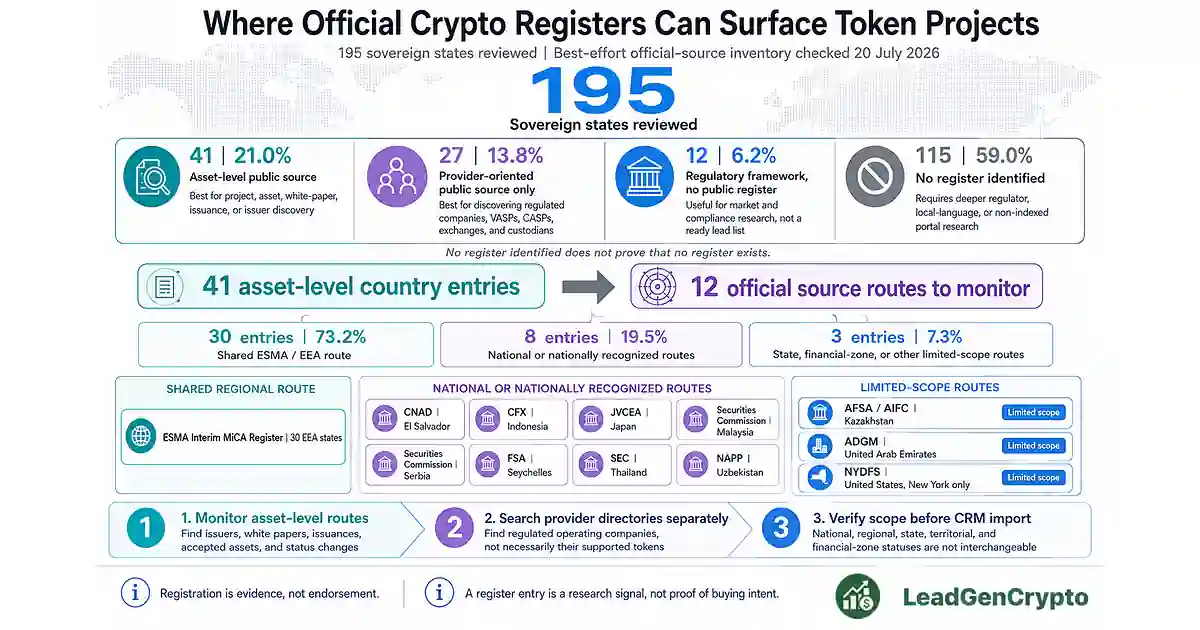
- The map covers all 195 sovereign states.
- Forty-one country entries, or 21.0%, connect to a free asset-level source.
- Thirty of those 41 entries use the European Securities and Markets Authority (ESMA) route.
- Twenty-seven entries expose provider-oriented public sources but no free asset-level list in this map.
- Twelve entries expose a framework without a public register, while 115 had no free crypto-specific register identified.
- The practical workflow starts by classifying the source, preserving its scope, and verifying the entity before outreach.
A useful map of official crypto registers by country is not 195 regulator tabs. It is 12 asset-level source routes, a separate set of provider directories, and a clear record of countries where no free public register was identified.
This article is a source-specific companion to the broader guide on how to find crypto projects to pitch and build a lead pipeline. It is for agencies and other B2B service teams researching projects, issuers, and regulated providers. It is not an investment screen or a country-by-country legal opinion.
What an official crypto register can actually mean
A public crypto register is not automatically a token list. The source type determines what you can discover and what the record can support.
| Source type | What it identifies | Best B2B use | What it does not prove |
|---|---|---|---|
| Asset, white-paper, or issuance source | A named asset, issuer, white paper, issuance, accepted token, or eligible asset | Project discovery and trigger-based qualification | Safety, performance, or universal approval |
| Provider register | A virtual asset service provider (VASP), crypto-asset service provider (CASP), exchange, custodian, issuer, or other regulated entity | Regulated-company discovery | Every asset the provider supports |
| Framework without a public register | A law, licensing path, anti-money-laundering regime, or official guidance | Market and compliance research | A ready-to-use lead list |
| No register identified | No free crypto-specific source identified as of 20 July 2026 | A prompt for deeper local-language and regulator research | Proof that no register exists |
In this map, not public means no free official asset-level list was identified for that entry. It does not mean a named provider register is private.
The distinction matters because a regulated company and a listed asset are different sales signals. One may suggest a compliance, infrastructure, or cybersecurity need. The other may indicate a white-paper, issuance, listing, or market-access milestone. Neither proves buying intent.
What the 195-country map shows
Asset-level discovery is limited, but it is highly concentrated. The classification is:
| Classification | Country entries | Share of 195 | Practical meaning |
|---|---|---|---|
| Asset-level public source | 41 | 21.0% | A free official route enumerates assets, white papers, issuances, issuers, or accepted assets |
| Provider-oriented public source only | 27 | 13.8% | A public provider, firm, resident, or sandbox-participant source exists, but no free asset-level source was identified |
| Regulatory framework, no public register | 12 | 6.2% | Rules or a licensing regime were found without a stable free register |
| No register identified | 115 | 59.0% | No free crypto-specific public register was identified as of 20 July 2026 |
The arithmetic is visible: 41 + 27 + 12 + 115 = 195.
Asset-level and provider-level public-register entries together total 68, or 34.9% of the country set. Add the 12 framework-only entries and 80 countries, or 41.0%, have at least one recorded register or official framework. The remaining 115 entries are negative search findings, not legal conclusions.
There is another compression step. The 41 asset-level country entries resolve to only 12 distinct sources:
- 30 entries, or 73.2%, use ESMA;
- 8 entries, or 19.5%, use another national or officially recognized route;
- 3 entries, or 7.3%, use a state, financial-zone, or other limited-scope route.
That is the operating insight. Monitor the 12 routes. Keep provider registers in a different research queue.
The 12 official asset-level source routes
Official sources use different status labels, including notified, registered, handled, designated, accepted, greenlisted, or approved for publication. Preserve the source's exact wording instead of labeling every entry an approved token.
| Coverage | Official source | Record type and safe interpretation | Scope |
|---|---|---|---|
| 30 EEA states | ESMA Interim MiCA Register | Notified white papers, asset-referenced-token and e-money-token issuers, authorised CASPs, and non-compliant entities. A listed white paper is not regulator-approved. | All 27 EU states plus Iceland, Liechtenstein, and Norway |
| El Salvador | CNAD Issuances | Digital-asset issuances registered under El Salvador's issuance regime | National |
| Indonesia | CFX Registered Crypto Assets | Assets used in Indonesia's supervised digital-financial-asset trading infrastructure | National |
| Japan | Japan Virtual and Crypto Assets Exchange Association (JVCEA) handled crypto-assets | Assets handled by member exchanges; JVCEA also publishes a separate Green List | National, FSA-recognized self-regulatory organization |
| Kazakhstan | Astana Financial Services Authority (AFSA) Green List | Assets reviewed for trading and custody by licensed digital-asset service provider (DASP) platforms | Astana International Financial Centre only |
| Malaysia | SC Malaysia digital-assets list | Tradeable digital assets on regulated exchanges and their Shariah status | National |
| Serbia | Serbia approved white-paper register | Decisions approving publication of digital-token white papers | National |
| Seychelles | Seychelles ICO and NFT register | Registered ICO and NFT offerings under the VASP Act | National, narrow offering scope |
| Thailand | Thai SEC specified-cryptocurrency notice and official appendix | A limited set of cryptocurrencies for specified ICO transactions and exchange base-pair uses | National, limited regulatory uses |
| United Arab Emirates | ADGM Accepted FRT list | Accepted fiat-referenced tokens for use by authorised persons | Abu Dhabi Global Market only |
| United States | New York State Department of Financial Services (NYDFS) Greenlisted Coins | Coins that NYDFS-regulated entities may list under the Greenlist process | New York State only |
| Uzbekistan | National Agency of Perspective Projects (NAPP) electronic crypto-asset register | Issued crypto-assets and their registration details | National |
Iceland follows the ESMA route. The EFTA MiCA factsheet covers the European Economic Area route, and the Central Bank of Iceland says Iceland's MiCA implementation took effect on 1 January 2026 and directs readers to ESMA's register.
Three scope traps deserve extra care:
- NYDFS is a New York State route, not a federal US asset register.
- ADGM is a financial free-zone route, not a UAE-wide asset register.
- AFSA's list applies within the AIFC, not automatically across Kazakhstan.
Save the legal scope beside every imported record. Without it, a true source can produce a false CRM claim.
Turn a register record into a qualified B2B lead
A register row is evidence, not a finished lead. Use this five-step Register-to-Pipeline Framework before contact.
1. Capture the source and its scope
Record the authority, register name, exact URL, date checked, record type, jurisdiction, and legal scope. Preserve the status verb used by the source.
A field saying greenlisted in New York is usable. A field saying US government approved is not.
2. Extract the entity and trigger
Capture the issuer, company, project, asset, white paper, or issuance exactly as published. Then record why the row matters now:
- white paper notified or approved for publication;
- issuance registered;
- asset added to a tradeable, handled, accepted, or greenlisted set;
- provider registered or authorised;
- record added, changed, or removed.
A name alone produces generic outreach. A dated trigger gives the research a reason to exist.
3. Resolve identity and deduplicate
Verify the official website, legal-entity and brand relationship, token name or symbol, blockchain, and token address where relevant. Do not infer a contract from a matching ticker.
Then set filters and exceptions before routing records and deduplicate by legal entity, domain, asset, token address, and contact.
4. Enrich and verify current business contact data
Official registers rarely provide an outreach-ready contact package. Enrich only after identity is resolved. Prefer current public business routes, and avoid copying personal contact fields from official records into campaigns without a clear privacy and outreach basis.
This is also why static crypto project contact lists fail. The source record, company identity, contact, and suppression state can all age at different speeds. Teams that need an automated intake layer can review the crypto project contacts API and lead-streaming workflow or the OpenClaw and LeadGenCrypto integration pattern.
5. Qualify fit and outreach basis
Connect one public signal to one research question. Do not turn it into an invented need.
| Official signal | Useful hypothesis | Qualification question | What to avoid |
|---|---|---|---|
| White paper or issuance record | A documented launch or issuance milestone exists | Which public operational, audit, legal, communications, or distribution gaps are visible? | Claiming the issuer is fundraising or wants a vendor |
| Tradeable, handled, accepted, or greenlisted asset | A defined market-access status exists | What is the exact jurisdictional scope, and has the project documented it accurately? | Calling the asset safe or nationally approved |
| Registered or authorised provider | A regulated operating entity exists | Is the entity a project, a service provider, or both, and which business function is relevant? | Inferring every supported token or service |
| Non-compliant or enforcement record | A risk signal exists | Should the record be suppressed, reviewed, or monitored? | Treating risk records as an ordinary sales trigger |
Phrase the CRM note as evidence plus a question. The reader makes the judgment.
Copy-paste register intake checklist
Use the same intake fields for every route. This is the point where a source map becomes an operating process.
- Confirm the source belongs to an official authority or officially recognized body.
- Classify the row as asset-level, provider-level, framework-only, or risk-related.
- Save the exact source URL and date checked.
- Record national, regional, state, territorial, or financial-zone scope.
- Preserve the source's status verb: notified, registered, handled, tradeable, eligible, accepted, greenlisted, or approved for publication.
- Capture the issuer, project, asset, white paper, or provider exactly as published.
- Resolve the official website and legal-entity relationship.
- Verify token symbol, blockchain, and token address from primary evidence when relevant.
- Identify a real service-fit question before outreach.
- Use current public business contact data, not copied personal records.
- Deduplicate by project, entity, domain, token address, and email.
- Merge opt-outs and suppression rules before any send.
- Log the trigger and source evidence in the CRM.
- Use a relevant micro-ask and a clear opt-out.
- Recheck the register before relying on an old status.
Limits, freshness, and outreach compliance
Official visibility is narrow evidence, not a quality badge. An entry does not automatically prove that:
- the asset is safe or suitable;
- the project is legitimate in every respect;
- the status applies across the whole country;
- the provider supports every associated asset;
- the source is complete or updated in real time;
- the entity needs your service;
- outreach is lawful in every relevant jurisdiction.
ESMA explicitly warns that a white paper in its interim register has not been reviewed or approved by a competent authority. Other sources use different legal tests and status words. Read the source note, decision, and scope before writing a CRM field or outreach sentence. This article is general research information, not legal advice.
Dynamic pages create a second limit. CNAD, ADGM, and Seychelles should be visually checked immediately before deployment and before a campaign depends on them. JVCEA's reuse terms also need review before commercial extraction or redistribution of its explanatory documents.
The same discipline applies to contact use. Keep the message relevant, minimize data, verify the recipient and business route, honor opt-outs, and apply the rules that govern the recipient and sender. The B2B crypto outreach compliance guide covers that separate job.
LeadGenCrypto can complement official-source research with records that include website, token address, blockchain, token name or symbol, verified emails, and other information. That does not remove the need for source checks, relevance, suppression, or human qualification.
If you want to compare an official-source row with an enriched project record, get a free verified lead to test the workflow.
Methodology
The unit of analysis is a sovereign-country entry, not a claim that every source is national. The country set contains 193 United Nations members plus the Holy See and the State of Palestine.
This map uses these categories:
Asset-level public source: a free official source enumerating named assets, tokens, stablecoins, white papers, issuances, issuers, or accepted assets.Provider-oriented public source only: a public VASP, CASP, exchange, custodian, issuer, regulated-entity, authorised-resident, or sandbox-participant source without a centralized free asset list. This working category includes scope exceptions and does not claim that every source is a complete provider register.Regulatory framework / no public register: an official crypto, distributed-ledger, licensing, or anti-money-laundering framework without a stable free provider or asset register found.No register identified: no free crypto-specific public register identified as of 20 July 2026.
Use the appendices as a discovery map, not as a permanent legal-status list. They group the 195-country classification and supplementary sources by type and provide current links for the 12 asset-level routes. Recheck each official source before using a record because registers, page locations, and statuses can change.
Appendix A: Coverage summary
| Metric | Value |
|---|---|
| Dataset | Global Official Crypto Registers - Worldwide Inventory |
| As of | 2026-07-20 |
| Sovereign states covered | 195 |
| Country entries with a free official asset-level route | 41 |
| Supplementary national, territorial, and financial-zone rows | 56 |
| Classification | Country count | Share of 195 |
|---|---|---|
| Asset-level public source | 41 | 21.0% |
| Provider-oriented public source only | 27 | 13.8% |
| Regulatory framework / no public register | 12 | 6.2% |
| No register identified | 115 | 59.0% |
Appendix B: The 195-country classification
Asset-level public sources: 41 countries through 12 routes
The route table above is the source map. Its country coverage is:
- ESMA: Austria, Belgium, Bulgaria, Croatia, Cyprus, Czechia, Denmark, Estonia, Finland, France, Germany, Greece, Hungary, Iceland, Ireland, Italy, Latvia, Liechtenstein, Lithuania, Luxembourg, Malta, Netherlands, Norway, Poland, Portugal, Romania, Slovakia, Slovenia, Spain, and Sweden.
- Other national or nationally recognized routes: El Salvador, Indonesia, Japan, Malaysia, Serbia, Seychelles, Thailand, and Uzbekistan.
- Limited-scope routes: Kazakhstan through AIFC, the United Arab Emirates through ADGM, and the United States through New York State.
Provider-oriented public sources: 27 countries
For every country below, the public source identifies providers, firms, authorised residents, or sandbox participants, while no free asset-level list was identified. Ghana is a scope exception: its source is an official sandbox participant announcement, not a complete provider register.
Official framework without a public register: 12 countries
| Country | Official framework or regime |
|---|---|
| Albania | DLT financial-markets law |
| Barbados | FSC legislation and guidance |
| Brazil | Central Bank VASP authorisation regime |
| India | FIU-IND VDA registration materials |
| Kenya | CMA regulatory framework |
| Oman | FSA VASP registration framework |
| Pakistan | Ministry of Finance virtual-assets framework announcements |
| Qatar | QFC digital-assets framework |
| Saint Kitts and Nevis | Virtual Asset Act statutory registers |
| San Marino | Central Bank regulations |
| South Korea | KoFIU VASP regime |
| Ukraine | National Bank virtual-assets updates |
No free crypto-specific public register identified: 115 countries
As of 20 July 2026, no free official asset-level source or crypto-specific public register was identified for the countries below. This does not prove that a source does not exist, that it is not available in a local language, or that it is not exposed through a non-indexed portal.
| Country 1 | Country 2 | Country 3 | Country 4 | Country 5 |
|---|---|---|---|---|
| Afghanistan | Algeria | Angola | Antigua and Barbuda | Armenia |
| Azerbaijan | Bangladesh | Belize | Benin | Bhutan |
| Bolivia | Bosnia and Herzegovina | Brunei | Burkina Faso | Burundi |
| Cabo Verde | Cambodia | Cameroon | Central African Republic | Chad |
| China | Colombia | Comoros | Costa Rica | Cuba |
| Côte d’Ivoire | Democratic Republic of the Congo | Djibouti | Dominica | Dominican Republic |
| Ecuador | Egypt | Equatorial Guinea | Eritrea | Eswatini |
| Ethiopia | Fiji | Gabon | Gambia | Grenada |
| Guatemala | Guinea | Guinea-Bissau | Guyana | Haiti |
| Holy See | Honduras | Iran | Iraq | Jamaica |
| Jordan | Kiribati | Kuwait | Laos | Lebanon |
| Lesotho | Liberia | Libya | Madagascar | Malawi |
| Maldives | Mali | Marshall Islands | Mauritania | Federated States of Micronesia |
| Moldova | Monaco | Montenegro | Morocco | Mozambique |
| Myanmar | Nauru | Nepal | Nicaragua | Niger |
| North Korea | North Macedonia | Palau | Palestine | Panama |
| Papua New Guinea | Paraguay | Peru | Republic of the Congo | Rwanda |
| Saint Lucia | Saint Vincent and the Grenadines | Samoa | Saudi Arabia | Senegal |
| Sierra Leone | Solomon Islands | Somalia | South Sudan | Sri Lanka |
| Sudan | Suriname | Syria | São Tomé and Príncipe | Tajikistan |
| Tanzania | Timor-Leste | Togo | Tonga | Trinidad and Tobago |
| Tunisia | Turkmenistan | Tuvalu | Uganda | Uruguay |
| Venezuela | Vietnam | Yemen | Zambia | Zimbabwe |
Appendix C: Verification notes
Treat the 115 entries without an identified register as research leads rather than definitive conclusions. Check the relevant regulator, local-language sources, and non-indexed portals before deciding that no public register exists. For provider-oriented and framework-only groups, not public refers only to the absence of a free asset-level list.
The asset-route notes that most affect interpretation are:
- ESMA publishes several distinct MiCA datasets and warns that listed white papers are not approved by a competent authority.
- CFX is the supervised market operator publishing the Indonesian asset list. It should not be described as OJK itself.
- JVCEA is an FSA-recognized self-regulatory organization, and its explanatory-document reuse terms require review.
- Seychelles exposes a narrow ICO and NFT offering register, not a broad token inventory.
- Thailand's current source covers limited ICO transaction and base-pair uses, not every asset available for trading.
- ADGM, AIFC, and NYDFS have limited geographic or legal scope.
- NAPP records can contain personal contact fields that should not be republished without a clear basis.
Appendix D: 56 supplementary register rows
The 56 supplementary rows cover national, territorial, and financial-zone sources that add provider, issuer, product, sandbox, or framework context. None provides a free asset-level list under the definition used in this map. Forty-six are provider-oriented. Ten use another classification.
Supplementary provider-oriented sources: 46 rows
| Country or jurisdiction | Official source | Authority | Scope note |
|---|---|---|---|
| Andorra | AFA register search | Andorran Financial Authority | Official register portal |
| Australia | AUSTRAC VASP register | AUSTRAC | National provider register |
| Bahamas | DARE registrant and licensee search | Securities Commission of The Bahamas | Digital-asset firms |
| Bahrain | CBB licensing directory | Central Bank of Bahrain | Crypto-asset service licensees |
| Belarus | Hi-Tech Park residents | Belarus Hi-Tech Park | Special crypto regime |
| Bermuda | BMA regulated entities | Bermuda Monetary Authority | Territorial digital-asset businesses |
| Botswana | NBFIRA VASP entities | NBFIRA | Regulated VASPs |
| Canada | FINTRAC MSB registry | FINTRAC | Virtual-currency dealing as an MSB activity |
| Cayman Islands | CIMA VASP source | Cayman Islands Monetary Authority | Territorial provider information |
| Chile | CMF financial-service provider registry | Comisión para el Mercado Financiero | National provider registry |
| Cyprus | CySEC CASP register | Cyprus Securities and Exchange Commission | National provider layer; ESMA supplies the regional asset route |
| El Salvador | CNAD service-provider register | Comisión Nacional de Activos Digitales | Provider layer; CNAD also publishes issuances |
| Estonia | Estonian supervised entities | Estonian Financial Supervision Authority | CASP, EMT, and ART filters |
| France | AMF DASP and CASP information | Autorité des marchés financiers | National provider information; ESMA supplies the regional asset route |
| Georgia | National Bank of Georgia VASPs | National Bank of Georgia | Registered VASPs |
| Gibraltar | GFSC DLT providers | Gibraltar Financial Services Commission | Territorial DLT providers |
| Guernsey | GFSC lending, credit, and finance source | Guernsey Financial Services Commission | Territorial VASP information |
| Hong Kong | SFC virtual-asset trading-platform lists | Securities and Futures Commission | Hong Kong licensed and applicant platforms |
| Israel | Licensed virtual-currency financial-service providers | Capital Market, Insurance and Savings Authority | Licensed providers |
| Japan | FSA registered crypto-asset exchanges | Financial Services Agency Japan | Provider layer; JVCEA publishes handled assets |
| Jersey | JFSC VASP entities | Jersey Financial Services Commission | Territorial VASP entities |
| Kazakhstan | AFSA public register | Astana Financial Services Authority | AIFC providers; AFSA separately publishes the Green List |
| Kyrgyzstan | Financial-market registers | Financial Market Regulation and Supervision Service | Official register portal |
| Liechtenstein | FMA MiCA and TT provider information | Financial Market Authority Liechtenstein | National provider layer; ESMA supplies the regional route |
| Malaysia | Registered digital-asset exchanges | Securities Commission Malaysia | Provider layer; the SC also lists tradeable assets |
| Mauritius | FSC online public register | Financial Services Commission Mauritius | VASP and issuer-related categories |
| Mexico | Authorised fintech institutions | CNBV | National fintech institutions |
| Mongolia | FRC registered VASPs | Financial Regulatory Commission | Official VASP PDF |
| Namibia | National payment-system participants | Bank of Namibia | Authorised or provisionally authorised VASPs |
| New Zealand | Financial Service Providers Register | New Zealand Companies Office | Broad provider register |
| Nigeria | Registered fintech operators | Securities and Exchange Commission Nigeria | Includes digital-asset operators |
| Norway | Finanstilsynet MiCA information | Financial Supervisory Authority of Norway | National supervision page pointing to ESMA |
| Philippines | BSP VASP list | Bangko Sentral ng Pilipinas | Official VASP PDF |
| Russia | Bank of Russia DFA operators | Bank of Russia | Information-system operators |
| Serbia | Digital-token service providers | Securities Commission of Serbia | Provider layer; Serbia separately publishes white-paper decisions |
| Seychelles | Licensed VASPs | Financial Services Authority Seychelles | Provider layer; the FSA also publishes ICO and NFT offerings |
| Singapore | MAS financial institutions directory | Monetary Authority of Singapore | Filter for Digital Payment Token Service |
| South Africa | FSCA regulated entities | Financial Sector Conduct Authority | Crypto-asset service providers |
| Thailand | Thai SEC digital-asset businesses | Securities and Exchange Commission, Thailand | Provider and framework layer |
| Türkiye | CMB crypto-asset service providers | Capital Markets Board of Türkiye | Provider status and lists |
| United Arab Emirates | ADGM FSRA public register | Financial Services Regulatory Authority, ADGM | ADGM authorised firms |
| United Arab Emirates | VARA public register | Virtual Assets Regulatory Authority | Dubai, excluding DIFC |
| United Kingdom | FCA cryptoasset register | Financial Conduct Authority | Anti-money-laundering registration perimeter |
| United States | FinCEN MSB registrant search | Financial Crimes Enforcement Network | Federal MSB registration, not prudential approval |
| Uzbekistan | NAPP licensed service providers | National Agency of Perspective Projects | Provider layer; NAPP also publishes assets |
| Vanuatu | VFSC VASP information | Vanuatu Financial Services Commission | Licensing and public information |
Other supplementary register and framework types: 10 rows
| Country or jurisdiction | Classification | Official source | Scope note |
|---|---|---|---|
| Hong Kong | Issuer-only register | HKMA licensed stablecoin issuers | Issuers, not a comprehensive token list |
| Bermuda | Issuer and framework source | BMA digital-asset issuance regime | Issuance framework, no central asset list identified |
| Switzerland | Provider and product directory | FINMA authorised institutions, persons, and products | Mixed official directories |
| United Arab Emirates | Framework, no current asset register | DFSA crypto-token framework | DIFC perimeter; former recognised-token list is no longer maintained |
| Albania | Framework, no public register | DLT financial-markets law | Licensing law, no asset list identified |
| Brazil | Framework, no public register | Central Bank VASP authorisation regime | No central asset list identified |
| India | Framework, no public register | FIU-IND VDA registration materials | Anti-money-laundering registration materials |
| Oman | Framework, no public register | FSA VASP registration framework | Official registration instructions |
| Saint Kitts and Nevis | Framework, no public web register | Virtual Asset Act | Law contemplates registers; current accessible list not located |
| Ghana | Sandbox participant list | SEC virtual-asset sandbox participants | Not a complete provider or asset register |
The 56 rows cover 52 unique jurisdiction labels. Bermuda and Hong Kong each appear twice, and the United Arab Emirates appears three times, because the sheet records separate routes or legal perimeters.
LeadGenCrypto • Blog & Newsletter
The Operator's Field Notes
Get practical prospecting workflows, compact checklists, and new research notes for teams selling services to crypto projects.
- Brief digests of new articles and their useful assets
- Actionable prompts for campaign reviews and team standups
- Calm tone, no pump language. Unsubscribe in one click.
Frequently asked questions
What is an official crypto asset register?
It is a public source maintained by an authority or officially recognized body that enumerates named assets, issuers, white papers, issuances, accepted tokens, or similar records. The legal meaning depends on the source. A register entry is not a universal approval or safety rating.
How is an asset-level register different from a VASP or CASP register?
An asset-level source identifies an asset, issuance, issuer, or white paper. A VASP or CASP register identifies regulated service providers or companies. A provider entry usually does not disclose every asset that the company supports.
Which countries use the ESMA MiCA register?
The route covers 30 European Economic Area states: all 27 EU members plus Iceland, Liechtenstein, and Norway. National authorities may provide local guidance or provider information, but ESMA is the shared regional register route used in this map.
Can these sources help find licensed crypto companies by country?
Provider registers can help identify registered, authorised, licensed, supervised, or sandboxed entities, depending on the exact regime. Preserve the source's wording. Do not automatically rewrite an anti-money-laundering registration as a full license or prudential approval.
Why do so many countries have no public crypto register?
A country may have a general law, a non-public process, a local-language portal, or a source that search engines do not index. No register identified records the search result, not proof that no data or legal framework exists.
Does a register entry mean a project or asset is approved or safe?
No. An entry may be a notification, publication decision, issuance registration, accepted-asset status, handled-asset record, provider registration, or another narrow legal fact. None of those facts alone proves safety, quality, performance, or suitability.
How often should B2B teams recheck register data?
There is no universal recheck schedule. Record every retrieval date, monitor event-rich sources at a cadence that matches the campaign, and recheck the specific entry before using an old status in qualification, outreach, or compliance work.
How do you turn a register entry into a verified lead?
Capture the source and scope, resolve the entity and project, verify the website and relevant asset identifiers, enrich current public business contacts, deduplicate, apply filters and suppression, then qualify one evidence-based service-fit question. The public record is the start of the research chain, not the completed lead.
Is it legal to contact companies found in official registers?
A public record does not create blanket permission to contact an entity. The lawful basis, permitted channel, data handling, message relevance, disclosure, opt-out, and suppression duties depend on the jurisdictions and circumstances. Review current rules and obtain legal advice where needed.