Crypto Service Offer Strategy: What Clients Really Buy

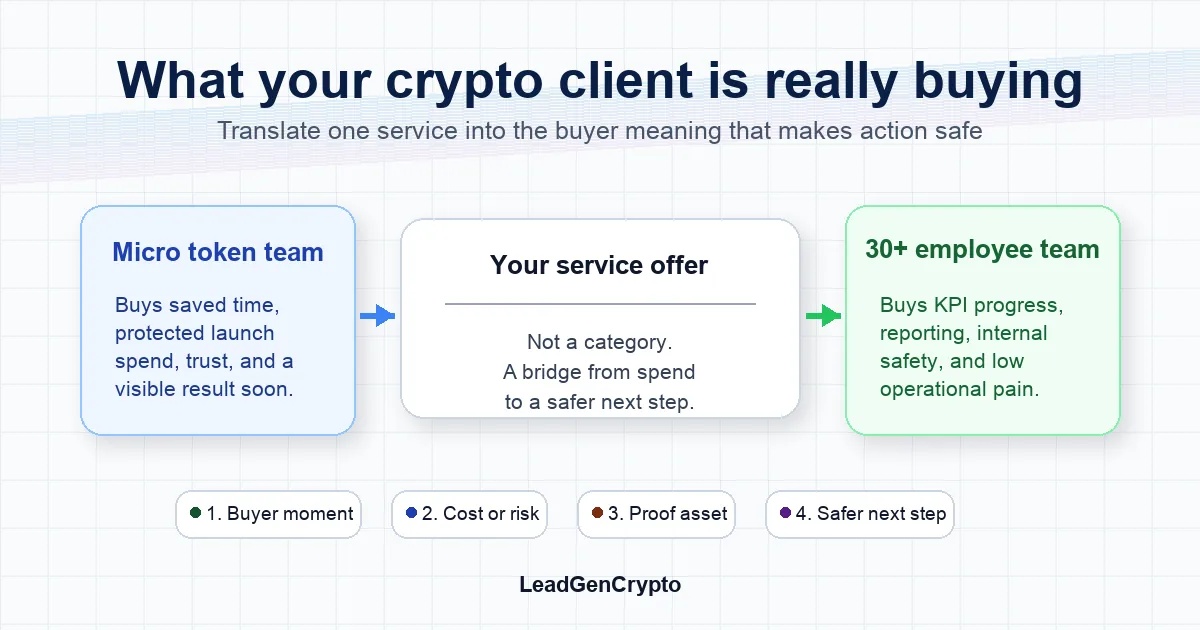
- Your crypto client is rarely buying your service category.
- Micro token teams usually buy speed, trust, saved time, or protected launch spend.
- Larger crypto companies buy KPI progress, reporting, internal safety, and low operational pain.
- The same service needs different buyer meaning by stage, size, and stakeholder.
- Use the client meaning matrix before you write the pitch or scale outreach.
A token project can reject a useful offer because it sounds like the wrong kind of purchase.
The founder hears "marketing retainer" and thinks, "I do not have time for a vague monthly expense."
The growth lead at a larger crypto company hears the same pitch and thinks, "I cannot defend this internally."
That is why a crypto service offer strategy has to do more than describe what you do. It has to translate your service into the buyer meaning that makes action feel safe. This article is for agencies and service providers selling services to token projects, not for token buyers, retail traders, or fundraising promotions.
If you want the broader map of service categories and lifecycle windows, start with the positioning guide for services crypto projects buy. This page goes narrower: how to make the same service sound like the right purchase to two very different kinds of crypto clients.
The direct answer: clients buy the safest path to a useful next step
Your client does not wake up wanting PR, SEO, audits, liquidity support, KYC, legal review, or lead data. They want a problem to become less expensive, less risky, less confusing, or easier to defend.
For a micro token team, the question is usually:
If I pay now, what comes back soon enough to matter?
For a larger crypto company, the question is usually:
If I approve this vendor, can I show progress without creating risk for myself or the team?
Those are different purchases.
The small team is often buying a bridge over a near-term gap:
- Trust before a launch, listing, partnership, or community push.
- Saved founder time.
- A lower chance of wasting launch spend.
- A concrete asset that can be reused in Telegram, X, email, decks, and partner conversations.
- Fewer emergency decisions when attention arrives.
The larger company is often buying an internally defensible workstream:
- KPI progress.
- Clean reporting.
- Clear scope.
- Low operational burden.
- Lower legal, compliance, privacy, security, or reputation risk.
- A vendor relationship that does not need daily babysitting.
Same service.
Different buyer meaning.
Before you write a subject line, rewrite your service as the thing the buyer is trying to protect: launch spend, founder time, internal approval, partner trust, security confidence, or compliance readiness.
Micro token teams buy speed, trust, and protected spend
A 1-5 person token team behaves more like a compressed startup than a mature marketing department. The founder may be handling launch copy, community replies, smart contract questions, DEX liquidity, media outreach, wallet visibility, listings, and vendor messages in the same day.
That founder rarely buys "brand awareness" as an abstract idea.
They buy one of these:
| What the founder says | What they may really be buying | Stronger offer language |
|---|---|---|
| We need PR. | Trust before launch traffic arrives. | Turn the launch story into a reusable proof asset before you spend on attention. |
| We need SEO. | Protection for branded search demand. | Make official pages easier to find so paid attention does not leak into fake or confusing results. |
| We need an audit. | Less security fear before a public launch. | Reduce avoidable security objections before partners, wallets, or community members ask. |
| We need a video. | A scalable explanation. | Give prospects one clear walkthrough instead of making the founder repeat the same explanation manually. |
| We need contacts. | A faster way to reach relevant project teams. | Start with real token project contacts that match your offer, then test one narrow message. |
The pattern is simple:
You pay X.
You get Y.
Y removes bottleneck Z.
That helps you avoid wasting money, time, trust, or launch momentum.
Use numbers only as assumptions, not promises.
For example, do not say:
This audit will make your token launch succeed.
Say:
If you are already spending on launch attention, an audit package gives you one less security objection to answer manually.
That language is safer because it does not promise token performance, price movement, exchange acceptance, investor interest, or guaranteed revenue. It explains the operational value.
Larger crypto companies buy KPI progress and internal safety
A 30+ employee crypto company does not buy like a solo founder. The buyer may be a CMO, Head of BD, growth manager, listing manager, compliance lead, security lead, finance owner, or RevOps operator.
That person is not only asking whether your service is useful.
They are asking whether the purchase is defensible.
| Stakeholder | What they are protecting | What your offer must show |
|---|---|---|
| CEO or founder | Growth, speed, and strategic risk | Why this moves the business without creating avoidable downside. |
| CMO or growth lead | Campaign KPIs and budget credibility | What metric improves, what report proves progress, and what scope is included. |
| Head of BD | Qualified conversations and partner pipeline | How the work creates better conversations without messy handoffs. |
| Compliance or legal | Future problems | How relevance, consent, claims, privacy, and opt-out handling are managed. |
| Finance | Predictability | Scope, pricing, invoice clarity, and no surprise commitments. |
| Manager or operator | Peaceful execution | Communication rhythm, deliverables, ownership, and what the vendor will not need from the team. |
A larger-company pitch should include four layers:
- The business outcome.
- The KPI or workstream it supports.
- The proof or reporting the buyer can show internally.
- The operational reason the vendor relationship will not become extra work.
So instead of:
We can help you with crypto outreach.
Say:
Your BD team needs more relevant token project conversations this quarter. We will deliver a filtered contact workflow, project-fit notes, weekly delivery reporting, and CRM-ready handoff fields so your team can test the segment without rebuilding research from scratch.
The second version is not louder.
It is safer to approve.
Translate the same service into two buyer meanings
The service category is the same. The reason to buy is not. Use this table before you write the pitch.
| Service | Micro token team meaning | Larger crypto company meaning |
|---|---|---|
| PR or media placement | A proof asset that makes the project easier to trust during launch. | Campaign visibility, reusable assets, and reporting for the marketing plan. |
| Guest post or founder interview | A public explanation that saves founder time in community and partner DMs. | External proof to support campaign, sales, and BD workflows. |
| SEO or branded search cleanup | Protection against losing interested users to fake, stale, or confusing results. | Topical authority, branded search quality, and reportable organic progress. |
| Creator video | A scalable explanation for people who will not read the docs. | Creator distribution inside a quarterly campaign with performance notes. |
| Listing or launchpad support | A structured market-entry process instead of a chaotic Telegram launch. | Launch readiness, partner process, and internal checklist completion. |
| Market making or liquidity support | A market that does not look broken when attention arrives. | Market-quality support and reporting during a listing or campaign window. |
| Audit or security review | Less fear before launch and fewer manual security objections. | Launch-readiness evidence and risk reduction for internal review. |
| KYC, AML, or legal support | Fewer blockers before serious partners, payment providers, or platforms ask. | Documented compliance workflow and reduced vendor or reputational risk. |
| Lead data | Saved founder research time and earlier access to relevant project teams. | CRM-ready intake, routing, dedupe, reporting, and pipeline support. |
If your message still sounds generic, use the offer-first rewrite sprint to turn a capability list into a decision package. If your proof is the weak point, use the vertical proof wedge before you scale the list.
18 pitch examples for Web3 B2B vendors
The fastest way to make the framework useful is to translate real vendor categories. The point is not to sell a category harder. The point is to sell the nearest bottleneck the buyer already cares about.
The dollar values below are positioning examples. Use them as visible assumptions, not as promised ROI. Replace them with the buyer's real budget, time cost, campaign size, approval blocker, or operational risk before you send a pitch.
Marketing & PR Agencies
A one-founder token project does not buy "full-cycle marketing." It buys launch momentum without having to become a marketer overnight.
Weak pitch:
We will place you in top crypto media, improve brand awareness, and give you exposure.
Stronger pitch:
We will build the launch campaign assets across PR, sponsored posts, AMAs, short video snippets, Telegram distribution, and social content so you do not have to write every message, chase every channel, and explain the project from scratch each time.
The buyer meaning is: "Help us avoid wasting the launch window by having trust assets, traffic sources, and campaign structure ready before attention arrives."
Guest Post Publishers
A micro token team does not buy a "guest post." It buys an external trust asset that keeps the founder from explaining the same story manually in every DM.
Pitch example:
We will turn your founder story or project explanation into an external article you can use in Telegram, partner outreach, launch decks, and community onboarding.
The buyer meaning is: "Give interested people something credible to read when they check whether this project is real."
SEO & Link Building
A micro token project rarely cares about a six-month SEO roadmap. It cares about what people see when they search the token name today.
Pitch example:
We will clean up your branded search layer with indexable pages, safe links, FAQ content, and token-name pages so paid launch attention does not leak into fake, stale, or confusing results.
The buyer meaning is demand protection. If a project spends on creators, PR, or community promotion, branded search should not be the place where interested users get lost.
YouTube Influencers
A one-founder token project does not buy "video views." It buys a scalable explanation.
Pitch example:
We will produce a creator review that explains your token utility, roadmap, risks, official links, and verification path in plain language, then give you a reusable video asset for the website, Telegram, X, and outreach.
The buyer meaning is: "Let someone explain the project clearly once so the founder does not have to repeat the same explanation manually."
News & Blogging Sites
A micro token project does not buy "coverage." It buys a public proof link that makes the project easier to trust.
Pitch example:
We will publish a sponsored or featured article that your team can reuse as a trust link in Telegram, partner decks, launch announcements, and email outreach.
The buyer meaning is trust reuse. The article is not just text. It is a proof asset the team can bring into many future conversations.
Coin Trackers & Voting
A micro token project buys tracker visibility because nobody knows it exists yet.
Pitch example:
We will place the project where crypto audiences already compare new tokens, charts, rankings, and token pages, so discovery starts from existing token intent instead of generic cold traffic.
The buyer meaning is: "Put us where people already look for projects like ours."
Listings, Launchpads & CEXs
For a micro token project, a listing or launchpad is not only prestige. It is structured market entry.
Pitch example:
We will help you move through the listing or launch process with technical requirements, token information, review steps, launch checklist, campaign calendar, and marketplace preparation.
The buyer meaning is: "Reduce the chance that the first serious market window is chaotic or wasted."
Market Makers & Liquidity
A micro token project does not buy "market making." It buys a market that does not look broken when attention arrives.
Pitch example:
We support market quality during the listing window with spread, order-book, liquidity, and reporting work so interested users do not immediately leave because the market looks empty or difficult to use.
The buyer meaning is not price support. It is reducing friction for honest trading and protecting the attention marketing already created.
OTC Desks & VCs
A micro token project often thinks it needs "investor intros." What it really needs is fewer wasted fundraising or strategic conversations.
Pitch example:
We will help prepare the investor package, filter irrelevant funds, shape the outreach angle, and focus introductions where the thesis matches your stage, chain, category, and traction.
The buyer meaning is: "Do not make the founder burn 50 hours on wrong-fit conversations before any serious counterparty has a reason to listen."
Smart Contract Auditors
A micro token project does not buy an audit PDF. It buys reduced fear before launch.
Pitch example:
We will audit the token contract, provide remediation notes, and package the result so the team can answer wallet, launchpad, partner, and community security questions with less panic.
The buyer meaning is: "Every dollar spent on marketing gets weaker if people see an unaudited contract."
Security & Bug Bounty
A micro token project does not buy a "bug bounty program." It buys early warning.
Pitch example:
We will set up vulnerability disclosure, bounty rules, severity levels, monitoring, and response workflow so a researcher has a path to contact you before a problem becomes public incident response.
The buyer meaning is: "Learning about a serious bug early is cheaper than learning about it from the market."
Blockchain Dev & DevOps
A micro token project does not buy developers. It buys a launch that does not break on the most expensive day.
Pitch example:
We will check deploy scripts, website uptime, RPC reliability, claim flow, token page behavior, monitoring, analytics, and rollback before the launch campaign sends traffic.
The buyer meaning is: "You are already paying for attention. Protect the moment that attention arrives."
Payments & Banking
A micro token project often ignores finance operations until it starts paying contractors, accepting fiat, working with vendors, or preparing a paid product.
Pitch example:
We will set up payment rails, stablecoin settlement workflow, fiat on-ramp and off-ramp options, invoicing, and finance operations support so the team stops solving every payment manually.
The buyer meaning is: "Make finance operations boring before manual payment work becomes founder work or vendor friction."
Wallet Providers
A wallet provider does not sell a micro token project "an integration." It sells a safer path from user interest to the official token.
Pitch example:
We will help with correct token logo, metadata, official links, swap route, or wallet SDK integration so users are less likely to confuse the official token with a wrong or fake contract.
The buyer meaning is: "You already brought the person into the wallet. Now help them avoid the wrong contract address."
KYC/AML Providers
A micro token project does not buy KYC or anti-money laundering tooling because it loves process. It buys access to serious platforms and lower risk of being blocked.
Pitch example:
We will provide KYC flow, wallet risk scoring, transaction monitoring, case management, and review workflow so launchpads, OTC partners, payment providers, or exchanges see fewer unanswered compliance questions.
The buyer meaning is: "Compliance is boring until it becomes the reason a partner says no."
Crypto Legal & Licensing
A micro token project does not buy a legal memo. It buys fewer expensive mistakes.
Pitch example:
We will review jurisdiction, token documentation, claims, partner questions, and red-zone language before the next exchange, launchpad, payment, or serious counterparty conversation.
The buyer meaning is: "Show us what needs to be rewritten, documented, or checked before a small mistake becomes a large rework problem."
L1/L2 Networks
An L1 or L2 ecosystem team does not sell a micro token project "deploy on our chain." It sells lower launch cost, ecosystem help, and less founder work.
Pitch example:
Deploying in our ecosystem gives you grant review, technical support, co-marketing options, bridge guidance, and partner introductions so you are not launching in isolation.
The buyer meaning is: "Reduce cost, reduce launch friction, and enter an ecosystem with users, builders, wallets, decentralized exchanges, and community channels."
Other Web3 B2B Tools
Long-tail Web3 software vendors often lose when they sell a feature list. Micro token teams do not need more features. They need saved time or early warning.
Pitch example:
We turn holder, liquidity, transaction, community, contract, partner, or campaign signals into a dashboard, alert, API, bot, or monitoring workflow so the founder stops checking everything manually.
The buyer meaning is: "Do not give us another dashboard. Give us the five signals we should check every day after launch so we do not miss a public problem."
Use the client meaning matrix before you pitch
A good pitch starts with the buyer's current pressure, not your internal service menu. The matrix below forces that translation.
Client type:
Current trigger:
Most expensive thing they are trying not to waste:
Manual work they want to stop doing:
Risk or blocker they want reduced:
Proof they would trust:
Decision owner:
Internal reviewer, if any:
Offer in one sentence:
Smallest useful next step:
What not to promise:
Here is how to use it:
- Pick one client type, not the whole market.
- Name the trigger that makes the service relevant now.
- Write the cost, time, or risk the buyer already understands.
- Choose one proof asset that reduces doubt.
- Make the first ask smaller than your full service menu.
- Add one honest limit before the buyer has to ask.
For example:
| Matrix field | Micro token team example | Larger company example |
|---|---|---|
| Current trigger | Launch campaign starts next month. | BD team has a quarterly partnership pipeline goal. |
| Cost or risk | Paid attention may leak if trust assets are weak. | Research takes too long and handoffs are messy. |
| Proof | One teardown, audit note, media sample, or checklist. | Weekly report, CRM field map, QA process, and sample records. |
| Offer sentence | We help launch teams protect paid attention by preparing trust assets before traffic arrives. | We help BD teams create qualified token project conversations with filtered contact intake and clean reporting. |
| Smallest next step | Review one launch page and one proof gap. | Test one segment and one reporting format. |
The matrix also prevents bad promises.
It keeps you away from claims like guaranteed token purchases, price growth, guaranteed listings, guaranteed fundraising, guaranteed wallet acceptance, or guaranteed reply rates. You are selling a better operating path, not certainty.
If the value statement depends on token price movement, guaranteed fundraising, guaranteed listing success, guaranteed wallet acceptance, or guaranteed buyers, rewrite it. Sell the operational path the vendor can control.
Ask discovery questions that reveal the real purchase
Discovery is where you stop selling your category and start selling the client's definition of value. After a first reply, do not ask only whether they are interested.
Ask what they are trying to protect.
For a micro token team:
- What is the most expensive thing you are trying not to waste this month?
- Which part of launch would be painful if it failed?
- What are you still doing manually that should not take founder time?
- What question do people ask before they trust the project?
- What would make this service pay for itself as saved time, avoided rework, or protected launch spend?
- What proof would make the next step feel safe?
For a larger crypto company:
- What metric matters most over the next 30-90 days?
- Who else reviews this decision?
- What has to be reported internally?
- What made the previous vendor, campaign, or internal attempt difficult?
- What matters more right now: speed, risk reduction, cost reduction, visibility, compliance, or pipeline?
- What would make this easy for your team to approve and operate?
Then rewrite the pitch in their language:
We help [specific buyer] achieve [practical outcome] without [main risk, delay, or manual pain].
If you want to pressure-test the actual wording before sending, compare your pitch against real cold email teardown patterns by vendor category. The best first touch usually feels less like a broadcast and more like a relevant business note.
Where LeadGenCrypto fits after the offer is clear
LeadGenCrypto is useful after you know who should hear the offer and why. A fresh contact source will not fix a vague promise. It can help you test a clear promise faster.
LeadGenCrypto helps agencies and service providers find newly launched token project contacts with website, token address, blockchain, token name or symbol, verified emails, and other information. You can review leads on the Leads page docs, export CSV for a small test, or later pull contacts through the Public API when the workflow is ready for automation.
If your matrix is clear, the next step is not a huge campaign.
It is a small test:
- Choose one service category.
- Choose one buyer meaning.
- Pull a small, relevant set of project contacts.
- Send a low-risk first touch.
- Track replies, objections, and disqualifiers.
- Improve the offer before scaling.
If that is the stage you are at, sign up for LeadGenCrypto and test the offer against a small number of fresh token project contacts before you build a larger campaign.
LeadGenCrypto Blog and Updates
Get sharper crypto service positioning notes
Subscribe for short, practical emails on offer design, outreach timing, and turning token project signals into better B2B conversations.
- Fast summaries of new LeadGenCrypto articles
- Practical ideas for teams selling services to crypto projects
- Useful resources, templates, and outreach angles without hype
What not to promise
The fastest way to weaken a good crypto service offer is to overpromise. Crypto buyers are already alert to scams, vague partner language, and impossible guarantees.
Avoid these promises:
- Guaranteed token purchases.
- Guaranteed token price movement.
- Guaranteed listing success.
- Guaranteed fundraising.
- Guaranteed wallet acceptance.
- Guaranteed reply rates.
- Guaranteed deliverability.
- Legal or compliance certainty without counsel.
Use safer language:
| Risky wording | Safer wording |
|---|---|
| We will increase the token price. | We help reduce friction around market quality and user trust. |
| We guarantee investor intros. | We help prepare and filter relevant conversations. |
| We guarantee inbox placement. | We help improve list hygiene, relevance, and opt-out handling. |
| We make you compliant. | We help document the workflow and identify questions for counsel. |
| We will get you buyers. | We help your team explain, verify, and operate the next step more clearly. |
If your sales motion includes commercial email, keep the outreach relevant, identify yourself honestly, and make opt-out handling part of the process. For US context, the FTC CAN-SPAM compliance guide is a useful official reference. This article is general information, not legal advice.
FAQ
What is a crypto service offer strategy?
A crypto service offer strategy is the way a service provider packages, explains, proves, and tests an offer for crypto project buyers. It should connect the service to a buyer's current trigger, cost, risk, proof needs, and safe next step.
Why do small token projects reject broad service pitches?
Small teams often have little time, limited budget, and urgent launch pressure. A broad pitch makes the founder do translation work. A stronger pitch names the bottleneck, the concrete deliverable, the cost or risk reduced, and the next step.
How is selling to a larger crypto company different?
Larger companies usually involve more stakeholders. The buyer may need to show KPI progress, reporting, procurement clarity, privacy care, compliance boundaries, and low operational burden. The service has to be useful and internally defensible.
Should I use ROI numbers in my pitch?
Use example math only when the assumptions are visible and the language is clearly illustrative. Do not imply guaranteed revenue, token purchases, price movement, replies, rankings, listings, or fundraising.
What should I give before asking for a call?
Give a useful asset that lowers decision friction. Good options include a teardown, checklist, audit note, proof sample, matrix, process map, or one-page decision package. The asset should make the buyer feel understood before you ask for time.
Where does LeadGenCrypto fit in this workflow?
LeadGenCrypto fits after your target segment and offer meaning are clear. Use it to find fresh token project contacts, test one specific message, and then decide whether the offer deserves a larger CSV, API, or CRM workflow.
Is this advice for token projects looking for investors?
No. This article is for agencies, consultants, vendors, publishers, auditors, and other service providers selling B2B services to token projects. It is not about finding token buyers, retail investors, trading audiences, or fundraising leads.