Crypto Conference Outreach for Web3 Service Providers

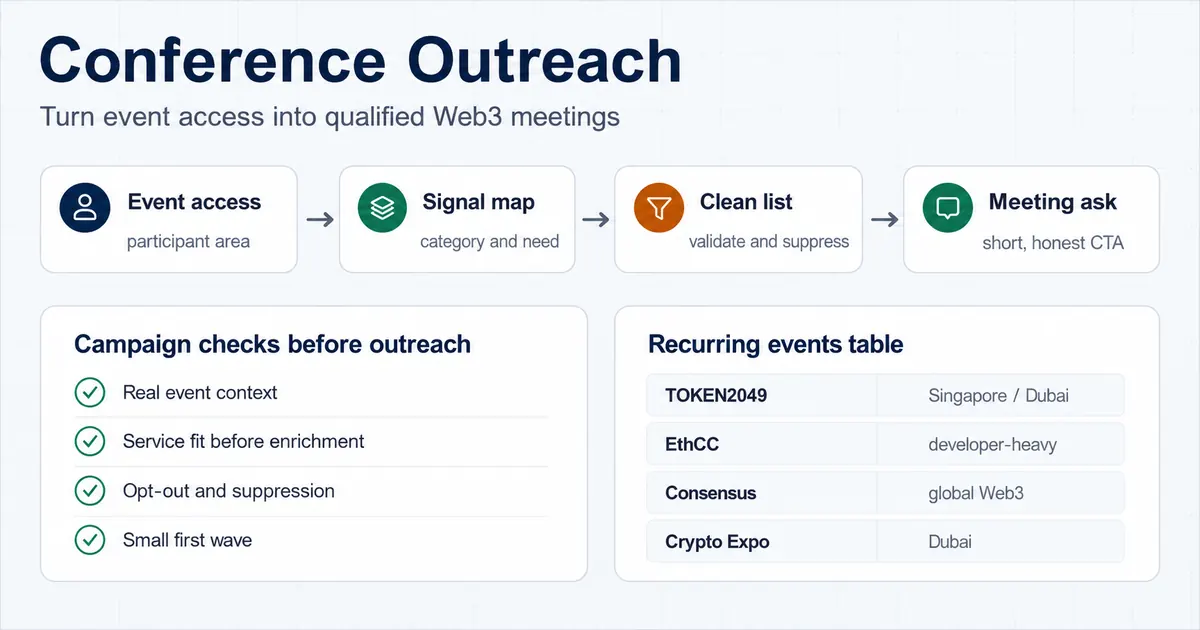
- Conference context gives Web3 outreach a believable reason to exist now.
- Start with a small, high-fit participant list instead of a giant scrape.
- Segment by service need before you enrich contacts or write copy.
- Ask for a short meeting, not a full sales conversation in the first touch.
- Combine event-based bursts with daily LeadGenCrypto discovery between conferences.
Most cold outreach to crypto projects fails before the first sentence.
Not because the sender cannot write.
Because the recipient has no reason to care right now.
Crypto conference outreach fixes that timing problem for agencies, founders, RevOps teams, and Web3 service providers that sell professional work to crypto projects. An event gives you a fresh reason to contact a smaller group of companies, a better way to segment them, and an opener that does not sound invented.
The useful question is simple: how do you turn conference access into qualified meetings without pretending you met someone, blasting every attendee, or treating a participant list like a finished sales pipeline?
Why conference-based outreach works when generic cold email feels random
The best outbound message does not start with a pitch. It starts with a believable reason to talk. A conference gives you that reason because the project, company, or founder is already connected to a recent market moment.
A cold email that says "we help Web3 projects grow" feels generic. A cold email that says "I noticed your team around TOKEN2049 Dubai and thought this may be relevant before your next listing push" gives the reader immediate context.
That does not mean you should fake familiarity. The point is not to pretend you met someone. The point is to use a real shared environment as the reason to start a relevant business-to-business conversation.
The event name creates instant context
A familiar event name works like a shortcut. The recipient may not remember you, but they understand why you are writing now.
Use careful language:
Safe: I noticed your team was listed around [Event Name].
Safe: I came across your project while reviewing companies connected to [Event Name].
Safe: Since [Event Name] is bringing together teams in this space, I thought this might be timely.
Unsafe: Great meeting you there.
Unsafe: I saw you at the booth.
Unsafe: We spoke during the event.
The unsafe lines only work if they are true. If the person bought a ticket and never showed up, the email loses trust immediately.
Conference lists are smaller, fresher, and easier to segment
A public token tracker can show thousands of projects. That is useful for broad discovery, but the reason to write can be weak.
A conference list is different. It is smaller, fresher, and often connected to a business activity. A project around a listing-heavy event may care about exchange access, liquidity, legal readiness, PR, paid visibility, know your customer checks, audits, or market-making support. A project around a developer-heavy event may care more about infrastructure, wallets, smart contracts, DevOps, analytics, or ecosystem integrations.
Smaller is the advantage. A focused list of 300 relevant companies can beat 10,000 stale contacts if the timing and offer are stronger.
You do not need to speak with everyone in person
Even a strong networker cannot meet everyone at a large event. Most teams speak with a small share of participants, then leave with an incomplete pipeline.
Conference outreach expands coverage. You can use the event before, during, and after the dates on the badge:
| Timing | Best goal | Best message angle |
|---|---|---|
| 2 to 3 weeks before | Book meetings early | "Worth a 15-minute chat during [Event Name]?" |
| During the event | Catch quick conversations | "We are around the event this week. Worth a quick intro?" |
| 1 to 7 days after | Convert fresh context into calls | "I reviewed teams connected to [Event Name] and had one idea." |
| 2 to 4 weeks after | Recycle good-fit accounts | "Not sure if this is still timely, but the fit looked strong because..." |
The event is not the whole strategy. It is a high-context trigger inside a broader sales system. If your team still needs a daily discovery layer outside events, use the crypto project discovery playbook as the upstream pipeline.
The Event Access to Meetings Framework
Do not treat a participant list as a spreadsheet. Treat it as a signal map. The goal is not to email everyone. The goal is to identify which projects have a real reason to care about your offer right now.
Use this framework:
Event Access
to Participant Signals
to AI Segmentation
to Contact Enrichment
to Validation and Suppression
to Meeting Ask
to Post-event Follow-up
Step 1. Get event access
Many conferences give ticket holders access to a participant area, networking portal, event app, exhibitor list, sponsor list, or meeting tool. Sometimes you will see direct contact details. Often you will only see company name, website, role, LinkedIn, or a short profile.
That is still enough to start account-level research. For a Web3 service provider, a ticket can be more than access to a venue. It can be access to a narrow, timely audience.
Before buying any pass, check five things:
[ ] Does the event attract crypto projects, not only general Web3 media?
[ ] Is there a networking app, participant area, sponsor list, or exhibitor list?
[ ] Does the audience match your service category?
[ ] Can your team send before the event, not only after it?
[ ] Is the ticket cost reasonable for a small campaign test?
Step 2. Collect participant signals
You do not need perfect data at the first step. You need enough signal to decide whether the company deserves research.
Start with company-level fields, then enrich contacts only for the rows that pass your fit test.
| Field | Why it matters | Example |
|---|---|---|
| Event name | Gives timing and opener context | TOKEN2049 Singapore |
| Company or project | Tells you who the account is | DeFi app, wallet, launchpad |
| Website | Lets you verify the project and find public contacts | Project domain |
| Category | Prevents one-size-fits-all copy | DeFi, gaming, infrastructure, wallet, exchange |
| Region | Helps with meeting timing and relevance | Dubai, Singapore, EU, LATAM |
| Visible need | Connects your service to a real business reason | No audit badge, upcoming listing, weak media footprint |
| Source | Keeps the list auditable | Event app, exhibitor page, sponsor page |
| Contact route | Shows how you can reach them | Email, LinkedIn, contact form |
| Confidence | Keeps low-quality rows out of first waves | High, medium, low |
| Next step | Turns the row into action | Enrich, send, suppress, recycle |
Do not rush enrichment. A bad contact on a good account is still a bad send.
Step 3. Segment with AI before writing emails
AI is useful here, but not for writing long, fake-personalized emails.
Use it to classify companies by category, likely need, maturity, chain, region, and service fit. Then let a human review the high-value rows.
| Your service type | Best conference signal | Strong outreach angle | Weak angle to avoid |
|---|---|---|---|
| Smart contract audits | Live product, no visible audit proof, listing pressure | "Trust check before the next growth push" | "We audit all Web3 teams" |
| Liquidity and market making | Listed or listing-ready token, low depth, event visibility push | "Liquidity readiness around your next exchange or campaign" | "We can pump volume" |
| PR and media | Launch, funding, listing, new feature, conference booth | "Turn event attention into credible coverage" | "Guaranteed viral exposure" |
| KYC and AML | Token sale, launchpad, exchange conversations, fintech region | "Reduce onboarding friction for partners and venues" | "Compliance solved forever" |
| Legal and licensing | Multi-region expansion, VASP, MiCA, or offshore mention | "Map licensing risk before expansion" | "We make everything legal" |
| SEO and link building | Weak organic footprint, high-value category, content gap | "Capture search demand after event attention" | "Buy links fast" |
| Wallets and infrastructure | Developer event, SDK need, chain expansion | "Simplify integration for users or partners" | "Generic blockchain development" |
| Influencer and AMA promotion | Consumer-facing token, community push, launch news | "Test 2 to 3 creator angles before scaling paid mentions" | "Guaranteed community growth" |
The goal is not to sound clever. The goal is to stop sending the same message to a wallet, a DeFi protocol, a centralized exchange, and a gaming token.
Step 4. Enrich, validate, and suppress before sending
After segmentation, enrich only the rows that match your offer. Then validate emails, check the project website, remove duplicates, and merge your suppression list.
This is where many campaigns break. Teams get excited by the event list and send too quickly. Then they hit bounces, irrelevant replies, or complaints.
A simple send policy:
Send: strong fit, verified contact, clear event context, timely offer.
Recycle: good account, weak timing, missing contact, unclear need.
Suppress: no fit, risky data, previous opt-out, irrelevant category.
Research: promising account, but not enough proof yet.
For list hygiene, connect this step with email validation before cold outreach and suppression handling in LeadGenCrypto.
Step 5. Send a short meeting ask, not a full sales pitch
Conference outreach should be short because the context already does some of the work.
The first email should answer four questions:
Why now? Because of the event.
Why them? Because their project fits a specific service need.
Why you? Because you can help with one clear outcome.
What next? A short meeting or quick reply.
Do not attach a deck. Do not write a full company story. Do not list every service you sell.
Ask for a small next step.
Do not write "great meeting you" unless you actually met. Do not write "saw you at the booth" unless you really did. Neutral event context is enough, and it protects trust before the conversation starts.
What to write before, during, and after the conference
Timing changes the message. The same company may ignore a generic pitch in May, accept a meeting request two weeks before an event, and reply to a useful teardown three days after it.
Build three versions of your outreach, not one.
Pre-event email: book the meeting before everyone gets busy
Pre-event copy should be direct. The reader is planning travel, meetings, side events, and partner conversations. Make the ask easy.
Subject: [Event Name] and [specific service outcome]

Hi [Name],

I noticed [Project or Company] around [Event Name].

We help crypto projects with [specific service outcome], especially when they are preparing for [launch, listing, visibility push, audit, compliance review, integration, or market expansion].

Worth a 15-minute chat during the event week?

If this is not relevant, reply "no" and I will not follow up.

Thanks,
[Your Name]
Use the bracketed lines as prompts, not as fake personalization. If you cannot fill the service outcome honestly, do not send.
During-event email: use urgency without pressure
During the event, people are overloaded. Your email must be short enough to answer from a phone.
Subject: Quick chat around [Event Name]?

Hi [Name],

Saw [Project or Company] in the [Event Name] ecosystem.

We are speaking with a few teams this week about [specific outcome].

Open to a 10-minute intro today or tomorrow?

If timing is bad, I can send one short idea after the event.

Thanks,
[Your Name]
This works best when you can actually meet or reply fast. If you are remote, say so and offer a call after the event.
Post-event email: follow up while the event is still fresh
Post-event outreach works because the event is still in the reader's inbox, calendar, photos, and follow-up list.
Use the event as the context, then add a new reason to reply.
Subject: One idea after [Event Name]

Hi [Name],

I came across [Project or Company] while reviewing teams connected to [Event Name].

One thing stood out: [specific observation].

If you are working on [specific outcome], I can send a quick 3-point teardown based on your public pages.

Useful?

If not, reply "no" and I will not follow up.

Thanks,
[Your Name]
A teardown, checklist, benchmark, intro, or short idea is better than "just checking in."
Which crypto conferences are worth testing first
A conference list is not a ranking. It is a campaign planning asset. The right event depends on what you sell, which region you target, and what kind of crypto project is likely to need your service at that moment.
The table below includes recurring crypto, Web3, blockchain, and adjacent events that can be tested for conference outreach. Use it to choose 3 to 5 events, check access rules, then run a small campaign before scaling.
Ticket prices, attendee counts, access rules, and event dates can change quickly. Use the official links before you buy a pass or build a campaign. The table below preserves the conference data from the supplied draft as a planning starting point, not as a live ticket-pricing database.
Full table of recurring crypto, Web3, and blockchain conferences
| Name of the conference | Official website | Usual number of guests | Cost of joining | How often it happens |
|---|---|---|---|---|
| Paris Blockchain Week | www.parisblockchainweek.com | 8,500 attendees at PBW 2026; site also markets a 10,000+ networking audience | Public 2026 ticket surfaced at EUR 1,699 | Annual |
| EthCC | ethcc.io | 6,500+ in 2025; 6,400 in 2024; 5,200 in 2023 | EUR 125 single-day; EUR 500 full pass; some student/volunteer tickets free | Annual |
| BTC Prague | btcprague.com | 8,500 Bitcoiners | EUR 45 Expo; EUR 195 2-day All Access | Annual |
| European Blockchain Convention | eblockchainconvention.com | 6,000+ attendees | EUR 500 early-bird general pass; EUR 750 regular; EUR 1,800 late | Recurring flagship event in Barcelona, launched 2018 |
| Istanbul Blockchain Week | istanbulblockchainweek.com | About 8,000+ per recent edition; 20,000+ cumulative since launch | Lowest clearly surfaced pass: US$399 | Annual since 2020 |
| Bitcoin Amsterdam | www.bitcoin.amsterdam | 5,000+ annually | EUR 121 two-day conference ticket | Annual |
| Proof of Talk | proofoftalk.io | 2,500 decision-makers; capped at 2,500 | Current public 2026 ticket price did not surface in reviewed sources | Annual |
| Web3 Summit | web3summit.com/about | Public attendee count not clearly stated in current official pages reviewed | Current public 2026 ticket price did not clearly surface in reviewed sources | Recurring summit, launched in 2018 |
| TOKEN2049 Singapore | www.token2049.com/singapore | 25,000+ attendees | Discounted 2026 ticket surfaced at US$359.10 | Annual series |
| TOKEN2049 Dubai | www.token2049.com/dubai | 15,000+ attendees | Current public 2027 ticket price did not surface in reviewed official pages | Annual series |
| WebX | webx-asia.com | Official social said 14,000+ attendees; official site positions it as Asia/Japan's largest Web3 conference | US$79 Booth Pass; US$249 Business Pass; US$3,999 VIP Pass | Annual; 2026 is the 4th hosting |
| Korea Blockchain Week | koreablockchainweek.com | 7,000+ attendees | US$99 student; US$499 early bird; US$999 last-minute | Annual since 2018 |
| Blockchain Life | blockchain-life.com | 15,000+ attendees | 694 AED standard; 1,207 AED business; 3,633 AED VIP | Recurring forum series; current page is the 17th forum; established 2017 |
| Devcon | devcon.org | 12,000+ attendees | US$349+ ETH early-bird GA; US$699 general admission later; discounted categories from US$149 and US$25 also surfaced | Recurring flagship Ethereum developer conference; not every single year |
| BUIDL Asia | www.buidl.asia | Current official pages do not publish a strong overall attendance figure | US$70 early bird; US$110 regular | Annual; official site says 2026 is the 7th edition |
| Consensus | consensus.coindesk.com | 15,000+ attendees for 2027 | Standard 2027 public ticket pricing did not surface in reviewed sources; 2026 student access was publicised as free | Annual; running since 2015 |
| ETHDenver | ethdenver.com | 25,000+ participants | Public sources reviewed say attendance may be free for SporkDAO members/builders; non-member pricing was not clearly surfaced | Annual since 2018 |
| Bitcoin Conference | b.tc/conference | Official site emphasises multi-year scale; related official pages say 56,000+ cumulative attendees | Reviewed pages clearly surfaced a US$3,999 Whale Pass in 2024; current 2027 general public prices did not surface | Annual |
| Blockchain.RIO | blockchainrio.com.br | Current official pages reviewed do not state a single overall attendee number clearly | R$297 Start Pass; R$1,597 VIP Network | Recurring annual conference series in Brazil |
| Mining Disrupt | miningdisrupt.com | 5,000+ attendees | Current public ticket prices did not surface in reviewed official sources | Annual |
| NFT.NYC | www.nft.nyc | Official current site confirms the 9th annual edition; official social references 18,000+ past attendees | Current 2026 in-person ticket prices did not clearly surface in reviewed official website sources | Annual |
| DC Blockchain Summit | www.dcblockchainsummit.com | Official pages reviewed did not state a clear usual attendee number | Public pricing did not clearly surface on official pages reviewed; an event-wallet directory pointed to tickets from US$149, lower confidence | Annual |
| LABITCONF | www.labitconf.com | Official/current site says it is LATAM's biggest Bitcoin conference; no clean per-edition count surfaced in reviewed sources | Current public ticket price did not surface in reviewed sources | Recurring Bitcoin/blockchain conference; official social says it has run since 2013 |
| Blockchain Africa Conference | blockchainafrica.co | 10,900+ cumulative attendees since inception in 2015; no clean per-edition number surfaced | Current public ticket prices were not visible in reviewed official pages | Recurring; 12th edition in 2026 |
| Solana Breakpoint | solana.com/breakpoint | Official current pages reviewed did not surface a reliable overall attendee count | US$250 developer; US$450 general; US$800 late-bird | Recurring flagship Solana gathering |
| Avalanche Summit | www.avalanchesummit.com | Official site lists multiple past summits; no reliable overall attendee count surfaced in reviewed official sources | Current public per-ticket pricing did not clearly surface in reviewed official sources | Recurring flagship annual gathering |
| Cosmoverse | www.cosmoverse.org | 2,500+ participants | Public ticket prices did not surface in reviewed official sources | Recurring Cosmos ecosystem summit |
| Crypto Expo Dubai | cryptoexpodubai.com/dubai | 7,000+ attendees; 100+ exhibitors; 140+ speakers; 40+ countries | Visitor: sale US$19 / full US$99; Standard: sale US$109 / full US$299; Delegate: sale US$399 / full US$999; VIP: sale US$999 / full US$2,499 | Annual; current page says 8th edition; next published dates Sept 9 to 10, 2026 |
| ICE Barcelona / ICE Gaming - requested ICE item; iGaming-adjacent, not Dubai/crypto-native | www.icegaming.com | 65,000+ visitors across 3 days; 600+ exhibitors; 186 countries; 200+ speakers | Public visitor price not clearly published on the current official page; registration/interest form and VIP/World Gaming Forum options are shown | Annual; current official event is Barcelona, Jan 18 to 20, 2027 |
| AIBC Eurasia / SiGMA Eurasia - RAK-Dubai | sigma.world/summits/eurasia | Exact attendee count is not clearly published on the current official page; event includes AIBC/SiGMA speakers, attendees, expo, awards, startup pitch and networking | Affiliate/Land-based participant: free Standard Pass if approved; Standard: sale US$303 / door US$590; Platinum: sale US$819 / door US$1,295 | Recurring regional summit within SiGMA/AIBC global series; next published RAK-Dubai edition March 15 to 17, 2027 |
| iFX EXPO Dubai | dubai2026.ifxexpo.com | 2025 edition reported 7.5K attendees, 180+ exhibitors and 120+ countries | Current public ticket prices were not available in accessible official registration text; registration required / not publicly verified | Annual Dubai edition; 2025 official reporting compared attendance year-over-year vs 2024; next official site is 2026 |
| TES Affiliate Conferences - TES Portugal/Cascais-Lisbon was historical; current official schedule rotates Prague and Spain | tesaffiliateconferences.com | 1,700 to 2,000 attendees | General Entrance Ticket: EUR 629 to EUR 999 depending on purchase date; Sponsored Affiliate Ticket: EUR 259 to EUR 599 for qualifying affiliates; exhibitor/meet-market packages start from EUR 1,348 | Twice a year; September in Prague and March rotating between Marbella/Seville on current official schedule |
How to choose the first 3 events for your service category
Do not start with the biggest event. Start with the strongest fit.
Use this decision matrix:
| Your service category | Best event type | Data to collect | First outreach angle |
|---|---|---|---|
| Listings and launch support | Token launch, exchange, trading, fintech, Dubai/Singapore events | Project stage, chain, token status, listing hints | "Listing readiness before the next growth push" |
| Liquidity and market making | Exchange, trading, launchpad, high-volume networking events | Exchange status, liquidity depth, market pairs | "Liquidity support around your next listing or campaign" |
| Security audits | Developer, DeFi, L1/L2, hackathon-style events | Contract status, audit badge, launch timing | "Trust and security proof before user acquisition" |
| KYC, AML, legal, licensing | Fintech, compliance, payments, global expansion events | Region, token sale model, partner targets | "Reduce friction for listings, partners, and onboarding" |
| PR, media, influencers, AMAs | Large consumer-facing Web3 events | Launch news, brand visibility, content gaps | "Turn event visibility into credible follow-up coverage" |
| SEO, guest posts, content | Events with many new or growing projects | Organic footprint, blog quality, backlink gaps | "Capture search demand after the event spike" |
| DevOps, infrastructure, wallets, analytics | Developer-heavy or ecosystem-specific events | Chain, SDK, integration needs, product maturity | "Make integrations easier for your next ecosystem push" |
| Payments and banking | Fintech, trading, iGaming-adjacent, CEX/DEX events | Fiat rails, checkout flow, region, compliance signals | "Support payment readiness for partners and users" |
A simple rule: if your offer needs technical trust, start with developer-heavy events. If your offer helps with visibility, listing, liquidity, or growth, start with launch-heavy and trading-heavy events.
Notes on ICE, SiGMA/AIBC, iFX, and TES
Some events in the list are adjacent to crypto rather than crypto-native. That can be useful, but it requires stricter targeting.
ICE is listed as iGaming-adjacent. SiGMA/AIBC connects iGaming, affiliate, startup, investment, and blockchain audiences. iFX EXPO is trading and fintech-heavy. TES is affiliate and media-heavy.
These can work if you sell services related to traffic, payments, fintech, compliance, media, partner channels, or market access. They may work less well if you need only crypto-native founders.
Mini case: 3,000 contacts to 27 meetings
The process matters more than the event name. One conference list is just a raw input. The outcome comes from access, segmentation, clean data, short copy, and fast follow-up.
Here is a simple example based on a conference-led outbound motion.
Over 2.5 months, the work was tied to several events, including ICE, SiGMA, iFX in Dubai, and TES in Portugal. The process was straightforward:
1. Get access to the participant or networking area.
2. Collect company-level signals.
3. Segment the list with AI.
4. Enrich only high-fit rows.
5. Validate contacts and suppress bad-fit rows.
6. Send short meeting asks before and around the event.
7. Follow up after the event with a useful reason to reply.
Example funnel:
| Stage | Result |
|---|---|
| Contacts reviewed | Around 3,000 |
| Meetings booked | 27 |
| Qualified leads | 14+ |
These numbers are not a promise. They are a useful funnel benchmark for one motion. Your result will depend on event fit, offer strength, contact quality, timing, deliverability, and reply handling.
What made the funnel work
The email did not need a complicated opener. The event provided the context.
The messages were short. The list was segmented. The ask was a meeting, not a huge commitment. Between conferences, normal email and LinkedIn outreach continued, but event-based messages had a stronger reason to exist.
The hidden advantage is scarcity. A crypto project may receive hundreds of generic vendor pitches. It receives fewer messages that connect to a specific event it just joined or planned to attend.
What could break the funnel
The same workflow can fail if the team sends too broadly.
Common failure points:
[ ] The event audience does not match the service.
[ ] The list includes too many media, investors, or students instead of buyers of services.
[ ] The email implies a personal meeting that never happened.
[ ] The sender writes a long pitch instead of a meeting ask.
[ ] No email validation is done before sending.
[ ] Previous opt-outs are not suppressed.
[ ] Replies are slow, vague, or routed to the wrong person.
Do not scale before validation. Start with 100 to 300 high-fit contacts, review replies and objections, then expand.
Compliance and deliverability checklist for conference outreach
Good outreach is specific, honest, and easy to decline. A conference context does not give you permission to message everyone forever. It gives you a timely business reason to contact relevant companies.
Use this checklist before any send:
[ ] The company is a realistic buyer of your service.
[ ] The event context is real and phrased honestly.
[ ] The contact route is business-relevant.
[ ] The email identifies the sender clearly.
[ ] The offer is specific to the project category or timing.
[ ] The message includes a simple opt-out.
[ ] Emails are validated before sending.
[ ] Previous opt-outs and bad-fit rows are suppressed.
[ ] The first wave is small enough to inspect manually.
[ ] The follow-up adds a new reason to respond.
Send only when there is a real service fit
Relevance is the main compliance and conversion filter.
A wallet integration offer sent to a media company wastes attention. A sponsored post pitch sent to a developer framework may miss the buying moment. A liquidity offer sent to a project with no token is too early.
Score each row:
| Score factor | Question |
|---|---|
| Event relevance | Does this event attract the type of project we serve? |
| Company category | Does the project fit our ideal customer profile? |
| Visible need | Can we see a real reason to contact them now? |
| Contact confidence | Is the contact route likely to reach the right team? |
| Timing | Is this pre-event, during-event, or fresh post-event? |
| Offer fit | Can we explain the value in one sentence? |
Only high-fit rows should enter the first wave.
Use opt-out and clean suppression
A good opt-out protects your domain, your brand, and the recipient's time.
Keep it simple:
If this is not relevant, reply "no" and I will not follow up.
Then honor it. Add the contact and company to your suppression list. If you later import new data from another source, merge suppression before the next send.
This article is practical outreach guidance, not legal advice. Laws, platform rules, privacy notices, sponsorship terms, and consent requirements vary by region and source. Review your process before scaling.
How to combine conference lists with LeadGenCrypto daily discovery
Conference outreach is a burst channel. LeadGenCrypto is a daily discovery layer. Use both because they solve different problems.
Conferences give you context. LeadGenCrypto helps you find newly launched token projects with fields such as website, token address, blockchain, token name or symbol, verified emails, and other information. You can export to CSV or pull data through the Public API for CRM workflows.
Use conference lists when you want a high-context campaign around a market event.
Use LeadGenCrypto when you want a steady pipeline of new crypto projects to research, segment, and contact.
Use conferences for high-context campaigns
A good conference campaign has a defined window:
2 to 3 weeks before: build list, segment, and send meeting asks.
Event week: send short, fast-response messages.
1 week after: send useful post-event follow-up.
2 to 4 weeks after: recycle good-fit accounts with a new reason.
In your CRM, track event name, source, service fit, segment, send timing, reply status, meeting status, and qualified lead status.
Use LeadGenCrypto for daily discovery
LeadGenCrypto helps fill the pipeline between events. That matters because conferences are seasonal. New token projects launch every day.
A practical motion:
Daily: review new LeadGenCrypto leads.
Weekly: export high-fit rows or pull via API.
Before events: enrich the campaign with conference context.
After events: compare event-sourced contacts with daily discovery leads.
Monthly: suppress duplicates and update ideal customer profile rules.
Helpful next reads:
- Build a broader pipeline with the crypto project discovery playbook.
- Turn fresh contacts into sends with email validation and list hygiene.
- Stream data into your tools with the LeadGenCrypto API workflow.
- See how to pull new token project contacts through the Public API when your CRM workflow is ready.
If your team already has a conference list and needs fresh daily project discovery between events, review a sample in the LeadGenCrypto Leads dashboard and compare it with your current campaign sheet.
LeadGenCrypto Blog and Updates
Get sharper event-sourced outreach notes
Subscribe for short, practical emails on finding token projects, segmenting outreach lists, and turning Web3 market signals into better B2B conversations.
- Fast summaries of new LeadGenCrypto articles
- Practical ideas for teams selling services to crypto projects
- Useful resources, checklists, and outreach angles without hype
The simple combined system
Conference list = high-context timing.
LeadGenCrypto = daily project discovery.
Email validation = safer sending.
Suppression = cleaner repetition.
CRM = memory and measurement.
This is the difference between occasional networking and a repeatable sales motion.
Copy-paste conference outreach checklist
Use this checklist before every event campaign. It keeps the work practical and prevents the usual mistakes.
Before the event
[ ] Pick 3 to 5 events that match your service category.
[ ] Check whether ticket access includes a networking app or participant area.
[ ] Review sponsors, exhibitors, speakers, and side events.
[ ] Collect company-level signals first.
[ ] Score each row by fit, need, timing, and contact confidence.
[ ] Segment with AI, then manually review high-value rows.
[ ] Enrich contacts only after segmentation.
[ ] Validate emails before the first send.
[ ] Merge suppression lists before writing copy.
[ ] Prepare 2 to 3 short message variants by service category.
During the event
[ ] Send only to high-fit contacts.
[ ] Keep messages short enough to answer from a phone.
[ ] Ask for a 10 to 15-minute intro, not a full sales call.
[ ] Reply quickly when someone engages.
[ ] Route positive replies to the right team member.
[ ] Log meeting status in CRM.
[ ] Avoid any wording that implies a personal meeting if none happened.
After the event
[ ] Follow up within the first few days while the event is fresh.
[ ] Add a new reason to reply, such as a teardown or checklist.
[ ] Recycle good-fit accounts that did not respond.
[ ] Suppress opt-outs immediately.
[ ] Review bounces, replies, meetings, qualified leads, and objections.
[ ] Compare event-sourced contacts with daily LeadGenCrypto leads.
[ ] Save the best-performing angle for the next event.
FAQ
Do I need to attend the conference in person?
No. In-person attendance helps, especially when you can book meetings on-site. But the workflow can still work if ticket access gives you a networking portal, participant list, exhibitor list, sponsor list, or company ecosystem to research.
The key is honesty. If you did not attend, do not imply that you met someone there.
Is it okay to email people from a conference list?
It depends on the context, laws that apply to your business, and how the data was obtained. As a practical rule, only contact relevant business prospects, identify yourself clearly, write honestly, include opt-out, and avoid personal-data overreach.
This article is not legal advice. It is a B2B outreach workflow.
What if the event app does not show emails?
That is common. You can still use company names, websites, roles, categories, sponsors, exhibitors, and project descriptions for account research.
If there is no reliable contact route, recycle the account instead of forcing a send.
Should I mention the event in the subject line?
Yes, if it is honest and relevant.
Good examples:
[Event Name] and your launch plans
Quick question around [Event Name]
One idea after [Event Name]
Avoid subject lines that imply a meeting or prior relationship if none exists.
How many contacts should go into the first wave?
Start with 100 to 300 high-fit contacts. That is enough to test deliverability, reply quality, objections, and meeting rate without risking a large bad send.
Scale only after you know which segment and message work.
Which service categories can use this workflow?
The workflow can fit PR, media, influencer marketing, AMAs, listings, launch support, liquidity, audits, KYC, AML, legal, payments, DevOps, wallets, analytics, SEO, link building, sponsored content, hosting, APIs, marketplaces, and other Web3 B2B services.
The message must change by category. The workflow stays the same.
What is the biggest mistake in conference outreach?
The biggest mistake is fake familiarity. Do not write as if you met someone when you did not.
The second mistake is sending the same pitch to everyone in the event list. Segmentation is what turns the list into a campaign.
How does this fit with LeadGenCrypto?
Use conferences for high-context event campaigns. Use LeadGenCrypto for daily discovery of newly launched token projects.
Together, they give your sales team both timing and consistency: event-based bursts when the market gathers, and fresh project discovery between events.