Web3 Content Marketing for Service Providers: Turn Views Into Sales Calls

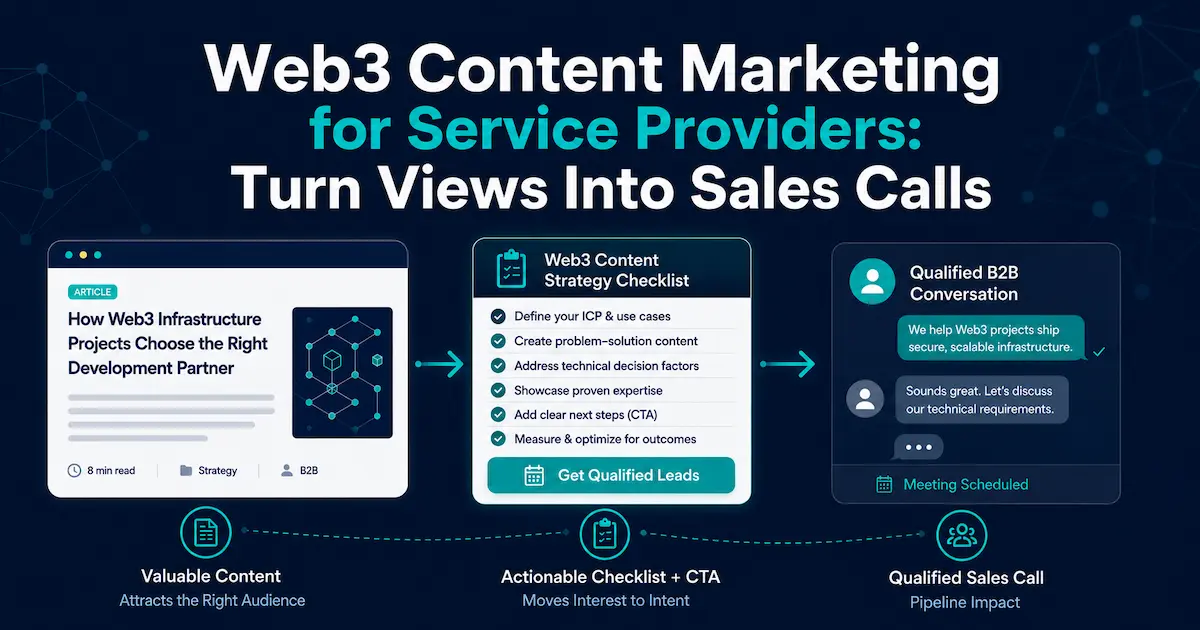
Web3 content marketing for service providers fails when the article gets attention but never gives the reader a useful next step.
- Start with the crypto project's live problem, not your service category.
- Give the reader a checklist, scorecard, teardown, or decision table before asking for action.
- Match the CTA to intent, from self-check to page teardown to targeted follow-up.
- Connect useful content to fresh token project contacts only after relevance, consent, opt-out, and list hygiene are handled.
- Treat sales calls as a path outcome, not a promise.
Your Web3 blog can get views and still produce no useful sales calls.
That usually does not mean the article is useless.
It means the article stops before the reader knows what to do next.
If you sell services to token projects, the missing piece is usually not another pillar post. It is a bridge from the problem the project feels today to a next step that feels useful, specific, and easy to take.
That bridge can be a launch-readiness checklist, a trust-page scorecard, a listing-materials teardown, or a short diagnostic tied to the article's point.
Before committing to a larger publishing plan, check whether content is the next investment your sales process needs. The constraint may sit in offer proof, delivery, or access to the buyer.
Why views do not become sales calls
The problem is rarely "more content." The problem is a missing path from the article to the next practical action.
A crypto project founder does not wake up thinking, "I need thought leadership."
They wake up thinking:
- The token is live and traction looks weak.
- Listing conversations keep asking for proof.
- Liquidity support is urgent but vendor risk feels high.
- The community is asking trust questions the team cannot answer cleanly.
- A partner wants verification, compliance, or technical clarity before moving.
If your article starts with your category, the reader may nod and leave.
If your article starts with the exact moment they are in, the reader has a reason to keep going.
That is the difference between content that gets attention and Web3 content marketing for service providers that can support a sales path.
If you are still choosing what to publish, start by turning a real sales question into a useful public answer, then decide which next step belongs after it.
The same path also has to survive machine retrieval. Use the AI-agent website policy and GEO checklist to decide which public facts should be easy to retrieve and which paths should stay restricted.
For broader offer and service positioning, keep the canonical positioning work in services for crypto projects. This article focuses on the narrower job: turning one useful article into a clear, low-friction CTA.
Start with the project moment, not your service category
A category explains what you sell. A moment explains why the reader should care today.
Many Web3 service articles begin with broad education:
- Why PR matters.
- Why audits matter.
- Why liquidity matters.
- Why KYC matters.
- Why SEO matters.
Those statements can be true and still be too wide.
A token project preparing exchange materials has a different content need from a live token with quiet Telegram, a protocol facing security questions, or a founder trying to explain a complex product before a partner call.
Use this switch before you draft:
| If you sell | Do not start with | Start with |
|---|---|---|
| PR or media | Why PR matters | What to publish when launch traction is weak |
| Audits | Why audits matter | What blocks listing talks when audit proof is missing |
| KYC or AML | Why compliance matters | How trust gaps slow partner conversations |
| Market making | Why liquidity matters | What weak liquidity signals do to buyer trust |
| Dev or design | Why UX matters | Where onboarding fails before a project can explain value |
| SEO or content | Why content matters | Why views do not become sales conversations |
The article becomes sharper when it names the pressure first and the service second.
You are not hiding your offer. You are earning the right to make it relevant.
Use the Content-to-CTA framework
A good longread should feel like a diagnosis, not a brochure.
Use this sequence:
- Name the exact project moment.
- Show the cost of delay.
- Explain why the usual fix does not work.
- Give one practical tool.
- Make the CTA the next natural step from that tool.
Here is the difference.
Weak angle: "Why every token project needs media coverage."
Stronger angle: "Your token is live, but your announcement did not travel. Here is the launch visibility checklist to fix before you buy more promotion."
Weak angle: "Smart contract audits build trust."
Stronger angle: "If listing talks keep stalling, check these audit-proof gaps before sending another exchange deck."
Weak angle: "Web3 content marketing is important."
Stronger angle: "Your Web3 blog gets views but no sales calls. Here is the Content-to-CTA checklist to fix before publishing the next post."
The stronger version filters the right reader. It also proves you understand the painful moment.
If your service page itself is still a loose list of capabilities, fix that first with the offer-first rewrite sprint. Content can guide a buyer only when the offer behind the content is clear enough to act on.
Give a tool before asking for action
A CTA works better after the reader gets a small win.
The tool can be simple. It only has to make the problem clearer.
Good tools for Web3 service providers include:
- a five-point launch visibility checklist
- a pre-listing trust scorecard
- a liquidity readiness table
- a KYC and compliance gap list
- a landing page teardown template
- a send, fix, or wait decision matrix
- a proof-pack checklist for exchange or partner conversations
If you compare two versions of the tool or CTA, evaluate them with qualified-demand A/B testing instead of declaring the version with more raw clicks the winner.
For example, a KYC vendor could include this mini-scorecard:
| Question | Yes | No |
|---|---|---|
| Does the website explain who must complete verification? | ||
| Does the project show why verification protects users or partners? | ||
| Is there a clear partner, listing, or access-control use case? | ||
| Is the verification step easy to find from the main site? |
The CTA after that scorecard should not be a vague "contact us."
A better CTA is:
If you scored fewer than three yes answers, send us your verification page and we will point out the first trust gap to fix.
That CTA feels like a continuation of the article.
It asks for a specific asset.
It promises a bounded next step.
It does not imply guaranteed listings, guaranteed investor interest, guaranteed replies, or guaranteed revenue.
Match the CTA to reader intent
Not every reader is ready for a call. A useful article should give the right next step for the stage the reader is in.
Use this table before you publish:
| Reader stage | Better CTA | Avoid |
|---|---|---|
| Just discovered the issue | Run this checklist | Book a call now |
| Comparing options | Use this decision table | See our full service menu |
| Has a live problem | Send your page for a teardown | Subscribe for updates only |
| Has fresh target accounts | Pull contacts into a workflow | Read more generic tips |
| Needs team approval | Share this scorecard internally | Ask for a long sales meeting |
There is no universal best CTA.
The CTA should answer the question the article created.
If the article helps a PR agency reader diagnose weak launch visibility, the CTA can be a launch visibility teardown.
If the article helps an auditor reader spot proof gaps, the CTA can be a pre-listing audit proof checklist.
If the article helps a RevOps reader turn content into follow-up, the CTA can point to fresh project contacts and CRM routing.
For LeadGenCrypto readers, the content path often connects to project discovery and outreach. Start with how to find crypto projects to pitch, then connect the article to a step-by-step cold email framework for Web3 service providers. If you want to test the workflow with real project data, use the Leads docs to understand delivered fields, CSV export, and free versus paid lead behavior.
Turn the article into a sales path
The article is not the full funnel. It is one asset inside a loop.
A practical loop looks like this:
- Publish one article that names a live project moment.
- Add one useful tool inside the article.
- Use one CTA that continues from the tool.
- Send the article only to projects where the moment is relevant.
- Track replies, objections, silence, and confusion.
- Rewrite the next article from what you learned.
When content generates a service request, measure enquiry handling through to a held meeting so you can examine the first useful reply as well as the CTA that started the conversation.
This is where many Web3 service providers break the workflow. They publish the article, share it once on LinkedIn, then wait.
Do not wait.
Turn the article into a targeted follow-up asset.
For example:
| Article asset | Best follow-up use | Safer CTA |
|---|---|---|
| Launch visibility checklist | Send to projects with weak launch coverage | Want the two gaps I see on your launch page? |
| Audit proof scorecard | Send before listing or partner conversations | Should I send a five-point proof gap list? |
| KYC trust checklist | Send to teams with unclear verification flow | Worth a quick trust-page teardown? |
| Landing page teardown template | Send to projects with confusing first screen | Want me to mark the first friction point? |
Keep the follow-up relevant and low-pressure.
If you are using fresh token project contacts, keep list hygiene and suppression rules in the workflow. For higher-volume intake, sync token project contacts into your CRM so the article, CTA, contact source, owner, opt-out status, and follow-up history stay connected.
Do the trust and compliance check before follow-up
A good CTA does not excuse sloppy outreach.
If your article leads into email follow-up, handle relevance, consent, opt-out, suppression, and list hygiene before you send. This article is general information, not legal advice, but the workflow should never treat compliance as an afterthought.
For US commercial email, the Federal Trade Commission publishes a business guide to the CAN-SPAM Act, including requirements around sender identity, subject lines, physical address, and opt-out handling. Review the official FTC CAN-SPAM compliance guide before treating any content-led email sequence as ready to scale.
For Web3 specifically, add these checks:
- Relevance: is the article tied to a real project signal, not a generic blast?
- Suppression: have you removed prior opt-outs, existing clients, bad domains, and irrelevant projects?
- Scam verification: have you checked that the website, token URL, Telegram, and email context belong together?
- Data hygiene: are duplicate projects, stale addresses, and risky generic inboxes handled?
- Deliverability: are you sending at a controlled pace with clean authentication and sane copy?
- Human review: would a founder understand why you sent this to them?
The safer version of Web3 content marketing for service providers is not "publish and spam."
It is "publish a useful diagnostic, then send it only where the diagnostic fits."
Copy-paste checklist before publishing
Use this before your next blog post, LinkedIn longread, guest post, or X thread.
[ ] The first screen names a painful project moment.
[ ] The article is clearly for service providers selling to crypto projects.
[ ] The article does not target token buyers, traders, investors, or retail demand.
[ ] The opening explains the cost of doing nothing.
[ ] The article shows why the usual fix is incomplete.
[ ] The reader gets a checklist, scorecard, table, teardown, or template.
[ ] The CTA follows naturally from that tool.
[ ] The CTA is specific enough that the reader knows what to send or do.
[ ] The CTA does not promise revenue, replies, rankings, listings, funding, or token performance.
[ ] Follow-up guidance includes relevance, opt-out, suppression, and list-hygiene checks.
[ ] The article links to the next practical workflow instead of leaving the reader stranded.
If several boxes fail, the article may still be useful.
It probably will not create many qualified sales conversations.
If your article is already useful but the next step is vague, test it with one small batch of relevant project contacts. Use a checklist, send only where the moment fits, and keep suppression clean. LeadGenCrypto can help you get a free verified project contact to test data quality before scaling through CSV or CRM workflows.
LeadGenCrypto Blog and Updates
Get sharper Web3 service growth notes
Subscribe for short, practical emails on turning content, project signals, and outreach into better B2B conversations with crypto teams.
- Fast summaries of new LeadGenCrypto articles
- Useful checklists for service providers selling to token projects
- No-hype ideas for content, outreach, list hygiene, and follow-up
FAQ
What is Web3 content marketing for service providers?
It is content built for agencies, consultants, vendors, publishers, auditors, and other B2B teams that sell services to crypto projects. The goal is not token promotion. The goal is to help the right project team understand a problem, use a practical asset, and take a clear next step.
Why does my Web3 blog get views but no sales calls?
Often because the article names a broad topic but never creates a path to action. The reader understands the category, but they do not know what to check, send, fix, compare, or request next.
Should every article have a sales CTA?
Every article should have a useful next step, but not every article needs a hard sales CTA. A checklist, related workflow, newsletter, free lead test, teardown request, or CRM next step can be better depending on reader intent.
What is a good CTA for a Web3 service article?
A good CTA is specific, low-friction, and tied to the article's tool. For example: "Send your launch page and we will point out the first visibility gap" is stronger than "contact us."
How do I avoid sounding spammy when I send an article to prospects?
Send only when the article matches a visible project moment. Keep the note short, explain why it is relevant, offer one small next step, and include opt-out and suppression handling in your process.
Can this framework work for PR, audits, KYC, legal, market making, and dev studios?
Yes, if the article starts with the project's situation instead of the vendor category. The useful asset changes by service type, but the path is similar: moment, cost, failed usual fix, better mechanism, tool, CTA.
Should I optimize for the broadest content marketing keyword?
Not if it attracts the wrong audience. A narrower phrase that clearly signals service providers selling to crypto projects can be more useful than a broader phrase that attracts token marketers, traders, or retail promotional traffic.
How does LeadGenCrypto fit into this workflow?
LeadGenCrypto is the contact and workflow layer after the article is useful. It can help service providers test an article-led CTA against relevant token project contacts, export data, or route new contacts into a CRM. The article still needs relevance, proof, opt-out handling, and human judgment.