Crypto Companies Email List: Why Static Databases Fail & The Dynamic Outreach Fix

· 24 min read
LeadGenCrypto Team
Crypto Leads Generating Specialists
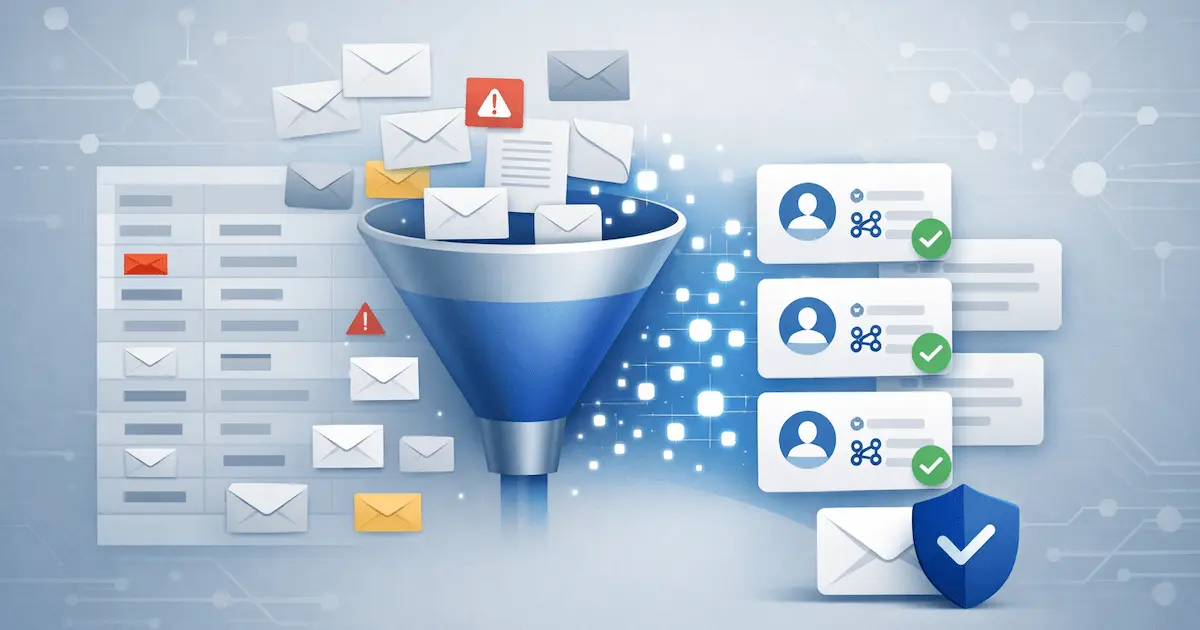
Crypto Companies Email List compared with verified Web3 leads, shown as a messy email database filtered into clean verified crypto company contacts
TL;DR

Stop buying dead data. The average Crypto Companies Email List decays faster than any other industry database due to high turnover, anonymity, and project pivots. To sell B2B services in Web3, you must switch from "spray and pray" static lists to Dynamic Contextual Outreach.

Key Takeaways:

  • Decay Rate: Static lists are often 30–50% invalid within months because crypto teams pivot, rebrand, or rug constantly.
  • The Trust Gap: Founders assume you are a scammer until proven otherwise. Your email must signal "insider" status immediately.
  • Binary Offers: Your CTA should not be "let's chat" (vague); it should be a binary "accept or reject" offer (specific).

If you are a B2B service provider in the blockchain space—whether you run a marketing agency, a listing platform, a security auditing firm, or a dev shop—you know the pain of the "empty inbox."

You have likely tried purchasing a Crypto Companies Email List from a data vendor or a freelancer marketplace. You were promised thousands of verified crypto company contacts. You loaded them into your sending tool, fired off a campaign, and watched in horror as your bounce rate spiked and your open rate plummeted.

Why does this happen?

It happens because crypto is the most volatile industry on earth. Projects launch and die in weeks. Founders use pseudonyms. Teams operate on Discord, Telegram, but not on LinkedIn with real names. By the time a static cryptocurrency mailing list is compiled and sold to you, it is already a graveyard of dead projects and abandoned inboxes.

Furthermore, crypto founders are the most skeptical buyers in the world. Their inboxes are flooded with phishing attempts, scammy "growth experts," and bot-driven spam. When you use a generic list, you sound like the noise. You get blocked, reported, and ignored.

There is a better way.

This guide presents the Dynamic Context Outreach Framework. It is a methodology that shifts you away from buying stale crypto email addresses and toward sourcing leads based on context and relevance.

We will cover:

  1. The Static Trap: Why the "database" model is broken for Web3.
  2. Dynamic Sourcing: How to find leads based on what they are doing, not just who they are.
  3. The Messaging Foundation: Constructing a "BrandScript" that resonates.
  4. Signal Research: The 5-minute recon process.
  5. Persuasion Architecture: Ethical psychology for skeptical founders.
  6. The Blueprint: Anatomy of a high-converting cold email.
  7. Sequence Strategy: Cadences that convert without annoying.
  8. Sector-Specific Angles: Adapting the play for your specific niche.
  9. Friction Removal: Handling objections like a pro.
  10. Quality Assurance: A scoring rubric to protect your reputation.

Phase 1: The Static List Trap (Why Databases Decay)

The Volatility of Web3 Data

In traditional B2B (selling to accountants or dentists), a contact list might remain 90% valid for a year. In crypto, a crypto companies contact list can degrade by 20% in a single month.

Why static lists underperform:

  • High Velocity Mortality: Projects fail, rug, or "soft exit" constantly. A list compiled in January is largely irrelevant by June.
  • Role Fluidity: The "Head of Marketing" at a DeFi protocol today might be the "Founder" of an NFT project tomorrow. Static lists rarely capture these shifts.
  • Context-Free: A CSV file tells you an email address. It does not tell you what's the project's token name, symbol, contract address, or blockchain type. Without context, your pitch is generic.
  • The "Tragedy of the Commons": If you can buy a list of crypto companies email contacts for $99, so can 500 of your competitors. That founder is receiving the exact same generic pitch from hundreds of vendors.

The Reputation Risk

Using a bad cryptocurrency mailing list isn't just a waste of time; it is dangerous.

  • Deliverability Damage: High bounce rates (sending to dead emails) destroy your sender score.
  • Spam Traps: Old lists often contain "spam traps"—emails monitored by ISPs to catch spammers. Hitting one can blacklist your domain.
  • Brand Damage: If you email a founder asking about their "upcoming token launch" when they launched (and failed) six months ago, you signal that you haven't done your homework. You are instantly categorized as "low tier."
The "Spray and Pray" Consequence

When founders detect a list blast, they don't just ignore it; they mentally tag your brand as noise (or worse, risk). In a small industry like crypto, reputation travels fast. Being known as a spammer is a death sentence for high-ticket B2B sales.

The Pivot: Stop looking for a "list." Start looking for a "feed." You need a stream of customized crypto companies email list data that is filtered by chain, token contract address, symbol and name. Therefore, a lead‑streaming model keeps that “feed” tied to fresh signals instead of stale CSV snapshots.


Phase 2: Dynamic Sourcing (The Signal-Based Approach)

Moving from "Who" to "When"

The most valuable data point in sales is not the contact's name. It is the timing. LeadGencrypto and similar tools focus on dynamic, contextual lead sourcing. This means you stop relying on static databases and start isolating active prospects using granular identifiers. Furthermore, the CoinMarketCap lead-finding workflow gives you a predictable way to surface newly listed projects before their inboxes get saturated.

To build a high-fidelity customized crypto companies email list, refine your search using these five precision filtering methods:

1) By Chain

Target projects based on their infrastructure (e.g., Ethereum, Solana, Arbitrum, or a new L1).

Why it matters: This reveals their tech stack, so you can tailor your pitch (example: "I see you're deploying on Arbitrum and might need L2 liquidity...").

2) By Token Address

Filter by the specific smart contract address.

Why it matters: This is the on-chain source of truth. It prevents you from pitching scam copycats and ensures you are analyzing the correct asset's activity.

3) By Token Name

Search for the official project name.

Why it matters: It keeps your outreach aligned with the brand and helps you find the correct entity in a sea of similarly named forks.

4) By Token Symbol

Filter by the ticker.

Why it matters: This lets you correlate your outreach with the prospect's brand more deeply.

5) By Website Domain

Filter by the project's official URL.

Why it matters: This helps verify legitimacy and filters out phishing domains.

The Contextual Advantage

When you use a reliable cryptocurrency contacts list that is enriched with these signals, your outreach transforms.

  • Old Way (Static): "Hi, we do marketing for crypto projects. Want to chat?"
  • New Way (Dynamic): "Hi, I noticed you just deployed on the Solana blockchain. Most teams at this stage struggle with [Specific Pain]. Here is how we help..."

Your copy still matters—but better inputs (lead quality + context) make good copy easier and bad copy less tempting.


Phase 3: The Message Foundation (BrandScript-Style)

Before you write a single email, you must define your "Message Foundation." A cold email performs best when your message is consistent across subject lines, first lines, proof, and CTAs. In addition, an ideal customer profile for crypto startups helps your offer, proof, and CTA land on the exact buyer you actually want.

Use this 7-point backbone to clarify your value proposition.

1. Aspirational Identity

Who do they want to be? Since you know they already have a token and you know which chain they are on, appeal to their desire to dominate that specific ecosystem. They don't just want "marketing services"—they want status within their chain's community.

  • Examples: "A credible, trusted [blockchain] based token," "A top-tier token on [blockchain] with real and active token holders," "The blue-chip standard for [blockchain] DeFi," "The deepest liquidity source across [blockchain] DEXs," "A breakout utility token leading the [blockchain] ecosystem."

2. What They Want

What is the tangible output they desire? Fundamentally, every crypto project wants to sell more of its tokens and increase market demand.

  • Examples: Listings on Tier-1 exchanges, deep liquidity, organic community growth, a clean security audit, regulatory clarity, sustained buying pressure.

3. The Problem (External + Internal)

  • External Problem: What is happening in the market? (e.g., "Liquidity is drying up," "Influencers are overpriced," "Compliance rules are tightening.")
  • Internal Problem: How does it make the founder feel? (e.g., "Uncertainty," "Fear of being exploited," "Stress about runway.")

4. Your Credibility / Authority

You need verified crypto company contacts to trust you. How do you prove it?

  • Proof Points: Case studies, verifiable on-chain results, specific credentials, unique processes.
  • Rule: No fabrication. If you are under NDA, say "under NDA" but describe the outcome.

5. The 3-Step Plan

Complexity kills conversion. Reduce your service to three steps.

  1. Quick Audit / Assessment
  2. Implementation / Sprint
  3. Optimization / Results

6. A Clear CTA

A sales email needs a primary CTA. Hinting is not a CTA.

  • Examples: "Reply 'yes' for the plan," "Open to a 12-minute call?"

7. Failure vs. Success

  • Failure: What do they risk if they ignore you? (Wasted budget, stalled growth, exploit risk, price stagnation, "zombie token" status).
  • Success: What is the happy ending? (Sustained token demand, stable markets, clean compliance, growing holder base, high trading volume).

The "Fill-in-the-Blanks" One-Liner

Use this template to align your team. If your email doesn't fit this logic, rewrite it.

At [YourCompany], we help [CryptoProjectsLikeThis] who want to be [AspirationalIdentity] get [WhatTheyWant], even when [ExternalProblem] makes [InternalProblem] worse.

We do it with [Authority] using a simple plan: (1) [Step1] (2) [Step2] (3) [Step3].

If you want to [SuccessOutcome], reply “yes” and I’ll send [NextStepAsset].


Phase 4: Signal-Based Research (The Personalization Ladder)

Even with a customized crypto companies email list, you cannot skip research. However, you cannot spend 30 minutes per lead. You need the "5-Minute Recon" method.

8-Point Quick Research Checklist

Run this check before hitting send:

  1. Website: Check the hero promise and CTA. Is the site live?
  2. Docs/Whitepaper: Look for token utility and roadmap timelines.
  3. Chain/Ecosystem: Confirm their L1/L2 and infrastructure partners.
  4. Token Status: Listed or Upcoming?
  5. Listing Status: Are they on DEXs? CEXs? What is the liquidity depth?
  6. Community: Check Discord/Telegram size vs. engagement quality.
  7. Social: Look for recent announcements or pinned tweets.
  8. Security: Have they been audited? By whom?

The Personalization Ladder

Not all personalization is created equal. Use this hierarchy to grade your outreach.

  • Level 1: Basic (Weak)
    • "Hi, I saw your project [tokenName] is on [blockchain]."
    • Verdict: Better than nothing, but barely.
  • Level 2: Relevant (Good)
    • "Hi [tokenSymbol] team, congrats on the launch of [tokenName] on the [blockchain] chain."
    • Verdict: Shows you are paying attention.
  • Level 3: Specific (Strong)
    • "Your roadmap mention of [Feature] stood out—it’s the hard part done right."
    • Verdict: proves you read the docs.
  • Level 4: Elite (Conversion Driver)
    • "I noticed [SpecificDetail] in your whitepaper; most teams miss that, but it suggests you’re solving [Pain] differently."
    • Verdict: Establishes you as a peer/expert immediately.

25 "First Line" Examples (Non-Cringe)

Here are ways to open an email to a crypto email address without sounding like a bot:

  1. “Congrats on [tokenName]’s [RecentSignal] — you’re moving fast.”
  2. “I noticed you’re building on [blockchain] — curious how [tokenName] is approaching [Pain].”
  3. “Your docs flow on [website] is cleaner than most projects at [blockchain] mainnet — nice work.”
  4. “Saw the announcement about [RecentSignal] for [tokenSymbol] — that’s a smart move before [Event].”
  5. “Your roadmap mention of [Feature] on [website] stood out — it’s the hard part done right.”
  6. “Tried the app at [website]: the [SpecificPart] experience is smooth.”
  7. “The way you position [tokenName]’s [ValueProp] is unusually clear for crypto.”
  8. “If you’re pushing [tokenSymbol] toward [Outcome] this quarter, timing is perfect.”
  9. “Your community engagement regarding [tokenName] is stronger than peers on [blockchain].”
  10. “I’ve been watching [Category] projects on [blockchain] — [tokenName] is one of the few shipping.”
  11. “Noticed [tokenName] is hiring for [Role] — looks like growth mode.”
  12. “Your utility section for [tokenSymbol] on [tokenUrl] is unusually grounded (no fluff).”
  13. “[tokenName]’s partnership with [Partner] is interesting — that opens doors.”
  14. “Most [blockchain] teams struggle post-[Milestone]; your plan for [tokenSymbol] looks tighter than average.”
  15. “Your emphasis on security for [tokenAddress] is a good signal for serious capital.”
  16. “Your UX at [website] is better than most [blockchain] wallets I’ve tested.”
  17. “The community Q&A on [Topic] for [tokenName] was handled professionally.”
  18. “You’re solving [Problem] for [blockchain] users; [tokenName]’s angle is differentiated.”
  19. “Your language around [tokenSymbol]’s [Claim] avoids hype — appreciated.”
  20. “I noticed [tokenName] is expanding on [blockchain] — smart for distribution.”
  21. “Your announcement about [tokenSymbol]’s [ListingStatus] suggests you’re preparing for liquidity pressure.”
  22. “I checked [website] and had a quick thought about how to reduce friction in [FunnelStep].”
  23. “Your whitepaper at [tokenUrl] raised a good point about [tokenSymbol] that most teams miss.”
  24. “[tokenName] has momentum; the next 2–3 weeks can compound it.”
  25. “[tokenName]’s positioning on [blockchain] is clear — now it’s about execution and distribution.”

Phase 5: Persuasion Architecture (Ethical Psychology)

Crypto founders are immune to hype. "To the moon" marketing is a red flag. You need to use persuasion principles that signal safety and competence. Also, a spam‑trigger word blacklist makes it easier to stay specific and credible without sounding like a hype-driven blast.

1. Reciprocity (Give First)

People respond to value. Instead of asking for a meeting, offer an asset.

  • Do This: "I pulled 3 quick opportunities I see for [tokenName] after reviewing [website] - want me to send them?"
  • Do This: "Not pitching yet: here’s a 60-second checklist [blockchain] teams use before a [tokenSymbol] listing push."
  • Avoid: Fake "free investors" or airdrop-style gimmicks.

2. Authority (Competence)

Reduce risk by showing you know the terrain.

  • Do This: "We’ve shipped [Proof] for [blockchain] contracts similar to [tokenAddress] - happy to walk you through the process."
  • Do This: "Our team includes [RelevantCredential] who specialize in [tokenName]’s specific niche (not general 'marketing gurus')."
  • Avoid: Name-dropping partnerships you don’t have.

3. Social Proof (Peer Trust)

Founders trust other founders.

  • Do This: "We supported [blockchain] teams similar to [tokenName] at [Stage] to achieve [Outcome]."
  • Do This: "If you want to see how we handled [Outcome] for a peer of [tokenSymbol], I can connect you with a reference."
  • Avoid: Inventing logos or results. The blockchain is public; they can check on-chain data.

4. Scarcity (Real Urgency)

Deadlines create action, but only if they are real.

  • Do This: "We take on only 2 new [blockchain] projects per month to keep quality high for partners like [tokenName]."
  • Do This: "Pre-listing windows are short; the next 2-3 weeks matter for [tokenSymbol]’s momentum."
  • Avoid: Fake countdown timers or "limited time offer" theatrics.

5. Challenger Insight (Teach)

Lead with an insight that changes how they see the problem.

  • Do This: "Most projects think listings solve liquidity for [tokenSymbol]. In practice, on-chain liquidity is what makes listings work."
  • Do This: "Community growth for [tokenName] isn’t a content problem - it’s an activation loop problem."
  • Avoid: Acting like an arrogant know-it-all. Challenge respectfully.

LeadGenCrypto • Updates

Get the Crypto Outreach Notes

Short, timely emails for teams selling services to crypto projects — practical sales advice, useful resources, and the occasional “steal this” template. Delivered straight to your inbox.

  • Fast digests of new posts (so you can skim, not scroll)
  • Action-ready outreach ideas you can deploy the same day
  • Plain-English guidance — no hype, no fluff, no “moon talk”

Phase 6: The Cold Email Anatomy Blueprint

A great email is assembled, not written. It has distinct components.

Subject Lines: The Gatekeepers

If they don't open, nothing else matters. Keep it boring, internal, and relevant.

  1. “[tokenName] + quick question”
  2. “[tokenSymbol] liquidity on [blockchain]”
  3. “Before [tokenName] hits [Milestone]”
  4. “[blockchain] growth idea for [tokenSymbol]”
  5. “[tokenName] <> [YourCategory]”
  6. “Reducing [Pain] for [tokenSymbol] holders”
  7. “One idea for [tokenName]’s [Outcome]”
  8. “[tokenSymbol] [RecentSignal] - next step?”
  9. “[tokenAddress]: fast audit check”
  10. “Worth a short chat re: [website]?”

The Structure

  1. Opening Line: Personalization (Level 2 or higher).
  2. Problem Framing: Connect external events to internal pain.
  3. Offer: Something to accept or reject (Simple Binary).
  4. Proof: Evidence, process, or authority.
  5. CTA: One clear next step.
  6. Signature Trust Stack: Identity + Minimal verification.

The CTA Rule: Don't Be Passive

Never say "Let me know your thoughts." It puts the cognitive load on the recipient. Be specific.

For Booking a Call:

  • "Open to a 12-minute call this week?"
  • "Worth a quick call to sanity-check [Outcome]?"
  • "If I send 2 time slots, will you pick one?"

Low-Friction (No Call Required):

  • "Reply ‘yes’ and I’ll send a 5-point plan."
  • "Want a quick teardown of your landing page?"
  • "Is this a priority right now — yes/no?"

Phase 7: Sequence Strategy (Templates)

One email is rarely enough. You need a sequence. However, don't just "bump" them. Add value with every touch. Additionally, these crypto cold email best practices give you hard guardrails for opens, replies, bounces, and complaint rates.

Email 1: Insight + Relevance

Objective: Earn attention with specific signal usage.

Subject: {{tokenName}} + quick question

Hi {{tokenSymbol}} team, congrats on {{RecentSignal}}.

Most token teams on {{blockchain}} chain hit {{Pain}} right after {{Milestone}}.
{{tokenName}} has a strong fit for what we do, so I wanted to share a quick thought:

We help crypto projects on {{blockchain}} get {{Outcome}} by {{Method}}.

If I send a 5-point plan tailored to {{tokenSymbol}} coin, will you tell me if it’s relevant?

Email 2: Problem + Solution + Proof

Objective: Show credibility and process.

Subject: Re: {{tokenSymbol}} + quick question

Hi {{tokenSymbol}} team, quick follow-up.

When {{Pain}} shows up, the hidden cost is {{InternalProblem}}.
The fix is usually not "more activity," but {{Reframe}}.

Our process is simple:
1) {{Step1}}
2) {{Step2}}
3) {{Step3}}

Example proof: {{Proof}} (placeholder).

Worth a 12-minute call to see if this applies to {{website}}?

Email 3: Objection Handling

Objective: Reduce risk.

Subject: Quick note on {{CommonObjection}}

Hi {{tokenName}} team, one concern I often hear is {{CommonObjection}}.

Totally fair. The way we reduce risk is {{RiskReducer}}.
We can start with {{LowRiskStep}} so you can evaluate fit without a big commitment.

If that’s useful, reply "yes" and I’ll send the details.

Email 4: The Break-Up (Polite Close)

Objective: Final touch.

Subject: Closing the loop for {{tokenName}}

Hi {{tokenName}} team, I’ll make this my last note.

Most projects think {{OldBelief}}.
In practice, {{NewBelief}} is what drives {{Outcome}}.

If you want, I can send a short plan customized for {{tokenSymbol}}.
If not, no problem - just reply "no" and I’ll close the loop.

Wishing you a strong {{Milestone}}.

Phase 8: Industry-Specific Angles

A generic pitch fails. A tailored pitch wins. Find your category in the table below and adopt the specific "Pain to Speak To" and "Proof."

Service CategoryPain to Speak ToProof That MattersRecommended CTA
Marketing / PR AgenciesLow attention + weak activationPast launches, growth deltas, distributionCall or Quick Plan
Listing / Launch PlatformsGetting listed + staying credibleExchange relationships, listing processDoc review
Investors / VCsQuality deal flow + riskTrack record, due diligence processReply-based intro
Guest Post PublishersEarned media + backlinksDomain Authority (DA) metrics, placementsReply "yes" for list
Payments / BankingOn/off ramp frictionCompliance + integration easeTechnical review
Security / AuditsExploit risk / Smart contract bugsAudit track record, methodologyMini-audit
Liquidity / Market MakersWide spreads / Low volumeMeasurable market metrics, dashboardsCall
DevOps / InfraRoadmap delays / ScalingShipping velocity, stack experienceCall
L1 / L2 NetworksEcosystem adoptionPartner programs, grantsCall
Wallet ProvidersUser onboarding frictionSDK adoption proofDemo
SEO / Link BuildingSearch visibilityPrior rankings, process proofAudit
Legal / ComplianceRegulatory uncertainty (MiCA)Opinions, jurisdictions handledCall

Export to Sheets

Copy the table above into Google Sheets to build your outreach "angle library" by category.


Phase 9: Friction Removal (The Objections Library)

When you are prospecting reliable cryptocurrency contacts list targets, you will hear "No." Here is how to handle it.

  1. "We get spammed constantly."
    The Fear: You are a time-waster or a scammer.
    The Response: "Totally fair - I keep this short and only reach out when there’s a fit. If it’s not relevant, reply 'no' and I’ll close the loop."

  2. "We don't have budget."
    The Fear: Spend without ROI.
    The Response: "Understood. We can start with a small audit/pilot so you see value before scaling."

  3. "We are just-launched / too early."
    The Fear: Premature spending.
    The Response: "Just-launched is often the best time to set foundations. If you want, I’ll send a short checklist for what to do before {{Milestone}}."

  4. "Send info first."
    The Fear: Being trapped on a sales call.
    The Response: "Sure - what would be most helpful: a 1-page overview, a case study, or a checklist?"

  5. "We are decentralized / DAO."
    The Fear: Unclear decision-making authority.
    The Response: "Understood - who owns {{Topic}} or where should I post a short proposal?"


Phase 10: Quality Assurance (The Scoring Rubric)

Before you blast your crypto email addresses, score your outreach. If it scores below 11, do not send it.

The 20-Point QA Checklist

  • Subject is short and specific?
  • Project name spelled correctly?
  • One personalization detail in first line?
  • Token parameters (symbol, address, chain) are accurate?
  • Pain matches their stage?
  • Offer is clear and binary?
  • Proof is honest (no fabrication)?
  • No hype language ("moon", "guaranteed")?
  • Tone is respectful?
  • Email is under 120 words?
  • One CTA only?
  • CTA is easy (reply yes/no or short call)?
  • Signature includes identity?
  • Includes opt-out line?
  • No attachments in first touch?
  • One link max (optional)?
  • No excessive formatting?
  • Follow-up cadence planned?
  • Segmentation matches offer?
  • Suppression list ready? Otherwise, a net‑new suppression list workflow prevents duplicate touches that turn “ignore” into unsubscribes and spam complaints.

Scoring Rubric (0-2 points each)

  • Relevance: Does it match their current stage?
  • Credibility: Do you sound like an expert?
  • Clarity: Is it easy to read?
  • Proof: Is there evidence?
  • CTA: Is the next step obvious?
  • Tone: Is it professional yet human?
  • Risk: Is it compliant and safe?

Decision Rule

  • Ship: Total ≥ 11
  • Revise: Total 8-10
  • Kill: Total ≤ 7

Bonus: AI Acceleration Prompts

Use these prompts to speed up your writing process. Rule: Never fabricate proof.

1. Generate Subject Lines

Generate 10 subject lines for a cold email to {{tokenName}} on {{blockchain}}.
Goal: {{Outcome}}.
Constraints: short, no hype, no spam words, include {{tokenName}} or {{tokenSymbol}} in at least 5 options.

2. The Rewrite (Shorter & Credible)

Rewrite this email to be under 105 words.
Remove fluff, keep the personalization, and make the offer binary (accept/reject).
Do not add any proof that isn’t already present.
EMAIL:
{{PasteEmail}}

3. Personalization Mining

Given this project summary, generate 10 personalization angles and 10 first lines.
Avoid creepy references; only use public, business-relevant details.
PROJECT SUMMARY:
Take it from this URL {{website}}.

Checklist: The Dynamic Outreach Launchpad

Ready to switch from static lists to dynamic growth? Use this launchpad.

  • Stop Buying Lists: Cancel subscriptions to static database vendors.
  • Setup Signal Feed: Configure LeadGencrypto or similar tools to track chain/stage activity.
  • Build BrandScript: Complete the "Message Foundation" exercise.
  • Create Templates: Draft your 4-email sequence using the blueprints above.
  • Warm Up Domain: Ensure your SPF/DKIM/DMARC is set up and your domain is warmed.
  • Pilot Batch: Select 50 high-fit leads.
  • Research: Spend 5 minutes per lead for the pilot (Level 3 personalization).
  • Launch: Send emails 1-50.
  • Review: Check reply rates. If under 5%, refine the offer or the data targeting. Therefore, the BOTTLE‑NECK™ diagnostic system helps you pinpoint whether the real constraint is data quality, messaging, deliverability, or follow-up discipline.

Frequently Asked Questions

Is buying a Crypto Companies Email List illegal?

Buying a list itself is usually not illegal, but using it can violate regulations like GDPR (Europe) or CAN-SPAM (USA) if you do not have a lawful basis for processing or if you do not provide opt-outs. However, a GDPR/MiCA‑aware compliance framework clarifies which lead sources, disclosures, and opt‑out mechanics keep outbound defensible as rules tighten. In crypto, the bigger risk is reputation; spamming a bought list is a fast way to get blacklisted by community-driven spam filters.

How do I verify crypto company contacts?

Verification in crypto is hard because of anonymity. The best method is to use dynamic data providers that verify active on-chain signals (e.g., recent smart contract deployment implies an active dev team) rather than just pinging an email server. LeadGencrypto enriches leads to ensure "liveness" by validating and providing specific parameters for each lead, including [website], [tokenAddress], [blockchain], [tokenSymbol], [tokenName], and [tokenUrl].

What is the best alternative to a static cryptocurrency mailing list?

The best alternative is dynamic lead sourcing. This involves identifying projects based on precise real-time parameters—such as the specific [tokenAddress] on a target [blockchain], the verified [tokenName], or their official [website]—and reaching out contextually. This relevance replaces the need for volume.

How do I avoid the spam folder when emailing crypto founders?

  • Authenticate your domain (SPF, DKIM, DMARC).
  • Avoid "spam trigger words" common in crypto (e.g., "100x," "guaranteed," "airdrop," "pump").
  • Send low volume with high personalization.
  • Include a clear physical address and opt-out mechanism.

Can I use LinkedIn for crypto outreach instead of email?

Yes, but response rates vary. Many crypto natives ("anons") do not use LinkedIn or check it rarely. They prioritize Discord, Telegram, and Email. However, checking LinkedIn is a great way to verify if a team is "doxxed" (public identity) which aids your research.

What is a "good" reply rate for cold email in Web3?

For a generic static list blast, a 1% reply rate is common (and poor). For dynamic contextual outreach using the framework in this guide, you should aim for 8-15% reply rates on cold traffic, provided your offer is relevant to their current project stage.

Share this post:
TwitterLinkedIn