Product Owner in a Service Business: Who Owns the Offer?

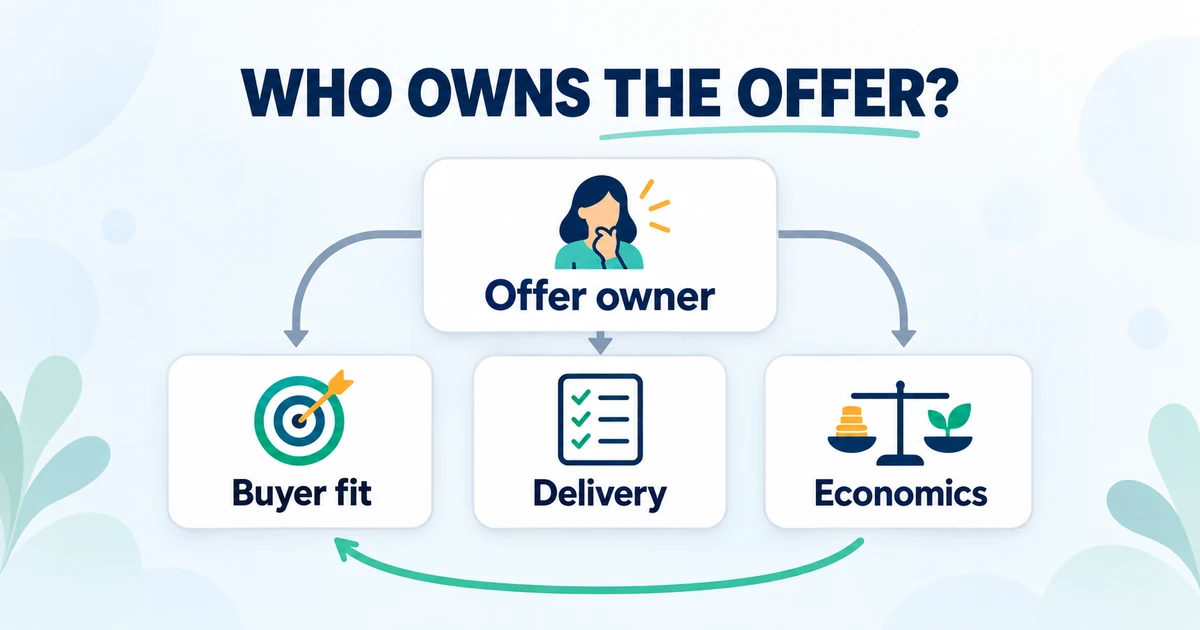
Sales wants a lower price. Delivery wants fewer promises. Marketing wants a clearer headline.
If you run an agency selling services to crypto projects, you can probably name who handles each request. But who decides what the offer itself should become?
A product owner in a service business takes responsibility for that decision: what you sell, why a suitable client should choose it, and how the team can deliver it sustainably. The role needs a shared definition of the offer, evidence from real work, and authority to make changes.
The founder can do this job. A service-line lead can do it. What matters is that improving the offer has an owner, instead of becoming whatever remains after the next proposal and client deadline.
A service list leaves product design with the buyer
“We provide marketing, community management, design, and development” describes a company's capabilities. It leaves the purchase largely undefined.
The project team still has to select the work, connect the pieces, identify dependencies, and decide what completion means. Before buying the service, the client has to help design it.
A useful offer removes some of that burden. It names the buyer situation, the problem, the scope, the starting conditions, and the result the provider can actually deliver. If that foundation is missing, use the lead-versus-offer diagnostic.
But a clearly described package is only a starting point. Calling it a “Web3 Growth Accelerator” adds a name. It does not explain why the buyer should prefer it to another provider, their own team, or postponing the work.
There are three different questions here:
- Clarity: Can the client understand the purchase?
- Relevance: Does it address a problem that matters to this client now?
- Preference: What makes this solution worth choosing over the alternatives?
The offer owner has to work on all three. Otherwise, the company can keep polishing its presentation while the reasons to buy remain unchanged.
Borrow Burger King's habit of designing the combination
In September 2024, Burger King announced three Million Dollar Whopper finalists: Fried Pickle Ranch, Maple Bourbon BBQ, and Mexican Street Corn. Each used a beef patty and bun, with different toppings and sauces.
For a service business, the useful analogy is the combination. Creating another reason to buy does not always require inventing a new professional capability.
Your marketer, designer, analyst, developer, partners, and established processes are the ingredients. The offer is how you assemble them around a particular buyer's problem.
The same team might prepare a product for its first acquisition campaign, adapt its onboarding for another language, or build a support process for business customers. Each requires its own scope, client inputs, delivery method, and completion criteria.
The analogy has a limit: a restaurant product launch does not prove that a service package will sell. It does suggest a useful management habit. Keep examining the combination you offer, rather than assuming your existing list of capabilities is the finished product.
Sometimes the better combination contains less work. Someone needs the authority to remove the unnecessary parts.
Make the offer easier to buy and deliver
Consider an illustrative offer for a crypto project with a functioning, user-facing product. The team wants to test user acquisition, but its landing page, campaign materials, and analytics are disconnected.
An offer concept might read:
Prepare a measurable acquisition campaign in four weeks.
We connect one landing page, three advertising hypotheses, materials for one agreed channel, and analytics for one agreed user action. The package includes launch support and two rounds of adjustments after launch.
Scope and price are fixed in the proposal. Media spend is separate. The four-week preparation period starts after the agreed access, materials, and approvals are available. Channel suitability is checked before commitment; launch timing depends on any required platform approval.
This is a hypothetical structure to test, not a client case or a promise of acquisition results.
It gives the buyer something more concrete than a marketer's presence in a chat. Yet several questions remain. Who fixes a mismatch between the landing page and analytics? How much time must the client contribute? What evidence shows the team can deliver? What happens when an approval arrives late?
Those questions belong in offer development. Adding ten more posts or another report may make the package bigger while leaving the difficult coordination with the client.
A community provider can apply the same idea. Instead of supplying moderators alone, it can define a knowledge base, escalation rules, coverage hours, and a route for questions that need the project team's expertise. The buyer can then see which recurring responsibilities the provider will take on.
A development company might specify supported networks and wallets, acceptance criteria, documentation, and a bug-fix period. Those boundaries can matter more to a particular buyer than a lower hourly rate.
Ask what the client will no longer need to organize themselves. Then check whether taking on that responsibility is something your team can deliver well.
The production method is part of the offer
Sometimes the desired offer is clear, but the company's current process makes it too expensive to provide. Better wording cannot resolve that constraint.
Consider a hypothetical calculation in US dollars:
| Version | Client price | Direct delivery cost | Amount left before other company expenses |
|---|---|---|---|
| Current process | $3,000 | $2,600 | $400 |
| Redesigned process | $2,700 | $1,500 | $1,200 |
The arithmetic is $3,000 minus $2,600, and $2,700 minus $1,500. These are illustrative inputs, not a pricing recommendation or forecast. The remaining amount still has to cover other business expenses, including the cost of developing the improved process.
The point is that a more attractive client price and healthier delivery economics can coexist if the production method changes enough. Whether that is feasible requires evidence from your own work.
Possible changes include standardizing intake, reusing components, limiting approval rounds, and separating custom requests from the core service. An owner should examine the cost and quality consequences before adding any of these to the promise.
Technology can help in either direction. If specialists repeatedly assemble the same report, an internal tool could handle that repeatable work and leave them more time for interpretation. But a dashboard that clients struggle to configure might become more useful as a managed service, with setup, data checks, and analysis included.
The choice depends on what work the buyer wants to keep and what responsibility they want to transfer. Automation is one possible production decision. It is not a substitute for deciding what the service should do.
What a product owner in a service business should own
The 2020 Scrum Guide gives the Product Owner accountability for the value of the product created through the Scrum Team's work. That is a useful reference for thinking about ownership beyond a task list.
A service company can apply the principle of accountable ownership without claiming to implement Scrum. The responsibilities below are a proposed operating arrangement for the service business, rather than rules from the framework.
| Responsibility | Main question | Typical decisions |
|---|---|---|
| Sales lead | How does this suitable buyer reach a decision? | Qualification, follow-up, proposal process, deal next step |
| Delivery lead | How do we fulfill the agreed commitment? | Work planning, capacity, quality, acceptance, issue resolution |
| Offer owner | What should this service become, and why? | Target situation, scope, client requirements, commercial terms, improvement priorities |
One person can hold more than one responsibility. Keeping the questions separate still helps. A sales conversation about this week's deal should not silently redefine the service for every future client.
The offer owner needs access to sales conversations, delivery problems, client feedback, and cost information. They also need agreed decision rights. Otherwise, their responsibility ends at the edge of the presentation deck.
For example, define which scope changes they can make, which price changes need founder approval, and how they agree production changes with delivery. They should not promise deadlines the team cannot meet or change an existing client's agreement unilaterally.
Their job is to bring buyer value and delivery constraints into the same decision. A title alone will not do that.
Give the owner a working record
Every active offer needs a shared description of what the company is selling. Add a record of what the owner is trying to improve and why.
Use this as a starting template:
Offer name and current version:
Accountable owner:
Target buyer and situation:
Problem the buyer wants resolved:
Result and acceptance criteria:
Included work and exclusions:
Client inputs and approval responsibilities:
Price, payment terms, and separate costs:
Delivery method, capacity, and direct-cost assumptions:
Evidence a buyer can inspect:
Closest alternatives, including internal delivery or postponement:

Next improvement decision:
Observation behind it and source:
What is known / what remains an assumption:
Proposed change and client benefit:
Expected delivery effect and cost to test:
Decision authority and approvals needed:
Test boundary and review date or trigger:
What would make us keep, revise, or stop the change:
Observed result and next decision:
The first half defines the current offer. The second prevents improvement work from becoming a collection of attractive ideas with no decision attached.
If the package fields are still blank, use the offer-first rewrite sprint to establish them. The owner's continuing job starts when that first version meets actual buyers and delivery conditions.
For a small company, this record can be a page the founder reviews with sales and delivery. It does not require a new department or a full-time hire. It does require protected time and somebody who can resolve a disagreement.
Improve the offer from evidence across the whole job
The U.S. Small Business Administration's market research and competitive analysis guidance connects learning about customers with examining their alternatives. Both activities matter when deciding what to change in an offer.
For each review, bring observations from three places:
- Before purchase: Why did suitable buyers proceed, delay, or decline? Which commitment or requirement needed another person's approval?
- During delivery: Where did the client have to coordinate the work again? What caused rework, waiting, or a disagreement about completion?
- After delivery: Did the buyer receive the agreed value? How much work did fulfillment require? Did the price cover that work on the assumptions used?
Suppose, in an illustrative campaign project, approvals kept arriving from different people. The next offer version could require one named client approver and a consolidated review at an agreed stage. The owner would then check whether this reduced conflicting instructions without hiding legitimate stakeholder needs.
That is an offer change with a reason to test it. “Improve onboarding” is still only a topic.
The objection “too expensive” needs similar care. It might mean the buyer lacks the budget, cannot see the value, distrusts delivery, or finds the initial commitment too large. A discount addresses only some of those possibilities. When the problem is how a stakeholder interprets the purchase, use the buyer-meaning approach to crypto service offers.
Avoid judging the next version only by the replies or meetings it generates. More conversations can arrive alongside more unsuitable requests. A larger contract can bring enough extra coordination to consume the apparent gain. A successful pilot may have no sensible continuation.
Keep the purchase, delivered value, and economics visible together. With only a few clients, treat observations as leads for investigation, not statistically proven improvements. Change something specific, record the result, and keep alternative explanations in view.
There is also a valid limit to standardization. If the client's problem is genuinely novel, a fixed implementation package may be premature. A paid discovery stage can define the uncertainty and establish the next scope. The offer owner's task is to decide where repeatability helps and where custom investigation is part of the value.
You can keep selling while doing this work. The requirement is a clear current version and an honest test, not a perfect product developed in isolation.
Test one version with a relevant project
Lead generation can help an offer owner learn before the package is finalized. It provides a way to find projects, investigate their situation, and test whether a specific problem is worth discussing.
LeadGenCrypto provides project records with websites, token addresses, blockchains, token names or symbols, and verified emails. Its Leads documentation explains the fields and the free plan's one contact every 24 hours.
A delivered contact does not establish need, budget, or permission to send a campaign. Check the current project website and business contact route, confirm relevance, and respect consent requirements and opt-outs. Keep suppression records and recheck stale contact data before outreach.
When you have one offer version worth testing, review a project on the Leads page and approach the team only if your research shows a relevant fit.
Keep improving what your agency sells
Get LeadGenCrypto article summaries, practical sales ideas, and resources for finding suitable crypto projects and improving your outreach.
Subscribe to LeadGenCrypto updatesAt your next offer review, put a person's name beside the current version. Give that person access to the evidence and authority to make the next decision. Then ask what the client will find easier, what delivery will do differently, and how you will know the change was useful.
That is when offer development becomes somebody's work.