How to Find Crypto Projects to Pitch: Vertical Proof Wedge

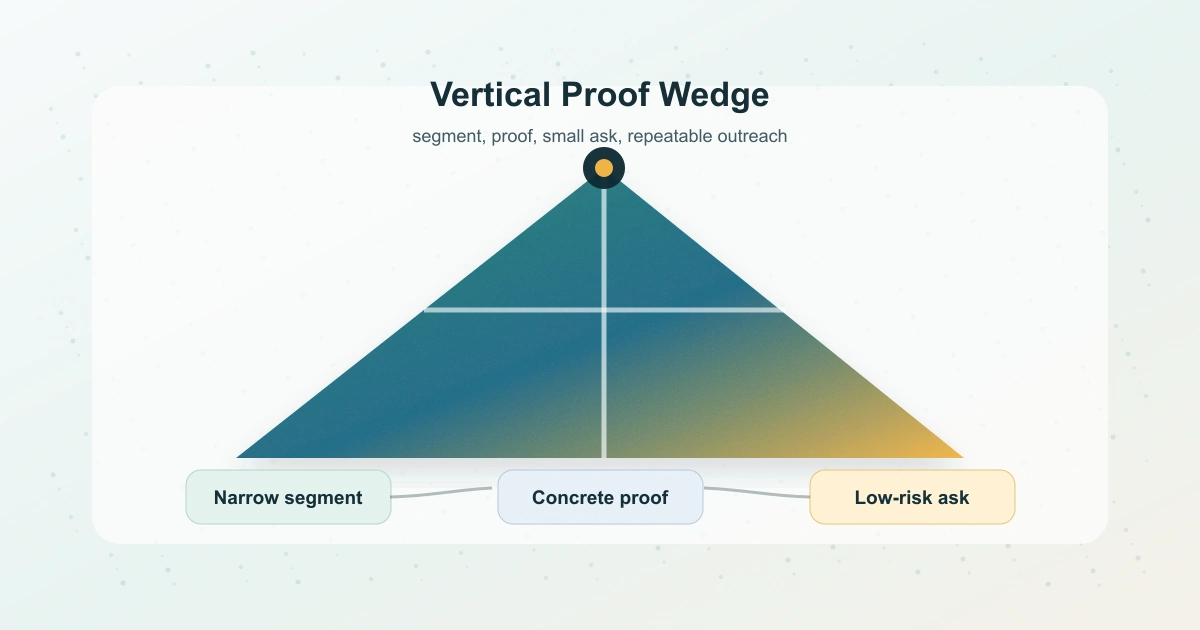
- A bigger list does not fix a vague agency pitch.
- Choose one narrow crypto segment before scaling outreach.
- Build one proof asset that makes the prospect feel understood.
- Use fresh project contacts after the wedge is clear.
- Keep the first ask small, useful, and easy to decline.
A cold crypto project does not need your full service menu.
It needs one fast reason to believe you understand its moment.
If you are trying to learn how to find crypto projects to pitch for agencies and service providers, the useful answer is not only "find more projects." It is: choose a narrow vertical, prove one relevant pattern, then use that proof to approach similar teams.
That mechanism is the Vertical Proof Wedge.
It helps agencies, consultants, auditors, PR teams, SEO providers, listing vendors, publishers, creators, and other B2B service sellers move from generic outreach to relevance-led outreach. The goal is not token promotion, investor acquisition, or price speculation. The goal is better B2B conversations with project teams that may need your service.
LeadGenCrypto is built for agencies and service providers who sell services to token-based crypto projects. It helps you find newly launched projects and reach them with verified contact data, not token buyers. If your wedge is already clear, you can get a free verified lead to test data quality before you scale a campaign.
The real mistake is selling capability instead of relevance
Broad service menus feel safe to the seller, but they feel vague to the buyer. When a token project sees your message for the first time, it is not evaluating your entire agency. It is asking one question: why are you relevant to us right now?
Most service providers answer with a capability list.
They say they do marketing, PR, SEO, content, ads, community, partnerships, listings, audits, market making, design, strategy, and growth.
That may be true.
It also sounds like every other vendor.
The problem is not the service. The problem is translation. A founder, BD lead, or growth manager has to map your broad offer to their launch window, listing push, security concern, SEO gap, or community problem. Most will not do that work for a cold sender. If you need a sharper translation layer, use the client meaning matrix for crypto service pitches before you scale the wedge.
If the first line does not create recognition, the rest of the pitch has to work too hard.
The three-second relevance test
A prospect does not need to believe that you can do everything. They need to believe three things:
- You understand their vertical.
- You have seen a similar problem before.
- The next step with you is low-risk.
That is the whole game.
A case study from a random IT company might be real, but a DeFi team may not know how it applies. A claim that you specialize in Web3 might sound good, but without proof it is just positioning language. Trust appears when vertical and proof meet.
Broad versus proof-led positioning
| Pitch type | What it says | What the prospect hears | Likely result |
|---|---|---|---|
| Broad capability pitch | We do B2B marketing, PR, SEO, and growth. | Another general agency. | Low recognition, low trust. |
| Niche claim without proof | We specialize in crypto projects. | Maybe, but where is the evidence? | Mild interest, weak confidence. |
| Case study without niche | We helped an IT company grow. | Good for them, but is this relevant to us? | Hard to apply. |
| Vertical proof pitch | We helped post-launch token projects solve this specific problem. | This sounds close to our situation. | Higher trust and lower perceived risk. |
Mini action: Before you build another list, write one sentence that explains why this exact type of project should trust you.
Use the Vertical Proof Wedge instead of a broad agency pitch
The Vertical Proof Wedge is a simple acquisition mechanism: choose one segment, prove one outcome, and use that proof to approach similar projects. You may still serve many kinds of clients later. You just should not lead with everything when trust is low.
Think of it as entering the market through a side door.
You do not need the whole crypto market to believe you. You need one narrow group to recognize itself in your message. Once you win there, the proof compounds. Then you can move to adjacent segments with a stronger story.
Paul Graham's Do Things That Don't Scale explains why manual customer recruitment, close observation, and high-touch early work often belong before automation.
The formula is:
We work with [narrow segment] that struggle with [specific problem].
We have already done [proof] for similar teams.
The next step is [small, low-risk ask].
Use that formula even if the proof is small at first. A focused teardown, pilot result, client quote, audit finding, or mini case study is better than a beautiful claim with no evidence.
A niche without proof is positioning theater
Many agencies say they specialize in crypto, Web3, blockchain, fintech, or token launches.
That is not enough.
The prospect has heard similar claims before. Some came from strong operators. Some came from vendors who barely understood the space. The prospect cannot tell the difference from the word "specialized" alone.
Useful proof examples:
- A short case study from a crypto PR campaign.
- A before-and-after positioning teardown for a token project.
- A list of Web3 teams you audited, with permission where needed.
- A measurable result from a small pilot.
- A public breakdown of a launch, listing, SEO gap, or community funnel.
- A process screenshot or checklist that shows you know the work.
Bad proof is vague.
Good proof is transferable.
A case study without a niche is hard to use
The opposite mistake is bringing proof from the wrong neighborhood.
A SaaS case study can still help. An ecommerce result can still show competence. But if you are trying to sell services to a token project, the prospect needs help translating the example.
Do not make them do that work.
Instead of saying:
We helped a B2B SaaS company increase organic traffic.
Say:
The same mechanism applies to Web3 infrastructure teams with education-heavy content: find technical pages that already get intent, improve trust signals, then route readers into partner or demo conversations.
That is still not as strong as a direct Web3 case study, but it is much better than dropping an unrelated logo into the pitch.
If you need the broader sourcing workflow after this positioning step, use the daily pipeline guide for finding crypto projects to pitch. The wedge should decide who belongs on the list before the list decides what you say.
Pick a vertical narrow enough to create recognition
"Crypto projects" is a market. It is not a wedge. A wedge is narrow enough that the prospect reads the first line and thinks, "This is about teams like ours."
A useful vertical has four traits:
- A repeated business pain.
- A visible buying trigger.
- A reachable contact role.
- A service you can actually deliver.
"Web3" is too broad.
"Newly launched token projects that need launch visibility and trust assets in the first month after launch" is much more useful.
It gives you timing. It gives you pain. It gives you a reason to reach out. It gives you a way to create proof.
Choose by buying trigger, not by industry label
A bad segment is only a category.
A good segment includes a moment when the company is more likely to care.
Examples:
- A token just launched and needs visibility.
- A project is preparing for exchange conversations.
- A Web3 infrastructure company is publishing technical education but not converting it.
- A DeFi project is approaching a security-sensitive integration.
- A crypto media buyer needs better partner targets after ad performance drops.
- A community team has activity but weak contributor quality.
This is why positioning and timing belong together. You are not just saying, "We serve crypto." You are saying, "We understand this moment in your lifecycle."
Vertical selection matrix
| Vertical wedge | Buying trigger | Proof needed | First offer | Best channel |
|---|---|---|---|---|
| New token projects | Recent launch or listing | Campaign result or public teardown | 3-point launch visibility audit | Email, Telegram, conference |
| Web3 fintech teams | Fundraising, launch, or expansion | Fintech or Web3 case study | Positioning and trust audit | Warm intro, LinkedIn, email |
| Crypto exchanges | Need listings, partners, or liquidity conversations | BD, listing, or partner proof | Target account list review | Conference, email, referrals |
| Audit-ready projects | Pre-launch, pre-listing, or integration window | Security, audit, or risk proof | Smart contract risk review | Email, ecosystem intros |
| Web3 SEO teams | Content push or link gap | Rankings, links, or pipeline proof | SEO opportunity audit | Email, LinkedIn |
| Crypto PR teams | Upcoming announcement or launch | Press, media, or campaign proof | Distribution gap review | Email, warm intros |
Do not choose the biggest market. Choose the market where you can create proof fastest.
If you need a deeper segmentation worksheet before choosing the first row, use the guide to build an ideal customer profile for crypto startups as a service provider.
Build the first proof asset before scaling outreach
If you do not have proof yet, your job is not to scale outbound. Your job is to create one believable proof asset. Cold volume before proof usually creates a worse problem: more people see a weak pitch.
This is where many service providers get impatient.
They want a database, an automation stack, and a sequence. Those things matter later. At the beginning, the better move is usually more manual: warm introductions, networking, small pilots, public teardowns, and focused audits.
That does not scale.
That is the point.
Early manual work teaches you what the market actually cares about.
Start with warm paths before cold volume
Warm paths can come from:
- Mutual introductions.
- Friends who work in crypto.
- Communities where founders and marketers already talk.
- Conference side events.
- Former clients who know Web3 teams.
- Public projects where you can create a teardown.
- Small pilots with low scope and clear measurement.
The goal is not to get rich from the first pilot. The goal is to learn the vertical and create proof.
A tiny but specific result can be enough:
- "We booked three qualified calls for a post-launch token team."
- "We found nine broken trust signals before a listing push."
- "We rebuilt one outreach sequence and improved reply quality."
- "We mapped the first 50 target projects for a niche Web3 vendor."
Specific beats large.
Use fresh project data after the wedge is clear
Once you know the vertical, data becomes powerful.
LeadGenCrypto delivers verified project contacts for newly launched token-based crypto projects. A lead can include website, token address, blockchain, token name or symbol, verified emails, and other information. Users can export contacts to CSV or pull leads through the Public API, including actions like viewRecentLeads and viewLatestLeads, to sync into CRMs.
Use that after you know what you are looking for.
If your wedge is "new BNB Chain token launches that need launch visibility," your list criteria are clear. If your wedge is "Web3 infrastructure teams with education-heavy content," your qualification rules are different.
This is where many agencies misuse data. They buy or export a list first, then try to figure out what to say. Flip the order.
First choose the wedge.
Then build the list.
Then write the pitch.
If contact quality is part of the bottleneck, review how to think about verified project contacts instead of static databases before increasing send volume.
What to document in the first proof asset
| Field | What to write | Why it matters |
|---|---|---|
| Segment | The exact type of project served | Shows relevance. |
| Trigger | Why the timing mattered | Explains urgency. |
| Starting problem | What was broken before you helped | Creates recognition. |
| Work delivered | What you actually did | Shows scope. |
| Timeframe | How long the work took | Reduces ambiguity. |
| Result | Measurable outcome or concrete learning | Creates proof. |
| Transferability | Why a similar project should care | Makes the case study reusable. |
| Limit | What the result does not prove | Builds trust. |
Your proof block does not need to be long.
Segment: Post-launch token projects on EVM chains.
Trigger: First 30 days after launch.
Problem: Public pages did not explain trust, utility, or next action clearly.
Work: Rewrote positioning, created a 3-point outreach angle, and mapped relevant partners.
Result: The team had clearer partner conversations and a reusable pitch asset.
Transferability: Similar post-launch teams face the same trust gap.
Limit: This does not prove token demand or investment potential.
Notice the last line.
In crypto, honesty matters. Do not imply that your service creates token demand, price movement, guaranteed rankings, guaranteed listings, or guaranteed growth unless you can support that claim.
Turn proof into a lower-risk pitch
The best outreach message is not the one that explains every service. It is the one that makes the next step feel safe. Proof changes the pitch from "trust us" to "we have seen this pattern before."
The prospect does not need your entire story in the first message.
They need enough relevance to keep reading.
They need enough proof to believe you might be useful.
They need a small next step that does not feel like a sales trap.
What a proof-led pitch must include
A proof-led pitch has four parts:
- Specific segment: who you help.
- Relevant trigger: why now.
- Proof: what you have already seen or done.
- Small ask: what the prospect can do with low effort.
That is it.
Do not start with your full origin story. Do not attach a giant deck. Do not ask for a 30-minute call before the prospect has a reason to care.
A good small ask could be:
- "Should I send the 3-point teardown?"
- "Worth sharing the list of gaps we saw?"
- "Should I send the short audit?"
- "Would this be useful for your growth or BD team?"
- "Is this the right person to send it to?"
Proof-led email template
Use this as a starting point. Keep it short and adapt the service category to your offer.
Subject: Quick idea for {{tokenSymbol}} on {{blockchain}}

Hi team at {{website}},

I noticed {{tokenName}} is live on {{blockchain}}. I pulled your token URL from {{tokenUrl}}.

We work with [service provider segment] helping newly launched token projects improve [specific business problem].

For similar projects, we usually find three gaps in [public pages, launch visibility, PR positioning, partner outreach, or community quality].

I can send a quick 3-point teardown based only on your public pages.

If this is not relevant, reply "no" and I will not follow up.

Thanks,
[Your Name]
The template works only if the proof behind it is real.
If you have no proof, use it for a teardown offer, not for exaggerated claims. If you do have proof, add one concrete line, but do not overstuff it.
Before you send, run the weak-vendor test
Ask these questions before scaling:
- Does the first line show a real reason for this exact project?
- Is the proof relevant to the same vertical?
- Is the claim honest and specific?
- Is the next step small?
- Is there a respectful opt-out?
- Would the message still make sense if the prospect removed your agency name?
- Does it avoid investment, price, and guaranteed growth language?
- Have you suppressed opt-outs, duplicates, and irrelevant contacts before sending?
If your answer is weak, fix the message before you send.
For more outreach QA, compare your draft against real inbox cold email teardowns by vendor category and run the pre-flight checklist before scaling cold outreach.
Use conferences as a vertical meeting engine
Conferences work best when they are not treated as random networking. They work when your vertical is already narrow and your meetings are prepared before you arrive.
Offline channels matter because crypto is trust-sensitive.
A cold email can start a conversation. A conference can compress trust. But the same rule still applies: if you walk in as a generalist, you are forgettable. If you walk in as the person who helps a specific kind of project solve a specific problem, people remember you.
For the event-specific version of this motion, use the crypto conference outreach workflow to turn participant access into segmented meeting asks before and after the event.
Pick events after you pick the segment
Do not choose events only because they are large.
Choose events because the right segment gathers there.
Examples:
- If you sell audit services, look for DeFi, infrastructure, bridge, and developer-heavy events.
- If you sell PR, look for launch-heavy, exchange, ecosystem, and marketing events.
- If you sell listings or BD services, look for events with founders, market makers, exchanges, and ecosystem funds.
- If you sell SEO or content, look for infrastructure, SaaS-like Web3, analytics, and wallet companies.
The narrower the event fit, the easier the outreach.
Instead of saying, "Are you attending the conference?" you can say, "We are speaking with post-launch teams preparing partner outreach after the event."
That is much more specific.
Conference workflow checklist
| Timing | Action | Output |
|---|---|---|
| 3 to 4 weeks before | Choose the vertical and offer | Clear meeting thesis |
| 2 to 3 weeks before | Build attendee and sponsor list | Qualified target list |
| 10 to 14 days before | Send relevance-first messages | Booked meetings |
| During the event | Qualify pain and capture notes | Next-step map |
| 1 to 3 days after | Follow up with proof and recap | Active pipeline |
| 1 to 2 weeks after | Move qualified accounts into CRM | Repeatable process |
Before the event, write one message that connects the event to your wedge:
Subject: Meeting during [event name]

Hi team,

We are meeting a few [vertical segment] teams at [event name] to compare what is working in [specific problem].

We recently documented the same issue across similar projects: [one short proof point].

If you are working on this after the event, I can share the 3-point teardown and compare notes for 15 minutes.

If this is not relevant, no worries.

Thanks,
[Your Name]
Keep conference outreach manual enough to stay relevant. Do not turn attendee lists into a spam batch. Capture opt-outs and do not follow up with people who asked not to be contacted.
Run one vertical long enough to learn, then expand
Narrow positioning is not a prison. It is a learning device. You are not choosing one market forever. You are choosing one market long enough to get real signal.
Many service providers panic too early.
They test crypto PR one week, Web3 SEO the next, auditors after that, then exchanges, then AI tools, then influencers. Each experiment is too short to teach anything.
The result is not diversification.
It is noise.
Give the wedge a real test window
Use a 30 to 60 day test window for one vertical.
During that window, keep the core variables stable:
- Same segment.
- Same trigger.
- Same proof asset.
- Same first offer.
- Same primary outreach channel.
- Same reply classification.
Then measure what happens.
You are looking for patterns:
- Which triggers create replies?
- Which titles respond?
- Which proof lines create trust?
- Which objections repeat?
- Which projects are not a fit?
- Which small ask gets the least friction?
A bad test is "we sent 200 emails and nobody bought."
A useful test is "post-launch teams replied to teardown offers, but pre-launch teams asked for pricing and then went quiet."
That is a signal.
Expand only when proof compounds
You can expand when the wedge shows evidence.
Signs you are ready:
- You have one reusable case study or proof block.
- Prospects repeat the same pain in their own words.
- Your first message gets relevant replies.
- Your service delivery process is repeatable.
- Your follow-up assets answer common objections.
- You can define the adjacent segment clearly.
Expansion should be adjacent, not random.
| First wedge | Adjacent expansion | Why it makes sense |
|---|---|---|
| Post-launch token PR | Web3 marketing teams | Same timing and visibility pain. |
| Web3 fintech positioning | DeFi infrastructure | Similar trust and explanation problem. |
| Audit-ready projects | Exchange listing teams | Same risk and readiness window. |
| Crypto SEO teams | Web3 link-building buyers | Same content and authority problem. |
| Conference BD for exchanges | Partner outreach for ecosystems | Similar meeting and qualification motion. |
If you want to connect this into a repeatable operating system, use the crypto project acquisition OS for agencies and providers and later sync token project contacts into your CRM once the wedge is working.
LeadGenCrypto Blog and Updates
Get sharper notes on crypto service positioning
Subscribe for short, practical emails on finding token projects, building proof-led outreach, and turning fresh project signals into better B2B conversations.
- Fast summaries of new LeadGenCrypto articles
- Useful resources for teams selling services to crypto projects
- Outreach and positioning ideas without hype
Copy-paste checklist: build your Vertical Proof Wedge
Use this checklist before you scale outreach, buy data, attend an event, or build CRM automation. It turns the article into an operating sequence.
Vertical Proof Wedge Checklist

1. Segment
[ ] I chose one narrow vertical.
[ ] The segment is recognizable to the prospect.
[ ] The segment has a repeated business pain.
[ ] The segment has a visible buying trigger.

2. Problem
[ ] I can describe the problem in the prospect's language.
[ ] I know why the problem matters now.
[ ] I can name the consequence of ignoring it.

3. Proof
[ ] I have one case study, pilot result, teardown, audit, or work sample.
[ ] The proof is relevant to the same segment.
[ ] The proof does not make exaggerated claims.
[ ] I can explain what the proof does not prove.

4. First offer
[ ] The first offer is small and low-risk.
[ ] The offer creates value before a sales call.
[ ] The offer is easy to say yes to.

5. List
[ ] I know which projects match the wedge.
[ ] I can find or verify contact data for those projects.
[ ] I can remove duplicates and suppress irrelevant contacts.

6. Message
[ ] The first line explains why this project is relevant.
[ ] The message includes segment, trigger, proof, and a small ask.
[ ] The message includes a respectful opt-out.
[ ] The message avoids token price, investment, and hype claims.

7. Follow-up
[ ] Each follow-up adds new context.
[ ] No follow-up says only "just checking in."
[ ] I stop when the prospect opts out.

8. Learning
[ ] Replies are tagged by objection and segment.
[ ] I run one vertical long enough to learn.
[ ] I expand only after proof compounds.
The checklist is intentionally simple.
If you cannot check the early boxes, do not compensate with more automation. Fix the wedge first.
If you can check the early boxes, then better data, CSV export, API pulls, and CRM workflows become much more useful.
Fit-based next step: If you already know the vertical you want to test, use one fresh verified project contact to check whether your wedge fits the real market before you scale. Start with the LeadGenCrypto leads workflow, then route only qualified contacts into your outreach stack.
FAQ
Should I hide the fact that I can serve other industries?
No. You do not need to pretend your agency can only serve one vertical. The point is to lead with the part of your experience that is most relevant to the prospect in front of you.
Broad capability can appear later in the sales process. Cold acquisition needs relevance first.
What if I do not have a crypto case study yet?
Start with warm introductions, small pilots, public teardowns, or low-scope audits. The first proof asset can be small if it is specific and honest.
You can also translate a non-crypto case study into a crypto-specific lesson, but make the limitation clear. Do not pretend the context is identical.
How narrow should my first vertical be?
Narrow enough that the prospect recognizes themselves immediately.
"Crypto companies" is usually too broad. "Newly launched token projects that need launch visibility and trust assets in the first 30 days" is much stronger.
Can I use LeadGenCrypto before I have a niche?
You can, but it is usually better to define the wedge first.
Fresh leads are more useful when you know which projects you want to reach, which trigger matters, and what proof you will use. Otherwise, a good data source can still produce a weak campaign.
How many case studies do I need before scaling outreach?
One strong proof asset can be enough for a small campaign.
More proof helps, but specificity matters more than quantity at the beginning. A clear pilot result in the same vertical can beat five unrelated logos.
Are conferences worth it for small service providers?
Yes, when the conference is tied to a narrow segment and meetings are booked before the event.
No, when the event is treated as random networking. The same Vertical Proof Wedge applies offline: segment, trigger, proof, small next step.
How do I avoid sounding spammy?
Be relevant, short, and honest.
Mention why you are reaching out, connect your proof to the prospect's situation, keep the ask small, and respect opt-outs. Avoid scraping personal emails, exaggerated results, token price language, and pressure tactics.
When should I broaden my positioning again?
Broaden after the first wedge creates repeatable learning.
You are ready when you have a proof asset, repeated replies from similar prospects, clear objections, and an adjacent vertical where the same mechanism likely applies.
What is the simplest next step?
Write this sentence:
We help [narrow crypto segment] solve [specific problem] during [trigger window], and we can prove it with [proof asset].
If that sentence is clear, build a small list and test it. If it is not clear, do not scale yet.