Crypto Outreach Triggers: 18 Angles for Service Providers

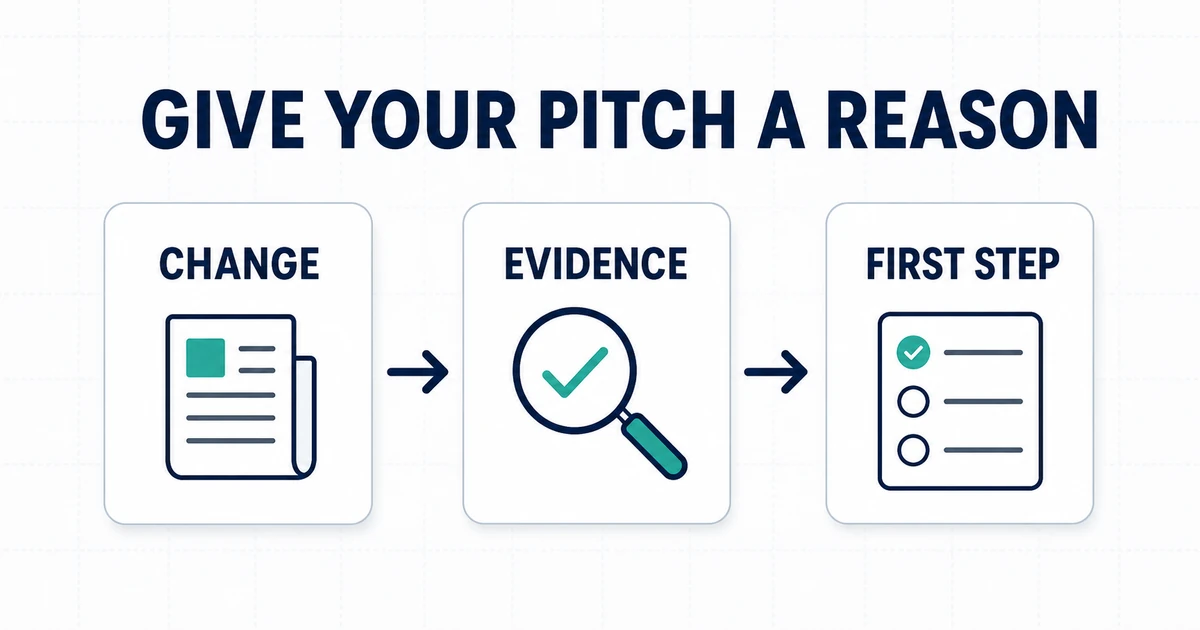
"gm, let's partner" leaves the hardest question unanswered: why should this team discuss your service now?
If you sell services to crypto projects, you have probably rewritten that greeting, added the token name, and mentioned a recent announcement. The message can still leave the recipient doing all the work of connecting your offer to their situation.
Useful crypto outreach triggers connect a public change to a task worth checking. Start with the change, verify its consequences, and prepare one small piece of useful work.
- Look for a specific project change that could make your service relevant now.
- Check a second source before treating that change as a reason to pitch.
- Prepare one bounded artifact, such as a comparison, checklist, or short demonstration.
- Keep observations separate from assumptions about need, budget, timing, and buying intent.
- Use the provider examples below to choose what to investigate and when to hold.
The difference can be small. "You launched a new interface" is an observation. "Your getting-started guide still shows the old interface, and I drafted the three screens to update" gives a content team something it can inspect.
That example is hypothetical. The research comes before the claim, including checking whether a newer guide already exists.
If you are still deciding which offer fits which project stage, start with the service positioning and lifecycle guide. Here, the job is narrower: find a defensible reason for one particular conversation.
What makes an outreach trigger worth using?
A project event becomes useful when you can explain what it changes for your service. A launch, release, migration, or public request is the beginning of that investigation.
Ask three questions:
- What changed, and where can the team verify it?
- What task might that change create, and what evidence suggests it is still open?
- What small deliverable can you prepare within your expertise?
Security reviews provide a concrete example of bounded work. In its Across Protocol differential audit, OpenZeppelin identifies the reviewed commit, the base commit, and the changes in scope. That is a real example of reviewing a defined change. It does not establish that another project's new release needs your services.
The outreach question is more modest: has the relevant change already been reviewed, and can the team confirm the scope?
A public update does not establish budget, permission to contact someone, or a desire to change suppliers. Record what you observed separately from what you think it might mean. If the second part cannot be supported, keep researching or hold the pitch.
Before opening your email editor, make that distinction visible in a research card.
Build a research card before writing the pitch
Your research should be easy to check and easy to discard when it is wrong. A simple note or spreadsheet is enough for the first project.
| Field | What to record | Example to investigate |
|---|---|---|
| Public change | Source URL, publication date, and date checked | A release note announces a new interface |
| Corroborating source | The current document, process, or user journey affected | The official setup guide still shows an older screen |
| Task hypothesis | One possible consequence, clearly labeled as an inference | New users may struggle to follow that step |
| First useful artifact | A deliverable small enough to inspect quickly | An annotated replacement for that part of the guide |
| Open question | What would change your interpretation? | Has a replacement guide already been published elsewhere? |
| Hold condition | A reason to stop or postpone outreach | Updated instructions already solve the issue |
Use the same card to compare prospects. A dramatic announcement with no service connection can be less useful than a modest update with a clear documentation gap.
Manual research works well while you are learning which signals matter. Saved searches, release feeds, or AI summaries can later help collect candidates. A person still needs to open the sources, check the current state, and approve the interpretation. Automating discovery does not establish demand.
Pick one category below and fill the card for a project you can research legitimately.
18 crypto outreach triggers, matched to your service
Choose the example that fits work you can actually deliver. These are research prompts and illustrative messages, not customer stories or claims that the work has already been done. Adapt a message only after completing the observation and artifact it describes.
1. Marketing and media agencies: check what happens after rewards end
The start of a giveaway is obvious. The period after it ends may pose a more useful question: what activity continues when the incentive stops?
Where participation and later product actions are publicly observable, define the cohort, action, and observation window. Count addresses as addresses, and avoid connecting them to personal identities. Multiple wallets can belong to one person; an address can also represent shared or automated activity.
A first deliverable could be an aggregate activity note with its method and limitations.
We compared public campaign participation with a defined product action after the reward period. The note explains what we could measure and what we could not. Would a small retention experiment be relevant to your current plans?
Without defensible data, use another signal. For community management, collect recurring product questions and draft a pinned guide. For conference services, compare publicly listed participating companies with the project's stated integration goals, then propose focused discussion topics. Confirm interest before promising introductions or attendance.
Choose the campaign format after identifying the task.
2. Listing and launch platforms: document a specific access obstacle
Look for public support questions about supported networks, deposits, withdrawals, or claim flows. Check the official route and current restrictions before offering listing support.
The useful artifact is a requirements map: which step is difficult, which platform controls it, and what would need to change.
Your support thread points to confusion about the supported network. We compared the official instructions with the current route and drafted the questions to resolve with the platform. Is this already being addressed?
For a planned token migration or points-to-token transition, prepare an issuance, distribution, and claiming checklist for an agreed test environment. Establish scope and dependencies before proposing implementation.
Verify exchange representatives through official channels. Never sell guaranteed listing approval, funding, or token performance.
3. Treasury operations providers: begin with a published operating requirement
A public budget or supplier-selection discussion can reveal an operational question. A wallet movement by itself cannot establish the team's financial position.
For treasury tooling or an over-the-counter (OTC) service, identify what the team explicitly wants to evaluate. A useful first step is a requirements sheet covering approvals, counterparties, settlement constraints, and questions for the responsible professionals.
Your public budget discussion raises questions about how project expenses will be paid. We drafted an approval and settlement checklist for the scenario described. Would the treasury team find that useful while comparing providers?
Keep the conversation within the team's stated mandate. Do not recommend selling assets or frame the project as distressed. Any regulated service needs appropriate authorization and professional review.
4. Guest post publishers: update a guide readers already use
Find a product change that makes an existing guide incomplete. If you own the publication, use your actual article analytics to assess relevance. Do not substitute site-wide traffic for readership of that page.
Your first artifact can be an update outline with the obsolete sections identified.
Our guide still shows your previous interface. We have marked the sections that need updating and drafted a new usage example. Would a clearly labeled sponsored update fit your documentation plans?
Agree on editorial accuracy, disclosure, and the practical task the guide helps readers complete. A placement has to earn its place in the publication.
5. YouTube creators: demonstrate the confusing part
Walk through an allowed product demo and compare it with public questions about a recent feature. The gap may be a step that existing videos skip or still show incorrectly.
Record a short draft of that step, including anything you could not verify.
The recent update changes the setup journey, while the tutorials I found still show the previous version. I drafted a walkthrough of the changed step. Would a sponsored demonstration be useful for your users?
A paid integration in a broader video should demonstrate a relevant task. Label the relationship clearly and follow YouTube's paid-promotion disclosure requirements, along with applicable local requirements. Do not present sponsorship as an independent recommendation.
6. Payments, banking, and card providers: map the route that stops short
A new market or payout feature can expose a gap between receiving funds and using them. Check the specific country, payment method, asset, network, fees, and eligibility rules in the provider's current documentation.
Prepare a flow comparison and a list of conditions to confirm.
Your announced market expansion changes the payment methods users may need. We mapped the documented route and marked the support questions still to confirm. Would a short integration review help before launch?
For a card program, start with a stated spending use case and supported countries. Keep costs, restrictions, custody, and implementation effort visible. Do not promise universal banking access or describe an unverified route as available.
7. Security and bug bounty providers: clarify the scope after a release
Compare a new component with the complete published bug bounty rules. Check permitted testing, exclusions, impact categories, and the reporting channel.
If coverage is unclear, prepare questions or a draft clarification.
The new release adds a component whose testing status was unclear to us in the published bounty rules. We collected the relevant scope questions. Has the program already been updated to cover this change?
A separate assessment requires agreed boundaries and an appropriate environment. Missing public information does not prove missing security work. Follow the authorized disclosure process for any finding; never condition delivery of a report on buying your service.
8. News and specialist blogs: revisit a promise that became usable
Keep a short list of announced capabilities relevant to your publication. Revisit them when documentation and an accessible demonstration make a practical story possible.
A useful first deliverable is a story outline showing what changed, what can be demonstrated, and which limitations need the team's comment.
Your earlier announcement described this capability. The current documentation now shows how to use it. We propose a clearly labeled sponsored feature that demonstrates the workflow and its limitations. Could your product team verify the outline?
Verify the result before describing it as working. For independent editorial coverage, preserve editorial independence and distinguish it from paid placement.
9. Market makers and liquidity platforms: define the execution question
Headline trading volume does not tell a project how a particular order would execute. A provider can prepare an order-book assessment around explicitly chosen example sizes, such as $500, $2,000, and $5,000, in both directions.
These are illustrative test sizes, not recommended trades. Report timestamps, available depth, spread, fees, and calculation assumptions. A snapshot estimate is not a future execution quote.
We prepared a timestamped depth assessment for several illustrative order sizes in both directions. It shows the method and the limits of the snapshot. Would you like to discuss the market-quality requirements you are evaluating?
For software or bots, offer a simulation with limits and failure conditions. Exclude wash trading, fabricated volume, price support promises, and performance guarantees.
10. Blockchain development and DevOps teams: help define an unresolved task
A public technical discussion can expose an open implementation choice before a request for proposals is finalized. Read the thread and its status; do not assume no contractor exists.
Prepare two plausible approaches with dependencies, tradeoffs, and questions. For an announced release, a website, contract, API, and monitoring checklist may be enough to start.
The implementation discussion leaves a dependency question open. We drafted two options and the assumptions behind each. Would this be useful while you finalize the requirements?
If the evidence comes from repositories, use the GitHub qualification workflow to check context and disqualify weak signals. Keep the proposed first engagement bounded, with an agreed test scenario and rollback plan where relevant.
11. L1 and L2 networks: propose one integration worth testing
Layer 1 (L1) networks and Layer 2 (L2) scaling networks need a project-specific use case for an ecosystem pitch.
Compare the project's roadmap with a relevant product in your ecosystem. Confirm that a proposed partner is interested before presenting it as an introduction.
Your roadmap includes a use case that may fit a product in our ecosystem. With the prospective partner's agreement, we can outline a limited integration test. The first discussion would cover compatibility, fees, and operating constraints.
A pilot can test one capability without requiring a full migration. Clarify bridge, liquidity, security, and maintenance dependencies before discussing incentives.
12. Wallet providers: count the steps before the first useful action
Try an authorized demonstration journey: open the product, create or connect a wallet, choose a network, arrange transaction fees, and complete an action.
Document where the journey stalls. A prototype can explore embedded wallets or sponsored transaction fees, subject to the chosen provider's support and costs.
We mapped the preparatory steps before the first product action and drafted an alternative onboarding flow. Would your product team review a limited test, including recovery, transaction-fee costs, and spending caps?
Sponsored fees still need a funding and abuse-control model. For custodial operations, a better starting point may be payout approvals, role separation, or access recovery. Establish the operating model before pitching an SDK, or software development kit.
13. Analytics, trackers, and voting platforms: resolve conflicting records
After a migration or new release, compare the project's official references with tracker listings and public dashboards. Confirm which network and version each source describes before calling it a discrepancy.
Your first artifact can be a table of conflicting records with source links and questions.
The official migration notice and a tracker entry appear to reference different versions. We prepared a comparison for verification. Could the team confirm the intended source of truth before any corrections are requested?
For voting platforms, scope a pilot around measurable activity after a vote, with appropriate tracking permissions. Do not imply that votes prove purchases or that you can establish attribution without the necessary data.
14. SEO and link building providers: repair an existing path
Look for relevant mentions without links, broken references after a domain change, or integration documentation missing a useful destination.
A short list of verified mentions and suggested destinations gives the team something concrete to assess. Another useful offer is consolidating scattered public information into a reference page with a method, sources, and an update owner.
We found existing mentions that point to an old page and checked their intended destinations. Here is the repair list. Would you like help coordinating those corrections with the publishers?
Measure relevant traffic and useful actions. Avoid promises built around a domain-authority score. If a placement is paid, Google's guidance prefers the sponsored link attribute; nofollow is also accepted. Do not sell paid links as independent editorial endorsements.
15. Smart contract auditors: compare the released version with the report
The absence of an audit is only one possible research prompt. An existing report plus a later release gives you a more specific comparison to investigate.
Identify the report's version and scope. Compare the new code within your expertise, and check for follow-up reports before assuming a review gap.
The published report describes an earlier version. We isolated the subsequent changes relevant to the withdrawal flow and checked the reports we could find. Has this change already had an additional review?
You can also offer a limited review of remediation status when the public record is unclear. Sell an assessment with a defined version, boundaries, and reporting process. Avoid declaring vulnerabilities from a code difference or offering a "100% safe" badge.
16. KYC and AML providers: test the changed process
Know your customer (KYC) and anti-money laundering (AML) work needs a specific operating context. A new customer type, payout flow, or market is a reason to clarify requirements with the project's compliance team.
Draft the questions and propose a test using synthetic data.
Your planned payout flow changes the scenarios the verification process needs to handle. We drafted a test plan covering supported documents, retries, and manual exceptions. Could your compliance team confirm the requirements before we scope a pilot?
Keep identity checks and transaction-monitoring requirements distinct in that review. Do not sell either as a complete compliance solution or promise to remove necessary checks to improve conversion.
17. Legal and licensing providers: start with a product-document mismatch
A new feature can make existing terms or product descriptions worth reviewing. Record the apparent mismatch and the questions it raises, without declaring a breach or a licensing requirement.
The new feature appears to add a user flow that the published terms do not describe. We prepared the passages and questions for review. Would a scoped assessment of the affected documents be useful?
For a planned market entry or business partnership, offer to organize the entity, product, roles, and flow-of-funds questions for the relevant advisers. Jurisdiction, activities, and asset characteristics matter. These examples are general service-scoping information, not legal advice.
18. Other providers: inspect a workaround the team already uses
A manual workaround can reveal an integration task more clearly than a broad infrastructure pitch.
| Provider | Public signal to verify | Small first deliverable |
|---|---|---|
| Bridge | Instructions require several cross-network steps | Route comparison with fees, assumptions, and risks |
| Hosting or API vendor | A documented dependency faces an announced change | Compatibility checklist and test-environment migration outline |
| Bot or automation team | A public recurring process repeats the same manual summary | Demonstration using public or synthetic data |
| Tokenization provider | A stated use case leaves lifecycle questions unresolved | Model covering issuance, transfer restrictions, rights, and redemption |
| Marketplace | An announced partnership lacks a published offering | Draft catalog for a limited, partner-approved test |
Confirm that the workaround is still used and that your alternative solves the relevant task. A demonstration should be assessable without production account access, private data, or a wallet connection.
The common thread across these categories is a first useful step that fits a verified situation. Now put a limit on how much you prepare.
Keep the first useful step small
Prepare enough work to make a conversation concrete. Scope implementation separately. An annotated screen, a short comparison, or a list of questions can establish what you mean without becoming a free engagement.
Set a research limit that fits the likely engagement value. There is no universal number of minutes. Stop when the next answer would require private access, specialist testing, or substantial implementation.
If evidence is missing, say what you could not confirm. If the team already solved the problem, retire the angle. If a proposed partner has not agreed to talk, leave the introduction out.
Before sending, compare your wording with the real vendor-email teardown examples. A useful finding can still be buried under a service menu or an oversized meeting request.
Use an appropriate business contact and confirm the project's identity through official sources. Check applicable outreach and consent requirements, validate contact data, authenticate your sending domain, and honor opt-outs and suppression records. A public address is not blanket permission. Review the B2B outreach compliance guide before scaling. Never request seed phrases, use private personal data to personalize a pitch, or conduct unauthorized security tests.
A credible first message can leave room for the answer "already handled."
Check the evidence, then send or hold
Send only when you can stand behind the observation and the work you claim to have done. Use this checklist before adapting any example above.
[ ] The project and business contact are verified through official sources.
[ ] I recorded the public change, source URL, and date checked.
[ ] I checked a second source and looked for a newer update or existing fix.
[ ] I separated the observable fact from my task hypothesis.
[ ] The proposed task fits work I can credibly deliver.
[ ] The small artifact actually exists and is safe to share.
[ ] The message makes no assumption about budget or buying intent.
[ ] Outreach requirements, contact quality, and suppression records are checked.
[ ] The request is small and the recipient can easily decline.
[ ] I have a hold condition and will retire a disproven angle.
For a documentation gap that you have verified and prepared work for, a first email could look like this:
Subject: A question about the updated setup guide

Hi team,

Your release notes describe a changed setup flow. The official guide I checked still shows the earlier screen.

I drafted an annotated update for that step, with the sources and date checked. Have you already replaced that guide, or would it help if I sent the draft?

If this is not relevant, let me know and I will not follow up.
Keep the sources in the artifact, make it easy to inspect, and avoid attachments or access requests that create unnecessary friction in the first contact.
If you sell services to token projects and need a repeatable source of project contacts, review LeadGenCrypto's contact fields and CSV workflow, then apply the research card to one project before writing. Contact data gives you a starting point; you still need to establish relevance.
Find a better reason for your next pitch
Get LeadGenCrypto updates, short article summaries, and practical resources for turning project changes into useful service conversations.
Expect outreach ideas, research checklists, and sales advice for providers working with crypto teams.
FAQ
What is a crypto outreach trigger?
It is an observable project change that gives you a reason to investigate whether a specific service is relevant. Pair it with corroborating evidence and a small proposed next step. The trigger alone does not prove demand.
Does a token launch prove buying intent?
No. It describes an event. Check which task remains open, whether you can help, and whether the team wants outside support. A launch can be irrelevant to your offer.
How much work should I do before contacting a project?
Enough to support one useful observation and make a small deliverable inspectable. Set a limit based on the prospective engagement. Move work requiring private access, professional assessment, or implementation into an agreed scope.
Can AI research these triggers?
AI can organize public information and suggest comparisons. Check the original sources, dates, identities, and conclusions yourself. Do not let a generated summary claim you tested a feature, found a vulnerability, or confirmed a partner's interest.
What if the task is already solved?
Thank the team for clarifying, update your notes, and retire the pitch. Do not repackage the same disproven assumption as another follow-up. A useful research process should prevent irrelevant outreach too.
How do I find the right project contact?
Use the project's official business channels or a documented project-contact source. Confirm identity, role relevance, contact quality, and applicable outreach requirements. Keep opt-outs and project-level suppression available before sending.