Crypto Project RFPs: A Guide for Service Providers
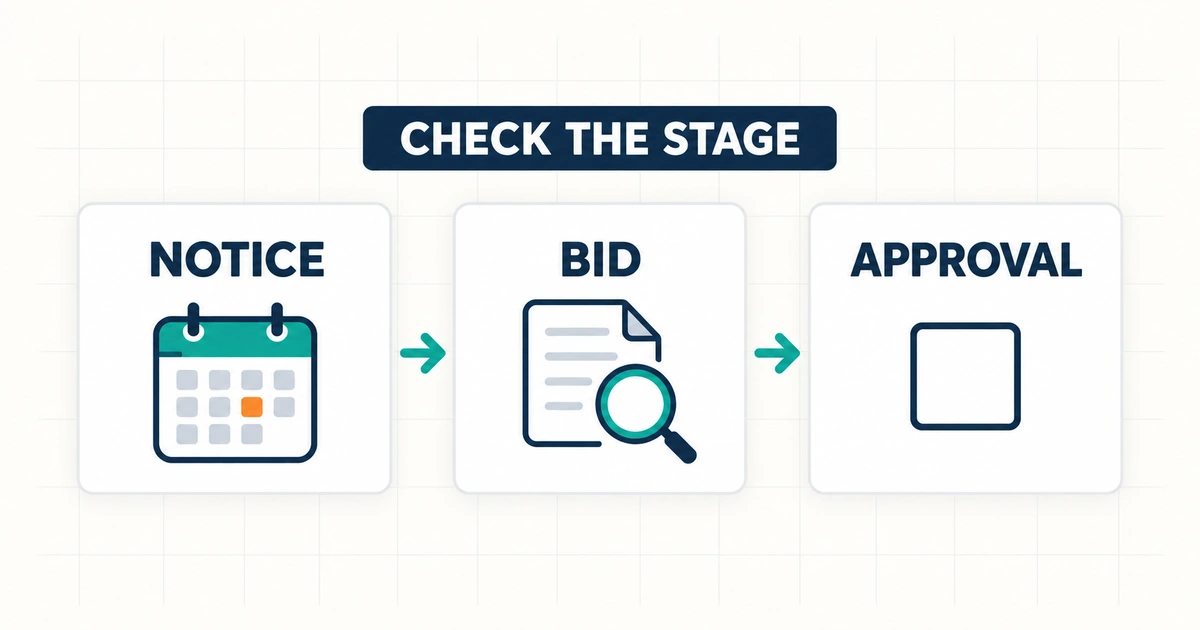
A convincing title can hide an expired deadline. A public budget discussion can still be waiting for approval. Admission to a supplier panel can leave another sales process ahead of you.
For a small analytics provider, crypto project RFPs are worth investigating because they describe work a potential buyer wants suppliers to propose. RFP means request for proposal: an invitation to submit an offer for specified work.
Before writing that offer, establish what the process is actually selecting. Then check eligibility, delivery capacity and bid effort. The tracker and annotated proposal below follow one fictional analytics engagement through those decisions, including what must happen before work starts.
For the broader sourcing process around this channel, see the guide to building a pipeline of crypto projects to pitch.
Where to find crypto project RFPs
Start with the organizations you can serve and follow their official purchasing routes.
Choose a small group of token projects or ecosystems where your team has relevant expertise. An analytics provider might investigate reporting requests. An events agency might look for conference production. An infrastructure firm might monitor requests for node or data services.
For each project, identify three places:
- Its official website or foundation website. Look for procurement, vendor, ecosystem, or governance links.
- Its governance forum. Search the relevant categories and read pinned process instructions.
- Its published procurement route. This may be a dedicated page, application form, or supplier-program notice linked from an official source.
A DAO is a decentralized autonomous organization. For this sales workflow, the practical question is who requests, evaluates, approves, and pays for the work. Those roles need to be established for the particular opportunity.
Search for the service as well as the procurement language
Try searches such as:
site:forum.arbitrum.foundation "request for proposal"
site:gov.uniswap.org "RFP"
"DAO" "request for proposal" "analytics"
"DAO" "procurement" "events"
"crypto" "service provider" "tender"
Also search the project's own forum for terms such as supplier panel, reporting, research, infrastructure, and your specific deliverable.
Use search results to locate the original notice. Then follow the project-controlled links to the current instructions. Record the notice URL and when you checked it.
A historical example beyond technical audits
Arbitrum's March 2025 events procurement toolkit describes how organizers could request and evaluate event services. It addresses provider experience, event concepts, operational capability, marketing, reporting, and pricing.
The toolkit is guidance for organizers, rather than an open invitation to bid. Its value to a provider is showing the kinds of work and evidence a procurement process can involve.
Begin manually, then automate collection
For your first few opportunities, read the notices yourself. You need to learn which terms signal work that fits your business and which pages merely discuss it.
Once that pattern is clear, use saved searches, available forum notifications, or an approved collection workflow to find candidates. An AI assistant can extract dates and requirements into a draft record. Have a person check those fields against the source, especially amendments and closing notices.
Where you also use contact data, keep it attached to the project record. The RFP's own instructions determine the submission route.
Your first task: choose three relevant organizations and save their official procurement or governance entry points.
Establish what the project is actually inviting
Give every opportunity a status before giving it a proposal.
The phrase “we need analytics” can appear in several different contexts. Each requires a different response.
| What you find | What to establish | Appropriate next action |
|---|---|---|
| Open RFP or tender | Applications are accepted, with current instructions and a deadline | Check eligibility and prepare a bid decision |
| Early discussion or request for comments | The project is exploring a need or approach | Contribute relevant information through the permitted discussion |
| Grant application | Applicants propose activities under a funding program's rules | Assess the grant route separately from service procurement |
| Provider renewal | An existing engagement is being reconsidered | Check whether competing proposals are invited |
| Supplier-panel application | The process selects eligible providers for later purchases | Evaluate panel admission and the subsequent sales process |
| Closed, awarded, cancelled, or archived process | The recorded stage is final or no longer accepting bids | Record the outcome and investigate only an explicitly announced next round |
A process may invite bids while funding or governance approval remains pending. Record that dependency. You can decide whether a conditional opportunity is worth bidding for without pretending its spending is already authorized.
Check dates in the notice and its updates
Arbitrum's January 2025 remote procedure call (RPC) panel RFP closed on February 21, 2025, at 17:00 UTC. An official February 24 update confirmed closure. A participant comment followed in February 2026.
The newer comment did not announce a reopened round. Read the original deadline, subsequent instructions, and the author's authority together.
Also distinguish a question deadline from a submission deadline. If the question window has closed, a material uncertainty may remain unresolved when you have to decide whether to bid.
A simple status note is enough:
Current stage:
Official notice and version:
Submission deadline and stated time zone:
Questions deadline:
Latest authorized update:
Funding or approval still required:
Last checked:
A published budget may help explain the context. Verify what portion, if any, is available for the proposed engagement. For earlier-stage signals, the guide to connecting public project changes to a service need provides a separate research process.
Decide whether the bid deserves your time
Before drafting, review the opportunity with the person who would deliver the work. A salesperson may see an attractive budget while an engineer sees an unsupported integration or an impossible deadline.
1. Can you meet the mandatory requirements?
Read the actual conditions for legal entity, location, qualifications, references, insurance, conflicts, subcontracting, and technical capability where these are specified.
Separate a requirement you cannot meet from one whose meaning is unclear. Ask about the unclear condition through the permitted channel. Describe a genuine exception openly if the process allows exceptions.
A strong portfolio cannot compensate for failing a mandatory condition that the buyer will not waive.
2. Does the requested outcome fit your service?
Write the main deliverable in one sentence.
For example: “Produce a report for a fixed 90-day period across the ten contracts specified by the buyer.”
If your team sells community moderation, an analytics RFP may be a poor fit even when the same DAO could eventually need moderation. Keep the bid tied to the work being purchased.
3. Can you supply relevant evidence?
List what a reviewer can inspect: a permitted case study, a public work sample, a methodology, an example report, or the experience of the people assigned.
A newly formed agency may have relevant individual experience. Explain whose work it was and what they did. Label demonstrations as demonstrations.
If the RFP requires completed client engagements that you cannot substantiate, resolve that eligibility question before writing a persuasive introduction.
4. Can you deliver under the proposed conditions?
Check staff availability, access to data, dependencies, review time, and ongoing support.
A four-week build depends on when the necessary inputs arrive. Record what the buyer must provide and when. If the proposed start depends on approval, your staffing plan needs to reflect that uncertainty.
5. Is the opportunity worth the application effort?
Estimate the time needed to prepare the bid and the direct cost of delivery. Include specialist reviews, demonstrations, vendor onboarding, and any travel.
Set a bid-effort limit before the work expands. A proposal requiring substantial custom research deserves a more deliberate decision than a short response using existing evidence.
Use three outcomes:
- Bid: the mandatory conditions are met, the delivery plan is credible, and the effort is justified.
- Clarify or hold: a specific answer or approval could change the decision. Record who can resolve it and by when.
- No bid: a mandatory condition fails, the economics do not work, or the team cannot responsibly deliver.
Write down the reason. It will be more useful at the next review than a vague label such as “interesting DAO.”
Work through one bid decision
Fictional example: a two-person analytics firm finds an open notice from Example DAO. Every organization, requirement, date, clarification and amount in this example is invented for teaching. It is not an available RFP or a record of a successful bid.
The notice requests a four-week reporting package for ten named contracts on one Ethereum Virtual Machine (EVM) blockchain. The fee ceiling is 7,500 USDC. It accepts a public-data demonstration as evidence, so this fictional firm does not need to invent client references.
The analyst and reviewer can cover the delivery window. They already have the tools for the proposed report. But the brief leaves the historical-data access and final approval route unclear.
Their first decision is Clarify or hold. They record:
Service fit: ten-contract historical reporting package.
Eligibility: stated conditions met; demonstration evidence accepted.
Delivery: four weeks after agreed start conditions, not from bid submission.
Unresolved: history window, data access and final approval route.
Internal owner: analytics founder.
Bid-effort limit: eight hours, including technical and commercial review.
Next action: submit material questions before the questions deadline.
The eight-hour limit is a choice for this example, not a recommended industry allowance. It covers one hour reading the process, one hour preparing questions, three hours adapting existing proof, two hours writing the response and one hour checking it. If the buyer asks for a substantial custom dashboard before selection, the founder must revisit that limit.
Now suppose the organizer publishes a clarification: the dataset covers a fixed 90-day period, the buyer supplies the agreed historical-data access, and a successful evaluation still needs a named committee's spending approval before contracting. The founder checks the scope against the firm's delivery estimate and confirms the proposed fee covers the planned work.
The decision becomes Bid, with approval recorded as a condition before kickoff. If the data access remains unresolved, or the buyer insists on completion four weeks from submission regardless of approval timing, the firm stays on hold or declines. A clarification matters when it changes the offer or the decision to prepare one.
Write a response the evaluator can assess
Organize the response around the buyer's criteria and make each answer complete.
A procurement reviewer needs to compare proposals. Help them locate your scope, evidence, responsibilities, and price in the places the instructions specify.
That historical Arbitrum RFP required an evaluation-table PDF through its form and a public version with confidential material removed. Optional attachments could not replace required answers.
Connect each requirement to a deliverable and proof
For every important criterion, answer four questions:
Requirement:
Our proposed delivery:
Evidence the buyer can inspect:
How completion will be checked:
If the criterion concerns reporting quality, describe the report's contents, source definitions, update process, and limitations. Point to a real sample. Explain how the buyer would check the finished work.
If it concerns execution capacity, name the actual roles and availability. Avoid listing impressive partners who have not agreed to participate.
Keep claims within your control. An events agency can describe its production plan and measurement method. It cannot guarantee the number of commercial partnerships attendees will form.
Ask questions that could change the offer
Use the published clarification route. Ask before the question deadline and expect that a process may share clarifications with other applicants.
For Example DAO, the data question could read:
Subject: Clarification on the analytics reporting scope

The brief requests historical reporting across the selected contracts.

Please confirm the required history window and whether the buyer will
provide access to the specified data source.

These inputs affect implementation time and any third-party data costs.
We will use the published clarification when preparing our scope and fee.
A separate question should establish the remaining approval route. A question about data history could change the price. A generic request to “tell us more about your vision” creates additional work without resolving the bid.
State commercial conditions where they affect delivery
Show the fee, pricing currency, payment milestones, included costs, review periods, and exclusions. Identify taxes or third-party expenses that require clarification.
Separate the date you submit a proposal from the date you can start work. Record any remaining contract, funding, access, or payment conditions.
Where a public response is required, prepare an appropriate public version and use the designated private route for permitted confidential material. Obtain permission before including customer names or private results.
AI can help organize requirements or check wording when your information-handling rules permit. Verify the source, every claim, fee, attachment and commitment yourself. Do not put confidential bid material into an unapproved tool.
Before submission: ask a colleague to find your answer to each scored requirement without explaining the proposal to them.
An annotated example of a DAO service proposal
A bounded proposal gives the buyer something concrete to approve and the supplier something concrete to deliver.
Return to the fictional Example DAO engagement. The firm is proposing 6,000 USDC against the illustrative 7,500 USDC ceiling. These prices are not a market benchmark. No real buyer has approved this response.
The excerpts below show the proposed content and why it belongs. Adapt them to the actual form and criteria; they are not a complete services agreement. The commercial guidance is general information, not legal advice; have the actual agreement reviewed for the parties and jurisdiction involved. In a real bid, supply your actual team, inspectable evidence and commercial details before submitting.
1. Scope and intended use
We propose a reporting package for the ten contracts listed in the final scope appendix. It will help the operations team review a fixed 90-day activity period and reproduce the reported figures.
The package includes one dashboard with four views: transaction count, unique initiating addresses, transaction fees in native units, and activity by contract. It also includes a CSV export, the query files, a methodology note, and one handover session.
We will deploy the dashboard into the buyer's account on the reporting platform agreed at kickoff and hand over its editable configuration. The dashboard covers the fixed historical dataset. Any continuing platform or hosting charges are paid by the buyer and must be disclosed and approved before kickoff.
Why this works: The buyer can identify the output and its boundaries. The proposal specifies the dataset rather than promising to analyze the entire ecosystem.
For this example, the proposed dataset contains successful transactions sent directly to one of the ten agreed contract addresses during the fixed 90-day window. Internal calls and failed transactions are excluded. The methodology records the chain, addresses, UTC start and end boundaries, source and extraction date. Counts use distinct transaction hashes; fees cover those included transactions, in native units. These are proposed definitions to agree with the buyer, not a universal definition of protocol activity.
A tiny acceptance fixture makes the rule testable: two successful transactions from address A to contract 1, one from address B to contract 2, and one failed transaction from A produce three included transactions and two unique initiating addresses. They do not establish that two people used the protocol. If the buyer needs activity through internal calls, the data source and scope need review before agreement.
2. Evidence and delivery team
Our response will identify the analyst responsible for the query definitions and the reviewer responsible for checking the results.
We will provide a public-data demonstration showing the proposed report structure, calculation definitions, and one reproducible query. The demonstration will be labeled as a sample. Relevant prior work will be included only where we can substantiate our contribution and have permission to share it.
Why this works: It explains what evidence the evaluator should receive without inventing customers or results. In an actual bid, replace future promises with the real names and evidence required by the RFP.
3. Delivery plan and fee
Our proposed fixed fee is 6,000 USDC for the scope described below. The four-week delivery period begins after contract execution, confirmation of the contract list and history window, required data and platform access, and receipt of the initial payment. It ends with submission of the final package and handover. Final review and any resulting corrections may extend beyond week 4.
| Stage | Deliverable | Target | Proposed payment |
|---|---|---|---|
| Scope and methodology | Confirmed contract list, metric definitions, source plan, and acceptance checklist | End of week 1 | 1,800 USDC before kickoff |
| Draft reporting package | Working dashboard, initial export, and reproducible queries | End of week 3 | 2,400 USDC after draft acceptance |
| Final package and handover | Agreed corrections, final export, query files, methodology note, and handover | End of week 4 | 1,800 USDC after final acceptance |
The three payments total 6,000 USDC.
Later milestone payments are proposed as due within five business days of written acceptance. Final delivery will not wait for a draft-milestone payment that is not yet due. Settlement network, token contract, paying party, and any applicable taxes must be recorded in the agreement before kickoff.
The fee includes labor and tools already available to our team. It assumes the buyer supplies the specified historical-data access. Any additional paid data subscription requires written approval before commitment.
Why this works: The amount, scope, and payment events agree. The fee ceiling gives context, while the proposal explains what the offered fee actually covers.
4. Acceptance and changes
Before approving the final scope at kickoff, both parties will agree the metric definitions and the test dataset used for acceptance. Any change that alters the proposed workload must be resolved in the scope and fee before implementation.
Acceptance checks will include coverage of all ten agreed contracts, the correct history window, successful execution of the delivered queries, and agreement between the displayed values and exports under the documented calculation rules.
The schedule assumes one designated reviewer and consolidated feedback within three business days of each review submission. We will allow two business days for one consolidated correction pass within the agreed scope. The draft-stage review window falls within week 4. Delayed inputs or reviews require a revised schedule. Silence does not count as acceptance under this proposed arrangement.
Additional contracts, another blockchain, new metrics, and ongoing refresh services require a separate scope and price.
Why this works: The buyer has observable checks, and changes have an agreed route. The schedule includes review time rather than assuming immediate feedback.
5. Support and reporting
We will provide a weekly written update covering completed work, upcoming work, blockers, and decisions needed from the buyer.
Defects against the agreed acceptance criteria reported within 30 calendar days after final acceptance will be corrected without an additional service fee. New requirements and changes to external data services are outside that correction scope.
Before work starts, we will confirm the person authorized to accept milestones and the evidence required by the payment operator.
Why this works: The engagement includes a communication rhythm and a defined correction period. It also connects delivery evidence to the process that releases payment.
Keep an RFP tracker that records the next action
Create one opportunity record per RFP. Link it to the project or account record so different service requests from the same organization remain distinct.
Use these eight core columns. The row below shows Example DAO after the fictional clarification, with dates chosen only for the example.
| Project | Requested service | Opportunity status | Eligibility | Deadline | Submission route | Internal owner | Next action |
|---|---|---|---|---|---|---|---|
| Example DAO | Four-week analytics package | Open; spending approval still required | Stated conditions met | 6 Nov 2026, 17:00 UTC | Official RFP form | Analytics founder | Finish criterion review by 3 Nov; submit before closing |
Copy these headers into a spreadsheet if you prefer a blank starting point:
Project,Requested service,Opportunity status,Eligibility,Deadline,Submission route,Internal owner,Next action
Add the official source URL and version, last-checked date, question deadline, bid decision, buyer roles and bid-effort estimate as supporting fields. For this example, the bid decision is Bid; the coordinator handles the process, the named committee must approve spending, and the contract must identify who accepts work and releases payment. Do not compress these into a single "decision owner" field. Preserve the deadline's original time zone as well as any UTC conversion.
If the coordinator, approver, and payment operator differ, identify each in the record. Keep unknown roles explicit.
Review active bids frequently enough to catch deadline changes and required clarifications. Update the record after each material event: question submitted, clarification received, proposal submitted, receipt confirmed, evaluation, decision, contract, and payment.
Save a copy of the submitted version and its acknowledgment. If the buyer changes the brief, record the amendment and the version your response addresses.
For the surrounding account workflow, use the guide to assigning owners and stages in a crypto sales pipeline.
Follow the opportunity through approval and payment
A favorable evaluation is one event in the engagement. Record what still has to happen.
The same Arbitrum RFP selected eligible suppliers for a panel. Individual buyers still chose providers for their scope and budget.
For each opportunity, ask what outcome the process produces: a shortlist, panel admission, an approved budget, a signed engagement, or permission to negotiate.
Identify who can move each decision
Uniswap's August 2025 Accountability Committee charter described support for third-party onboarding and proposal preparation while preserving the DAO's decision role. It also described distributing funds under authorized decisions and using receipts documenting completed work or fulfilled key performance indicators (KPIs).
That historical arrangement illustrates why you should identify the facilitator, approver, and payment operator separately. Establish the current roles for the opportunity you are pursuing.
Before kickoff, confirm:
- Which party enters the services agreement and owes payment.
- Which approvals and spending conditions remain outstanding.
- Who accepts deliverables and what evidence they require.
- Who releases funds and under what agreed timetable.
- What happens if a required input, approval, or payment is delayed.
For a deeper treatment of contracting identity and confidential information, use the guide to checking the counterparty before confidential crypto client work.
Close the loop after the decision
If selected, confirm the agreed scope and start conditions in writing. Prepare the reporting format before delivery begins.
If unsuccessful, request feedback through the permitted route. Record the stated reason separately from your interpretation. “The buyer selected another supplier” does not establish that price was the reason.
For an announced future round, preserve useful research and set a review date. Repeatedly reposting the same offer into a closed thread adds little to the next application.
RFP submission checklist
Copy this checklist into the bid record and assign a reviewer:
[ ] Official notice, amendments, and current application status checked.
[ ] Questions and submission deadlines recorded with their time zones.
[ ] Mandatory eligibility and permitted exceptions reviewed.
[ ] Bid decision and application-effort limit recorded.
[ ] Required criteria answered in the specified submission format.
[ ] Claims, team availability, references, and work samples verified.
[ ] Scope, exclusions, dependencies, and acceptance checks agree.
[ ] Fee components and payment milestones add up correctly.
[ ] Public and confidential material separated as the process requires.
[ ] Remaining approvals and proposed kickoff conditions recorded.
[ ] Submission version and acknowledgment retained.
[ ] Next action has an internal owner and a date.
Use procurement alongside your project pipeline
Treat RFPs as a distinct opportunity type within your sales process.
A project record tells you which organization you are researching. An RFP record tells you what work is being requested, who can apply, and how the process operates.
LeadGenCrypto's Leads documentation and CSV workflow describe project records with website, token address, blockchain, token name or symbol, verified emails, and other information.
Use those records where they fit your prospecting segment. Establish procurement status independently through the project's official notice. A delivered contact does not establish that the project has an open RFP, and a procurement process may require a specific route regardless of the other contacts available.
Start with one official notice relevant to your service. Complete its tracker row, make the bid decision, and map the requirements to evidence before drafting the response.
That produces a useful outcome even when the decision is to hold: you know which fact must change before more sales effort is justified.