AI Agents Are Website Visitors: GEO for Crypto Service Providers

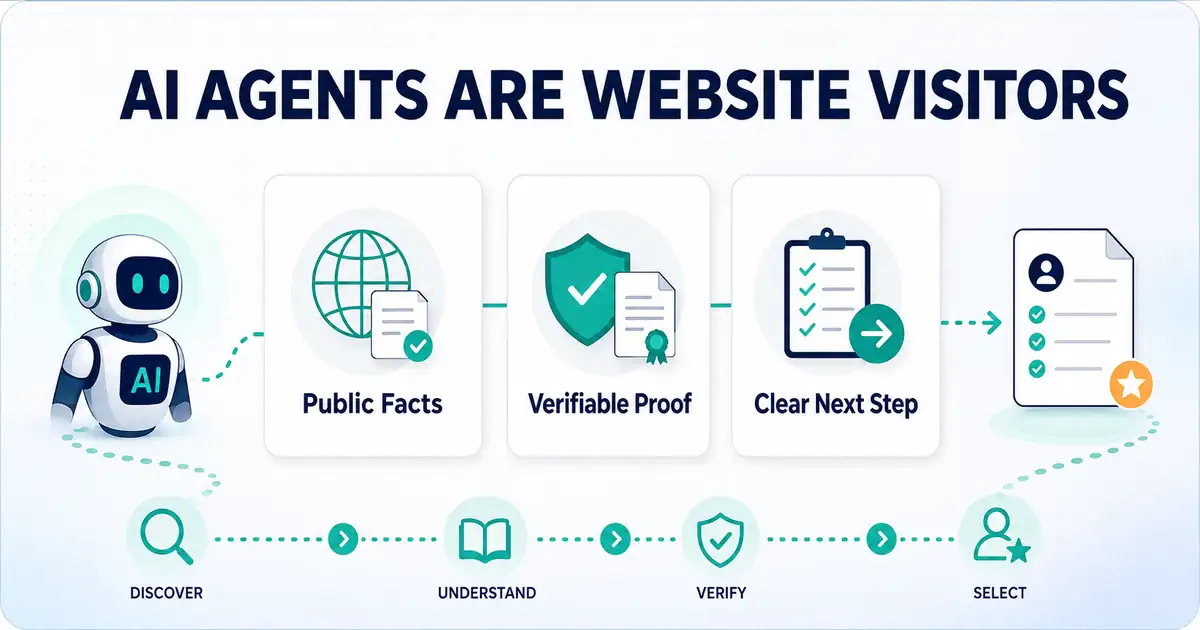
Your next prospect may receive an AI-generated vendor shortlist before opening a search result.
The agent can inspect public pages, compare claims, and summarize which providers appear to fit. For a service firm selling to crypto projects, that changes how a website earns consideration. The first reader may be a machine, while the human sees only the resulting answer.
- AI crawlers, fetchers, and agents create different value and risk.
- TollBit and Akamai measurements show machine demand is growing quickly.
- Choose whether to block, monetize, or optimize before chasing GEO tactics.
- GEO supports inclusion and accurate representation inside generated answers.
- Clear public facts and verifiable proof help both humans and machines.
- Measure demand, visibility, accuracy, and commercial influence separately.
Your Website Now Has a Machine Audience
The important change is not that bots exist. It is that some bots now retrieve information when a person asks a question.
A conventional search crawler indexes pages for future search results. A training crawler collects material for model development. A real-time fetcher looks for current information needed by a user now. An agent may go further by comparing providers, navigating pages, or completing part of a task.
Those visitors may all look automated in a server log, but they do different jobs.
| Visitor type | Main purpose | Typical timing | Possible value to a service provider |
|---|---|---|---|
| Search crawler | Index pages for ranked results | Before a search | Future impressions and clicks |
| Training crawler | Collect material for model development | Before future model use | Uncertain attribution or discovery value |
| AI fetcher | Retrieve fresh facts for a current request | In real time | Inclusion in an answer without a click |
| AI agent | Research, compare, navigate, or act | During a multi-step task | Shortlist influence, a visit, or a completed action |
| Human visitor | Read, compare, contact, or buy | During a session | Direct interaction and measurable conversion |
Two primary-source measurements show why this deserves a policy.
TollBit reported that publishers on its network moved from one AI bot visit for every 200 human visits at the start of 2025 to one for every 31 human visits in Q4. Its analysis of the data-acquisition stack also describes how scraping services can rotate user agents, IP addresses, browsers, and acquisition methods.
Akamai reported that AI scraping accounted for 0.1% of daily traffic across its network in May 2025, already representing more than one billion requests per day. Its analysis of AI scrapers, retrieval, and agents explains that retrieval-augmented generation can gather external information in real time and that one user request can produce many web requests.
These figures should not be combined into one market share. TollBit measures participating publishers. Akamai measures activity across its own network. The definitions, customers, and denominators differ.
The useful conclusion is directional: machine demand for public web information is growing, and some of that demand is tied to current user tasks.
A publisher selling access to content faces different economics from an audit firm, PR agency, market maker, or infrastructure vendor using content to earn consideration. The same bot traffic can be a licensing problem for one company and a discovery opportunity for another.
Choose a Machine-Visitor Policy Before You Optimize
GEO tactics are premature if your team has not decided what machines should be allowed to access.
Start with three policy options: block or restrict, monetize or license, and optimize for legitimate discovery. A website may use all three on different paths.
| Strategy | Best fit | Main benefit | Main risk | Practical first action |
|---|---|---|---|---|
| Block or restrict | Sensitive content, expensive tools, licensed research, abuse, or private areas | Protects content, infrastructure, and customer data | Useful agents may be blocked, while disguised scrapers may continue | Classify traffic and protect high-value paths beyond robots.txt |
| Monetize or license | Publishers, proprietary databases, and frequently updated research | Creates a controlled access route and possible revenue | Standards and buyer demand are still developing | Define content classes, access terms, attribution, and pricing |
| Optimize for agents | Service providers that benefit from accurate discovery and comparison | Makes public commercial facts easier to retrieve and represent | Information may influence a decision without a referral click | Improve one high-value service page and test its representation |
Block or Restrict
Restriction is rational when machine access creates more cost or risk than value.
Protect private account areas, customer information, licensed reports, rate-limited tools, and infrastructure that cannot absorb automated volume. Treat robots.txt as a published preference, not your only control. Enforcement belongs in access rules, authentication, rate limits, and bot management.
The mistake is using one blanket rule for every automated visitor. A user-triggered fetcher and an unknown scraper do not create the same risk.
Monetize or License
Licensing makes sense when content itself is the product.
A publisher, research firm, or proprietary database may create a controlled machine-access route with explicit terms. Most crypto service providers will not start here because their public content exists to build trust and demand, not to generate licensing revenue.
Optimize for Legitimate Discovery
For many service providers, the practical priority is making selected public facts easy to retrieve and verify.
Useful public facts may include:
- exact services and deliverables;
- project types and technical environments served;
- engagement requirements and exclusions;
- supported chains, jurisdictions, or integrations where relevant;
- public case evidence and methodology;
- current qualification and contact routes;
- limitations and outcomes the provider does not promise.
Optimizing public information does not mean giving machines unrestricted access to private data, licensed material, customer records, internal tools, or expensive endpoints. Separate public discovery value from protected operational value.
What GEO Means for Crypto Service Providers
Generative Engine Optimization, or GEO, improves how a source can be discovered, used, cited, and represented inside a generated answer.
The foundational GEO research formalized this problem and tested content changes such as adding relevant citations, quotations, statistics, and clearer language. Its benchmark reported visibility gains up to 40% in some settings.
That number is not a ranking promise. The researchers found that results varied by domain, and their experiments did not establish a permanent formula for every AI platform or future model.
A durable working definition is simpler:
GEO makes a company easier for generative systems to discover, understand, verify, select, and represent accurately.
That includes content quality, technical accessibility, entity consistency, source authority, freshness, and outside corroboration. It does not replace SEO.
| Dimension | SEO | GEO |
|---|---|---|
| Primary surface | Ranked search results | Generated answer, comparison, or agent workflow |
| Immediate objective | Earn visibility and a click | Be selected, used, cited, or represented accurately |
| Main unit of competition | Page position | Fact, passage, entity, claim, or source |
| Dependence on referral traffic | Usually high | Potentially lower |
| Common success signals | Impressions, rankings, clicks, conversions | Mentions, citations, accuracy, inclusion, assisted conversions |
| Common failure mode | Page is not ranked or clicked | Source is ignored, misunderstood, or used without a visit |
SEO builds crawlability, authority, useful pages, and discoverability. GEO asks whether those assets survive retrieval and synthesis. If you need the tactical layer, use the existing guide to source pages, schema, and AI-readable site structure. This article owns the policy decision that comes first.
Make Public Facts Easy to Verify
Vague marketing copy is weak source material.
An AI system comparing vendors needs facts it can separate, verify, and reuse. “Leading full-service Web3 partner” provides almost nothing to test. A narrower statement about audience, scope, deliverables, proof, and limitations is more useful.
This is also good positioning for human buyers. If your service page still lists every possible capability, first clarify which services crypto projects buy and when.
Answer One Buyer Question Per Page
A focused page should make four things obvious:
- Who provides the service?
- Which project and situation is it for?
- What is delivered, with what limits?
- What evidence and next action are available?
A page that tries to cover fifteen unrelated capabilities forces both humans and machines to infer the real offer.
Put Proof Near the Claim
Useful proof can include public case studies, methodology, customer-authorized examples, dated research, named experts, technical documentation, and independently verifiable references.
If a number has no scope, date, source, or denominator, remove it or qualify it. If a testimonial cannot be published with permission, use process evidence instead.
Keep Time-Sensitive Facts Current
Supported networks, product features, qualification rules, prices, schedules, compliance scope, and team details can become stale. An update date helps only when someone actually reviews the page.
Assign an owner and a review trigger. A service change, new jurisdiction, discontinued integration, or altered engagement requirement should prompt a factual update.
Make the Next Action Explicit
A machine may understand your offer but still fail to identify the correct next step.
Name the action clearly: request a scoped review, send required documentation, compare a checklist, or contact a specific team. For content pages, the action should continue the reader’s current job. The Content-to-CTA framework for Web3 service providers shows how to connect a useful article to a low-friction next step without turning it into a generic sales page.
Run the GEO Readiness Checklist
Audit one commercially important page before launching a site-wide project.
Copy this checklist into your review document.
Access and Policy
- We distinguish search crawlers, training crawlers, fetchers, agents, and unknown scrapers.
- Sensitive and expensive paths have controls beyond
robots.txt. - Public pages intended for discovery are accessible as useful text.
- Machine-traffic decisions have an owner and review date.
Audience and Offer
- The page names one primary buyer situation.
- Deliverables, inputs, and exclusions are explicit.
- The page avoids token-buyer, investor, and price-promotion ambiguity.
- The next legitimate action is clear.
Facts and Proof
- Important claims have public evidence nearby.
- Numbers include source, date, scope, and denominator where relevant.
- Service limitations are stated honestly.
- Company, product, and service names are consistent across pages.
Freshness and Extraction
- Time-sensitive facts have a named owner and review trigger.
- Essential information appears as text, not only in images or video.
- Headings describe real questions or decisions.
- The page remains understandable without a complex interface.
AI Representation
- A machine can identify the provider.
- A machine can identify the right buyer and non-fit cases.
- A machine can identify the deliverables and evidence.
- A machine can identify the next action without guessing.
A page that fails this checklist does not only have a GEO problem. It probably has a human positioning and conversion problem too.
Measure Influence Without Inventing Certainty
GEO measurement is less standardized than SEO measurement. Separate the signals instead of forcing them into one score.
1. Machine Demand
Review server and edge logs. Track known and inferred AI traffic, frequently requested pages, response codes, infrastructure cost, and blocked versus allowed requests.
Do not treat every browser-like request as a verified agent. Identity can be spoofed, and ordinary human traffic can look automated.
2. Answer Visibility
Create a controlled set of commercial questions that real crypto project teams may ask, such as:
- Which audit firms support this chain and publish example reports?
- Which PR agencies show verifiable token-launch work?
- What should a project compare before selecting a market maker?
Test the same questions periodically across relevant systems. Record mentions, citations, competitors, and source accuracy. One prompt is not a ranking report.
3. Representation Quality
A mention is not automatically useful.
Check whether the generated answer correctly describes service scope, supported projects, public evidence, limitations, brand identity, and the current contact route. An inaccurate recommendation can create more risk than no mention.
4. Commercial Influence
Ask qualified prospects how they found the company and whether an AI assistant helped with research. Watch branded search, direct traffic, untagged requests, and language prospects repeat from public pages.
These signals will not produce perfect attribution. They can reveal influence that referral analytics misses.
What You May Be Thinking Right Now
“Is this just SEO with a new name?” No. The foundations overlap, but the selection moment and measurement problem differ.
“Should we allow every AI bot?” No. Allow, restrict, or license by content value, visitor identity, cost, and risk.
“Can better pages guarantee recommendations?” No. Retrieval systems are opaque and change over time.
“Is publisher data relevant to a service firm?” Directionally, yes. Economically, not always. Use it to understand machine demand, not to predict your traffic or pipeline.
The safest first move is modest: choose one high-value page, run the checklist, tighten the public facts, and test whether several systems represent the company accurately.
LeadGenCrypto Blog and Updates
Keep the useful signal, skip the GEO hype
Subscribe for practical notes on AI discovery, content, positioning, and B2B growth for teams selling services to crypto projects.
- Fast summaries of new LeadGenCrypto articles
- Useful checklists and service-provider growth frameworks
- No token promotion, price speculation, or guaranteed outcomes
Frequently Asked Questions
What is Generative Engine Optimization?
Generative Engine Optimization, or GEO, is the practice of improving how a generative system discovers, understands, uses, cites, and represents a source inside an answer.
Is GEO replacing SEO?
No. SEO remains foundational because generative systems still depend on accessible pages, useful information, search indexes, and established authority. GEO focuses on what happens when information is retrieved and synthesized into an answer.
What is the difference between an AI crawler, fetcher, and agent?
A crawler collects or indexes pages. A fetcher retrieves current information for a user request. An agent can use that information to compare options, navigate, decide, or complete part of a task. Real systems may combine these roles.
Does robots.txt block AI agents?
Not by itself. It publishes a crawling preference. Stronger enforcement can require authentication, rate limits, access rules, or bot-management controls, depending on the path and risk.
Should a crypto service provider block AI bots?
It depends on the content and traffic. Protect sensitive, licensed, costly, and private paths. Consider allowing legitimate access to public pages that should influence vendor discovery, while continuing to monitor identity, volume, and cost.
Does GEO require llms.txt?
No single file guarantees inclusion in an AI answer. A file may help some systems locate preferred pages, but source selection also depends on accessibility, relevance, evidence, authority, freshness, and the behavior of each retrieval system.
Can GEO create pipeline when AI platforms send few clicks?
It can influence consideration without creating the first referral click, but attribution is imperfect. Ask prospects how they researched the company, monitor branded and direct demand, and test representation quality without claiming that every change created pipeline.
How often should GEO visibility be reviewed?
A monthly or quarterly review is sufficient for many B2B providers. Review sooner after major changes to services, pricing, supported chains, public evidence, compliance scope, or company identity.