Stop Scoping for Free: How to Sell Paid Discovery to Crypto Projects
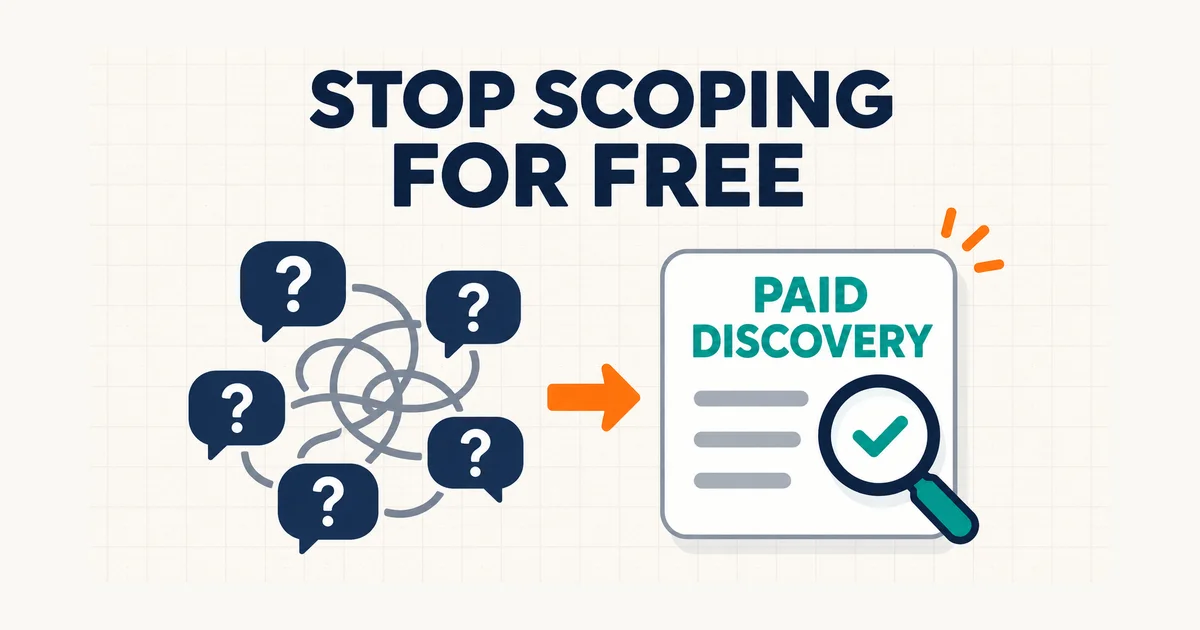
Look at this fictional reply from an analytics studio to a crypto project:
“Send us all your questions. We'll check the data sources, work out the dashboard structure and come back with a detailed proposal. No charge.”
That offer promises a substantial part of the project before the client has bought anything. The studio still needs to inspect the inputs, resolve conflicting requirements and decide what can actually be built.
Sell paid discovery by making that investigation a small, separately priced service with a useful result the client keeps. Leave enough free conversation for both sides to judge fit. Then name the uncertainty, the work needed to resolve it and the decision the buyer will be able to make.
The studio, messages, fees, time estimates and findings below are illustrative. They demonstrate an approach, not a client case study or market-rate benchmark.
Change the promise before changing the price
Adding “discovery fee: $1,200” to the original reply does not explain why the buyer should pay. They may reasonably think you are charging them to prepare your own quote.
Start by separating two jobs. A sales conversation helps the buyer assess your service. Discovery investigates their situation and produces something they can act on.
For the fictional studio, the request is a dashboard combining activity from two contracts on one network with the client's internal revenue report. The buyer asks whether the data can be joined, which metrics are reliable and what the build would cost. The studio has seen the public contracts but has not received a usable internal data sample.
Those questions do not all need the same treatment:
| Buyer question | What a useful response requires | Where it belongs |
|---|---|---|
| “What do you deliver, and can we see an example?” | Your approved service description and an anonymized sample | Free buying information |
| “What does discovery cost and how does it work?” | Your actual scope, fee, terms and availability | Free buying information, with current availability confirmed |
| “Can these two data sources support our proposed metric?” | Inspection of the sources, definitions and missing data | Paid investigation if it is material to the decision |
| “Can you guarantee the dashboard by our launch?” | A verified scope, dependencies and delivery capacity | Human decision after the relevant checks; no automatic promise |
A long list is not, by itself, a reason to charge. A careful buyer may have many ordinary questions. The boundary is work required to produce a reliable answer, not how annoying the conversation feels.
If your standard package already answers the question, answer it. The one-page service offer guide can help make those answers visible before the call.
When the questions multiply, an AI reply can become another promise to check
Suppose a prospect who once sent one broad question now sends twenty detailed ones. That is a hypothetical 20x increase in question count, not a measured claim about the crypto market. If more prospects behave this way, answering each thread yourself can consume the time you need for paid delivery.
The arithmetic is uncomfortable even with modest assumptions. Twenty questions at five minutes each take 100 minutes before any research, follow-up or context switching. An AI assistant may draft them faster, but somebody still needs to know whether the answers are true.
A response such as “Yes, we can combine those sources and include the metric” can quietly become part of what the buyer expects. If nobody inspected the data, the confident sentence has not resolved the uncertainty.
NIST's Generative AI Profile describes confabulation as confidently generated false or erroneous content. That risk matters in presales because an invented capability, deadline or inclusion can change a buying decision.
Hiring yourself as the unpaid reviewer of every generated answer is also an expensive operating model. The useful change is to limit what the conversation is trying to accomplish before payment.
Give AI a smaller job and the buyer a clear next step
Start with one maintained page of approved service facts: deliverables, exclusions, process, published fees where applicable, examples and answers you have checked. Give each answer a source and review date. Keep live capacity and project-specific estimates out of material that can become stale unnoticed.
Use AI to group duplicate questions, retrieve relevant passages and prepare drafts. Ask it to separate supported answers from unknowns. A source link is a review aid, not proof that the draft interpreted the source correctly.
For a small studio, a workable first version is:
- Known buying information: send approved wording or a link to it. If you later automate this, prefer fixed, checked responses for recurring questions over freshly invented promises.
- An exception or commitment: a person checks it. This includes a custom price, delivery date, inclusion, compatibility claim or change to terms.
- A question needing investigation: explain what remains unknown and offer a defined discovery task, a smaller standard scope, or a pause.
Do not let the assistant resolve an unknown by sounding confident. If a source is absent or contradictory, the fallback is a holding response and an unresolved item in the question list. Keep private client material in tools approved for that use; do not upload it merely because it would make a draft easier.
Grounding and review reduce some opportunities for error; they do not make AI infallible. Test the process against old questions with known answers before allowing automated replies, and check what actually gets sent. If your team cannot maintain the approved material or review exceptions, keep AI internal and use the checked FAQ directly.
You can also make the human workload smaller without being evasive. Offer one fit call, request a consolidated question list and reply in an agreed batch. In this example, the studio chooses a 20-minute fit call and one written follow-up. That is its proposed operating boundary, not a universal allowance for every buyer.
For the data-source question, the reply becomes: “We have not verified that join. Discovery will inspect a sample and tell you which metrics the available data supports.” The client receives an honest route to an answer.
Sell one decision the project needs to make
“Two workshops and a strategy document” describes activity. The buyer still needs to understand why that activity matters.
For this project, the decision is whether to build a combined dashboard now, build a smaller version, or wait until the internal reporting data is usable.
The GOV.UK discovery guidance offers a useful general principle: investigate the problem and constraints before committing to a build, and use what you learn to decide whether to proceed. It is guidance for government services, not a pricing benchmark for crypto agencies.
Here is the fictional studio's offer:
Dashboard feasibility brief - $1,200 fixed fee. Five business days after the agreed inputs are complete and payment is received. The client names one decision-maker and supplies the two contract addresses, metric definitions, a redacted internal data sample and the reporting deadline.
The studio inspects those inputs, holds one working session and delivers a source map, a list of supported and unsupported metrics, a recommended first scope, and an implementation estimate with assumptions. A review call and one consolidated factual-correction round are included.
Production code, additional networks, security assurance and implementation are outside this engagement. The client can use the findings internally or share them with another supplier. Agree any limits on reusable studio templates separately; the findings should not become hostage to a second purchase.
State the access rule before taking payment. If the required sample cannot be supplied, postpone the start or agree a smaller investigation. If an input becomes unavailable after work begins, report the limitation and agree whether to stop, narrow or extend the work. Do not silently turn discovery into an unlimited data-cleaning project.
Acceptance should be inspectable: the brief addresses the agreed questions, identifies evidence and unknowns, presents the options, and states the assumptions behind any estimate. A finding that the proposed dashboard should not be built can still satisfy that scope.
Price the investigation you can actually deliver
A discovery fee needs its own delivery economics. Do not choose a token amount just to make the larger proposal look attractive.
In this illustrative package, the studio budgets eight hours at an internal loaded cost of $75 per hour, plus $100 of allocated tooling and $200 for uncertainty. That gives a planned cost of $900. A $1,200 fee leaves $300 above that modeled cost before taxes or any costs omitted from the model. These are example assumptions, not recommended market rates.
If the eight hours do not include preparation, analysis, writing, the review call and corrections, the package is undercounted. If the scope needs more investigation, reduce the question set or revise the fee before selling it. The Web3 service pricing guide develops that cost calculation in more detail.
Decide explicitly whether you credit discovery toward implementation. A credit can be part of an offer, but account for it as a reduction in the later project's revenue. In this example, discovery stands alone and is not credited. The client is buying findings they can use without hiring the studio again.
Show what the client keeps when the answer is “build less”
An anonymized sample from real work is useful when you have permission to share it. Without one, label a demonstration clearly. Do not manufacture a testimonial to make the package look established.
Here is an illustrative completed decision memo for the same project:
Question: Can the first dashboard combine contract activity with the internal revenue report at the requested level of detail?
Evidence inspected: The supplied event samples from the two contracts, the redacted internal reporting file and the client's metric definitions. This is a sample review, not a guarantee about every historical record or future data change.
Finding: In this constructed example, the internal sample contains daily totals but lacks the common identifier needed for the requested transaction-level matching. A single joined metric is therefore unsupported by the supplied evidence. Daily totals can be shown separately with their definitions and refresh times visible.
Recommendation: Build the initial report with separate views. Defer the joined metric until the client can supply a suitable identifier and a new sample can be checked. If that metric is essential to the business decision, pause implementation instead.
First scope: Two contract-activity views and one daily internal-report view, using approved definitions. No transaction-level attribution or additional networks. Client supplies the recurring file and approves the metric labels.
Estimate basis: An illustrative 24-32 implementation hours, subject to a check of the actual file-delivery method and final definitions. This is a planning range, not a fixed-price offer or reserved delivery slot. Any later proposal must name its rate or fee, exclusions and schedule.
Open item and owner: The client's data owner must confirm whether a common identifier can be provided. No date for that dependency has been assumed.
That memo gives the buyer a concrete choice and explains the evidence behind it. Another supplier can challenge the assumptions. The client can also decide that a smaller dashboard does not justify the spend. Discovery has produced a usable answer even if implementation does not follow.
Know when the paid step adds friction without value
Skip separate discovery when the job is routine, the inputs are clear and you can responsibly quote a standard deliverable. Do not charge a buyer to explain your own service or repair a vague offer.
A client may already have a credible specification. Review enough to determine whether you can quote it, then identify only the unresolved work that genuinely needs investigation. You may need a small validation task rather than your full discovery package.
If the buyer has no decision-maker, cannot obtain the necessary inputs or has no path to fund even a small engagement, more unpaid analysis is unlikely to solve that blockage. Clarify what must change and pause. A procurement process that requires unpaid proposals may also be a conscious bid-or-decline decision; a discovery policy will not automatically change its rules.
Once implementation has begun, additional requests need the separate scope-change conversation. Do not keep relabeling unfinished delivery as a new discovery purchase.
Replace the open-ended reply
For the fictional project, the revised message could read:
Thanks for the questions. I can answer the service, process and
commercial questions in our fit call and one written follow-up.

The unresolved issue is whether your internal report can support
the metric you want alongside the two contract-activity views.
We have not verified that, so I cannot responsibly promise it yet.

We can investigate it through a $1,200 dashboard feasibility brief.
The scope is one network, two contracts and one redacted internal
data sample. We deliver within five business days after the agreed
inputs are complete and payment is received.

You receive the source map, supported and unsupported metrics,
a recommended first scope and an estimate with its assumptions.
One review call and one factual-correction round are included.
This does not include production code or security assurance.

You can use the findings with us, internally or with another supplier.
There is no obligation to commission the build, and the discovery
fee is separate from any later implementation fee.

If you already have those findings, send them and we can assess
whether a direct implementation quote is possible. Otherwise,
shall we first confirm the sample is available and who will approve
the discovery scope?