A/B Testing for Web3 Service Businesses: Optimize for Qualified Demand

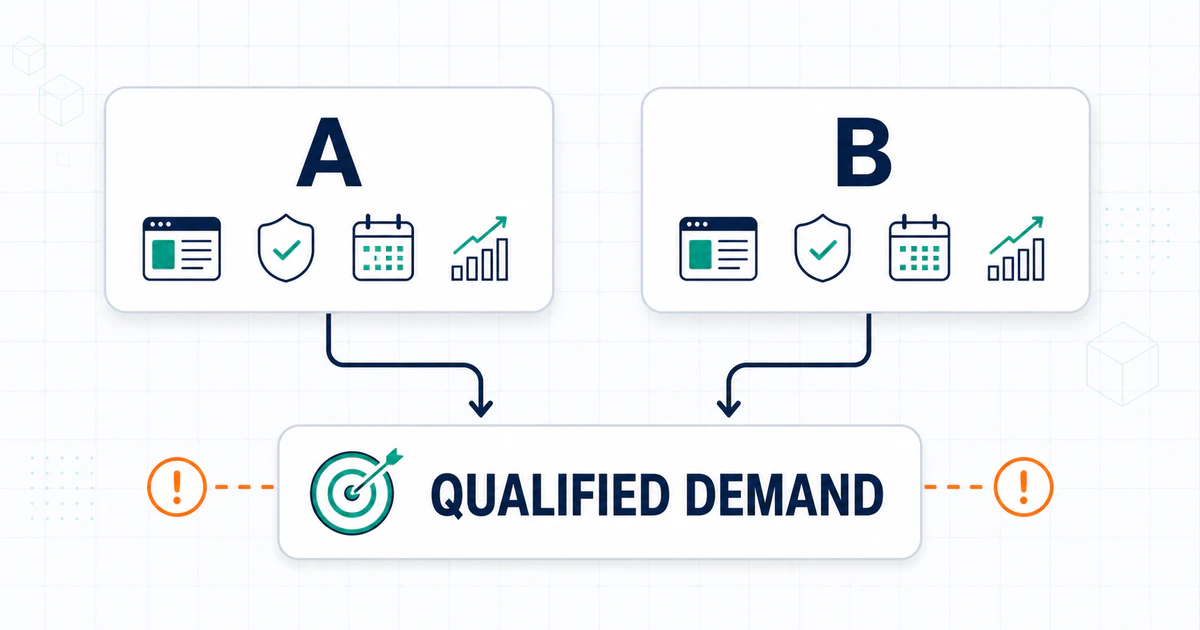
Variant B creates more form submissions.
Sales rejects more of them.
The website dashboard calls B the winner. The CRM says it attracted worse prospects.
For a team selling B2B services to token projects, this is the central problem with A/B testing for Web3 service businesses: the easiest conversion to increase is rarely the outcome the business needs most.
- Define the eligible project population before you randomize visitors or accounts.
- Choose one qualified commercial outcome as the primary decision metric.
- Use clicks and forms as diagnostics, not automatic definitions of success.
- Plan sample size, duration, segments, and stopping rules before launch.
- Reject results when assignment, exposure, or instrumentation cannot be trusted.
- Skip conventional A/B testing when traffic cannot answer the business question.
The direct answer is simple: build the test around a decision, not a page element.
A trustworthy experiment needs an eligible population, a falsifiable hypothesis, persistent assignment, one primary metric, a small set of guardrails, enough observations, and a stopping rule chosen in advance. The foundational controlled-experiments survey by Kohavi and colleagues treats randomization, power, sample size, and reliable implementation as core parts of online experimentation.
That discipline matters even more when qualified Web3 B2B traffic is scarce.
The variant with more leads can still lose
A conversion rate is only useful when the conversion represents progress toward the business outcome.
Consider this illustrative landing-page result:
| Metric | Control A | Variant B |
|---|---|---|
| Eligible project visits | 1,000 | 1,000 |
| Form submissions | 30 | 45 |
| Visitor-to-form rate | 3.0% | 4.5% |
| Qualified meetings | 12 | 9 |
| Visitor-to-qualified-meeting rate | 1.2% | 0.9% |
| Proposals | 3 | 2 |
Variant B produces 50% more forms. It also produces fewer qualified meetings and fewer proposals.
If the team declared B the winner from form submissions, the test would answer the wrong question correctly.
This is why the primary metric should match the decision. A service page might be judged by qualified meetings per eligible visitor. A pricing-flow test might need proposal rate or revenue per visitor. An onboarding test might use completion within a defined period, with support requests and retention as guardrails.
The deeper your reliable metric sits in the funnel, the closer the test gets to commercial value. The trade-off is time and sample size.
If the whole pipeline feels weak, first diagnose the active acquisition bottleneck before choosing a page element to test.
Choose one primary metric that decides the test. Use secondary metrics to explain the result, and guardrails to stop a local improvement from damaging lead quality, cost, user experience, or customer retention.
Define the audience before you randomize
Randomization makes the treatment groups comparable. It does not make irrelevant traffic commercially useful.
A perfectly implemented test among retail traders will not tell an audit firm which page converts protocol teams. A test among every website visitor may not answer a question about newly launched token projects. A campaign that mixes outbound prospects, branded search, job seekers, and token-price traffic may hide the effect for the people who can buy the service.
Define eligibility before assignment.
For example:
Eligible population:
- Token or protocol project with an active public website
- Project stage matches the service offer
- Reachable business or technical contact
- No existing customer relationship
- Not present on the suppression list
The exact rules depend on the offer. A listing consultant, audit firm, PR agency, liquidity provider, and infrastructure vendor should not use the same population definition.
If that audience is still vague, use an ideal-customer-profile worksheet for crypto startups before spending qualified traffic on an experiment.
Contacts are not experimental traffic
A project-contact source can help build an eligible outbound population. It does not create website exposure by itself.
The workflow is:
project contact -> qualification -> assignment -> message or page exposure -> outcome tracking
That distinction prevents a common reporting error. A contact record is a prospect. It becomes an experiment observation only after the account is assigned, receives the intended treatment, and enters the measurement window.
Randomize the project when stakeholders can cross variants
Several people from one project may visit the same service page. If one stakeholder sees A and another sees B, the team can compare screenshots or receive inconsistent pricing and proof.
For high-value B2B tests, project-level assignment can be more coherent than session-level assignment:
project identifier -> persistent variant
Use the least sensitive identifier that reliably preserves assignment. Keep personally identifiable information out of analytics events. Apply applicable consent, retention, and data-minimization rules.
| Randomization unit | Useful when | Main risk |
|---|---|---|
| Session | Anonymous, low-stakes page behavior | The same person or account can switch variants |
| User or browser | Repeat visits matter | Consent, device changes, and cookie limits |
| Project account | Several stakeholders influence one purchase | Fewer independent units and more implementation work |
| Campaign or cohort | Routing happens before the website | Time and source effects can become confounders |
Write the test specification before building the variant
A good hypothesis predicts a mechanism and an outcome. “Try a new homepage” does neither.
Use this structure:
Business problem:
Eligible population:
Randomization unit:
Control:
Treatment:
Expected mechanism:
Primary metric:
Secondary metrics:
Guardrails:
Baseline period and rate:
Minimum effect worth acting on:
Planned sample and duration:
Stopping rule:
Predefined segments:
Decision rule:
Owner:
Here is a filled example:
Business problem: Too few newly launched token projects book qualified calls.
Eligible population: Best-fit project accounts within the selected lifecycle window.
Randomization unit: Project account.
Control: Generic Web3 growth headline.
Treatment: Launch-stage-specific outcome headline.
Expected mechanism: Better relevance and faster buyer recognition.
Primary metric: Qualified meetings per eligible project account.
Secondary metrics: CTA clicks, forms, proposals.
Guardrails: Sales rejection rate, complaints, page performance.
Stopping rule: Fixed sample and duration chosen before launch.
Decision rule: Ship only if the primary metric improves without guardrail damage.
Change one causal idea
If B changes the headline, pricing, proof, form, and CTA, a win does not reveal which idea worked.
A coherent test may update several words or visual elements, but they should represent one mechanism. For example, moving from a generic service category to launch-stage-specific positioning is one causal idea. Rebuilding the entire sales experience is not.
Predefine segments
Segments are useful when they reflect a prior business question, such as inbound versus outbound accounts or pre-launch versus live projects.
They become dangerous when the team searches dozens of slices after seeing the result. More comparisons create more opportunities to find a chance pattern. Keep one primary metric and a short predefined segment list. Treat unexpected segment patterns as hypotheses for the next test.
Choose one decision metric and several guardrails
The primary metric decides. Secondary metrics diagnose. Guardrails prevent collateral damage.
Use the sales funnel to place each metric:
| Layer | Example metric | Best use |
|---|---|---|
| Attention | CTA clicks per eligible visit | Fast diagnostic of message response |
| Capture | Forms per eligible visit | Measures lead-capture friction |
| Quality | Qualified meetings per eligible account | Strong primary metric for many service firms |
| Commercial | Proposals or customers per eligible account | Closer to revenue, but slower |
| Economic | Revenue or gross profit per eligible account | Strongest business link, usually slowest and noisiest |
| Retention | Active customers after a defined period | Useful for onboarding, qualification, or pricing tests |
Revenue per visitor is:
cohort revenue / eligible visitors
Revenue per account uses the same logic with eligible project accounts as the denominator.
Do not mix denominators between variants. Do not remove non-converting assigned accounts from one arm because they never reached a later step. That can make the treatment population look better after the fact.
A practical hierarchy might be:
- Primary: qualified meetings per eligible project account.
- Secondary: CTA clicks, form submissions, proposals, customer conversion.
- Guardrails: unqualified-lead percentage, complaints, cancellation, page latency, and acquisition cost.
If the article or landing page itself lacks a useful next action, fix the content-to-CTA path for Web3 service buyers before testing superficial button variations.
Decide whether the test is feasible
The right test can still be impossible with the traffic and effect available.
Sample-size planning depends on at least these inputs:
- baseline conversion rate;
- minimum detectable effect, or the smallest change worth acting on;
- desired power;
- significance threshold;
- number of variants;
- allocation ratio;
- clustering or repeated-account behavior.
Smaller baseline rates and smaller target effects usually require more observations. A visitor-to-customer outcome can be commercially ideal and operationally impossible for a small agency to test in one quarter.
That does not justify switching to the shallowest metric available. Choose the closest meaningful outcome that can collect enough data, then continue observing downstream quality.
Test-or-don't-test matrix
| Situation | Best next move | Why |
|---|---|---|
| Enough eligible traffic and reliable assignment | Run a planned A/B test | The method can answer the decision |
| Low traffic but a large, high-value change | Test a bold hypothesis or use a closer meaningful metric | A larger effect may be detectable |
| Very low traffic and long sales cycle | Use interviews, sales-call evidence, usability tests, or a sequential rollout | A conventional split may stay inconclusive |
| No stable instrumentation | Fix tracking or run an A/A validation | A winner cannot be trusted |
| Offer or audience is still unclear | Run offer and audience validation first | Optimization cannot rescue an undefined market |
| Security-critical contract behavior changes | Use formal review and controlled release processes | Page experimentation is not a security substitute |
The validate-before-ads case study shows the upstream principle: confirm audience and message before paid distribution amplifies weak assumptions.
A large observed lift based on a handful of conversions can still be highly uncertain. Report the estimated effect, sample, and interval or uncertainty. Do not describe an inconclusive result as proof that both versions are equal.
Protect the result from false wins
Trust the experiment plumbing before you trust the uplift.
Run these checks before analysis:
- Population validity: Were the exposed accounts actually eligible buyers?
- Assignment validity: Was allocation random and persistent?
- Exposure validity: Did each arm receive the intended experience?
- Sample-ratio validity: Does the observed allocation fit the planned split?
- Instrumentation validity: Are events and CRM joins defined identically?
- Power and duration: Did the test reach its planned stopping condition?
- Funnel latency: Did later outcomes have enough time to arrive?
- Multiplicity: Were variants, metrics, and segments limited or adjusted?
- Decision validity: Is the estimated effect large enough to matter?
Watch for sample-ratio mismatch
If a planned 50/50 test produces a large unexplained allocation imbalance, investigate before reading conversion rates. Possible causes include assignment bugs, eligibility filters, tracking loss, bot filtering, or one variant failing to load.
An imbalance is a diagnostic signal, not automatic proof of a specific bug.
Do not peek at a fixed-horizon test and stop on green
Repeatedly checking a conventional test and stopping when the result first crosses a significance threshold changes the statistical behavior of the procedure.
Choose one operating model:
- Fixed horizon: plan the sample and duration, then analyze at the chosen stopping point.
- Sequential method: use an approach designed for valid repeated monitoring.
Research on always-valid inference for continuously monitored A/B tests explains why ordinary fixed-sample p-values are unreliable under arbitrary optional stopping.
Do not casually mix the two models.
Practical Web3 service experiments worth running
Test changes that could alter a buyer's decision, not details the team can debate safely without an experiment.
| Experiment | Control and treatment | Primary metric | Guardrail |
|---|---|---|---|
| Positioning | Generic category versus project-stage outcome | Qualified meetings per eligible account | Sales rejection rate |
| Proof | Logo wall versus detailed relevant case evidence | Proposal-ready meetings | Page speed and trust complaints |
| Qualification form | Short form versus structured fit questions | Qualified meetings per eligible visit | Completion and privacy risk |
| Pricing presentation | Call-for-price versus a truthful starting range | Revenue per eligible account | Sales-cycle length and cancellation |
| Content CTA | Generic contact CTA versus bounded diagnostic | Qualified requests per eligible reader | Low-fit submissions |
| Onboarding | One long intake versus staged intake | Completion in a defined period | Support load and early cancellation |
For wallet or on-chain UX, keep the underlying reviewed business logic, permissions, network, and economic effect the same unless a separate security and product process approves those changes. A copy experiment should not become an unreviewed smart-contract experiment.
For the moment after a prospect submits a service enquiry, test the first substantive reply with a fixed meeting outcome and a response standard your team can sustain.
Copy-paste pre-launch checklist
Use this before exposing the first account:
[ ] One business decision is named.
[ ] The eligible project population is explicit.
[ ] The assignment unit matches the buying process.
[ ] Assignment persists across repeat exposure.
[ ] Control and treatment differ by one causal idea.
[ ] One primary metric decides the result.
[ ] Secondary metrics and guardrails are predefined.
[ ] Baseline, meaningful effect, sample, and duration are planned.
[ ] The stopping rule is written before launch.
[ ] Segments are defined before results are visible.
[ ] Exposure and outcome events use the same definitions in both arms.
[ ] CRM outcomes can be joined without sending PII into GA4.
[ ] SRM and missing-event checks have owners.
[ ] External shocks and unrelated site changes will be logged.
[ ] The ship, reject, or inconclusive decision rule is written.
Objections before you run the test
We do not have enough traffic
Do not lower the quality bar until the test produces an answer. Test a larger causal change, use a closer meaningful metric, extend the window if the environment stays comparable, or choose qualitative research and a staged rollout.
Revenue takes too long to observe
Use qualified meetings or proposals as the primary metric when they are reliable leading outcomes. Keep revenue and retention as downstream checks. Document that the final economic verdict is delayed.
We do not have an experimentation platform
Tooling helps, but the design comes first. A simple server-side assignment, stable campaign routing, or controlled landing-page split can work if assignment, exposure, and outcome data remain trustworthy. Run an A/A validation when the stack is new.
Project-level assignment creates privacy concerns
Use a pseudonymous project key where possible. Keep raw emails, personal identifiers, wallet addresses, and free-text form data out of analytics events. Obtain consent and legal guidance where applicable. This article is operational guidance, not legal advice.
The result is commercially important or statistically complex
Get specialist review for clustered assignment, several variants, adaptive allocation, sequential inference, or decisions with material customer, security, or financial consequences.
Once the eligible population is clear, LeadGenCrypto can reduce the manual research step. You can review how delivered project contacts and CSV export work, then assign and expose qualified accounts through your own controlled workflow.
This is for service teams that already have a specific offer and buyer definition. If that is you, review one verified project contact and use the specification above before you scale the test. The contact is an audience input, not an experiment result.
LeadGenCrypto Blog and Updates
Get practical Web3 growth experiments
Subscribe for concise guides on audience quality, outreach systems, useful sales metrics, and better B2B decisions for teams selling services to crypto projects.
- Short summaries of new LeadGenCrypto articles
- Checklists for qualified outreach and sales operations
- No-hype ideas you can test without inventing certainty
Frequently Asked Questions
What is A/B testing for a Web3 service business?
It is a controlled comparison of two experiences among eligible prospects or accounts. The goal is to estimate whether one defined change improves a predefined outcome, such as qualified-meeting conversion, without damaging commercial guardrails.
What metric should a Web3 agency use?
Use the deepest reliable outcome that can collect enough observations. Qualified meetings per eligible account often provide a better decision than form submissions. Pricing and onboarding tests may need proposal, revenue, completion, or retention metrics.
How much traffic does an A/B test need?
There is no universal number. It depends on the baseline rate, minimum effect worth detecting, desired power, significance threshold, allocation, number of variants, and assignment structure. Calculate feasibility before launch.
How long should a B2B A/B test run?
Long enough to reach the planned sample and cover representative traffic patterns plus the relevant funnel delay. Do not stop only because an early dashboard looks favorable.
Should I randomize sessions, users, or project accounts?
Choose the unit that receives the treatment and makes the buying decision. Project-level assignment can reduce contamination when several stakeholders from one company may visit, but it also reduces the number of independent units.
Can LeadGenCrypto run the A/B test for me?
No. LeadGenCrypto can provide project-contact information as one prospect-sourcing input. Your team still needs to qualify accounts, assign treatments, deliver the experience, record exposure, and analyze outcomes.