Free AI Follow-Up Email Prompt Builder for Web3 Service Providers

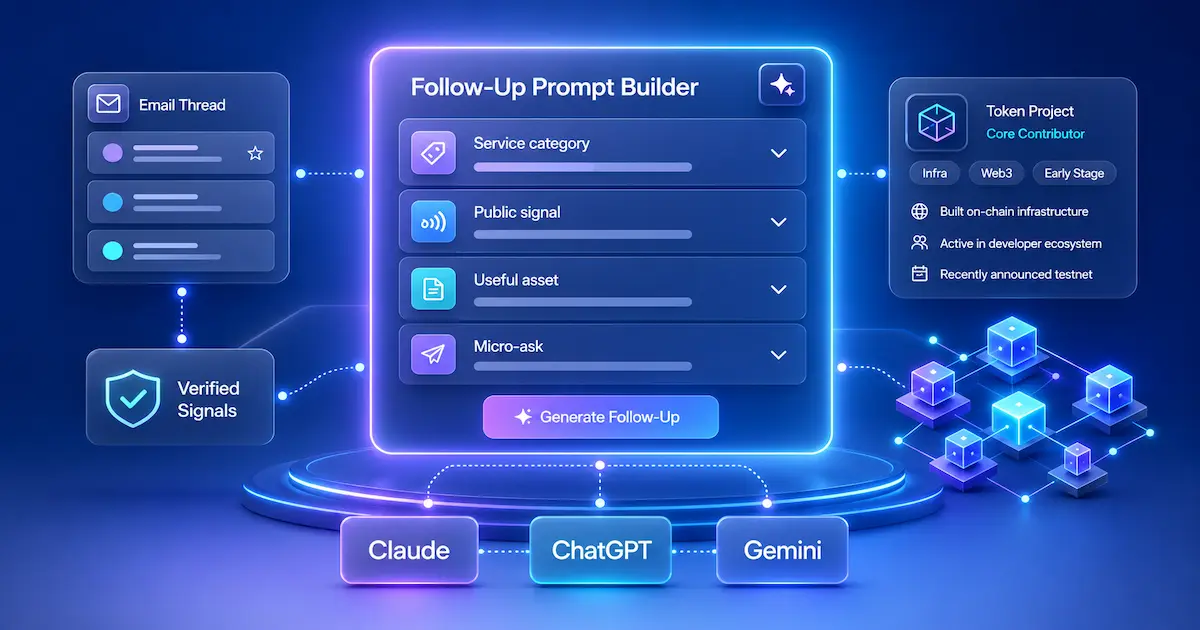
- Use the free AI follow-up email prompt builder below to generate a complete operating brief, not a finished email.
- The same Web3 follow-up email prompt structure works in Claude, ChatGPT, Gemini, or similar AI tools.
- For copy-paste follow-up emails and category templates, use the micro-ask follow-up template library.
- Strong prompts define objective, sources, constraints, output format, and verification.
- Paste previous communication so the AI can avoid generic reminder language.
- Built for no-response follow-ups after silence, not first-touch cold email or finished templates.
- Use the static fallback when JavaScript or the builder is unavailable.
Most no-response follow-ups fail before a human reviews them: the model gets a vague ask, invents a project detail, or writes another "just checking in" line. A free AI follow-up email prompt builder fixes that upstream by turning your service, thread, and project fields into a full operating brief for Claude, ChatGPT, or Gemini, with ROLE, CONTEXT, and TASK sections, source hierarchy, touch-specific rules, and verification, not a one-line "write a follow-up" command.
If you sell services to crypto projects and the thread has gone quiet, use this page to generate AI prompts for Web3 follow-up emails you paste into any chat tool, then edit before send. Finished copy, category templates, and send timing live elsewhere.
Pair this Web3 follow-up email prompt builder with the canonical guide to micro-ask follow-ups when a token project goes quiet. That guide owns the template library, category angles, and full no-response framework. This page owns the interactive builder, static fallback, and reference prompt pack for no-response follow-up prompts for service providers.
LeadGenCrypto supplies verified project contacts (website, chain, token fields) you can map straight into the builder inputs below.
Free AI follow-up email prompt builder (interactive)
This free AI follow-up email prompt builder turns a few sales inputs into a complete prompt brief with ROLE, CONTEXT, and TASK sections. It does not call OpenAI, Claude, Gemini, or any sending platform. Your browser assembles the prompt text, then you paste it into your AI chat tool and review the email before sending.
The generated prompt asks the AI to produce one follow-up email body only. It also tells the AI to use only the provided previous communication, service description, and lead fields, then silently verify that the final draft is specific, low-pressure, and fact-safe.
- Type what you sell to crypto projects.
- Choose Touch 2, Touch 3, Touch 4, Touch 5, Post-reply reminder, or Quality assurance rewrite.
- Paste previous communication with the prospect or your initial email.
- Optionally paste lead fields for the potential buyer, meaning the token project contact that may buy your B2B service.
- Generate the prompt, copy it, paste it into Claude, ChatGPT, Gemini, or a similar AI chat tool, then edit the returned email before sending.
The interactive Prompt Builder loads in your browser. If it does not appear, use the static fallback table below.
If the interactive builder does not load, use the static fallback table and generic prompt below.
Static fallback (no JavaScript)
Use this fallback when the builder is unavailable or when you want to assemble the prompt manually. The table maps each input to the role it should play inside the final prompt.
| Builder input | What to paste | How the AI should use it | Example |
|---|---|---|---|
| What do you sell to crypto projects? | Your service in plain language | Sender context and service fit | We list tokens on centralized crypto exchanges... |
| Follow-up type | Touch 2, Touch 3, Touch 4, Touch 5, Post-reply reminder, or Quality assurance rewrite | Touch-specific constraints and definition of done | Touch 3 (asset offer) |
| Previous communication with the prospect, or your initial email | Earlier email, thread, reply, or notes | Primary source for thread stage, objections, tone, and facts | Your first cold email plus any reply, or silence after the first send |
| Lead fields for your potential buyer | Website, token name, token symbol, blockchain, token URL, token address, verified email, or Telegram | Secondary source for project context and allowed merge fields | website: example.io, tokenSymbol: EXM, blockchain: Ethereum |
| Generated prompt review | Read the output before sending | Human QA before the email enters a sequence | Check facts, CTA, tone, length, and unsupported claims |
Potential buyer means the token project contact that may buy your B2B service. It does not mean a retail token buyer, investor, trader, or customer for a token.
Generic fallback prompt, replace bracketed fields, then paste into any AI chat:
ROLE:
Act as a senior B2B sales professional and Web3 follow-up email copywriter for service providers selling to token-based crypto projects. Use this role as an operating lens: buyer relevance, source-grounded specificity, low-pressure micro-asks, and factual restraint.

CONTEXT:
Service the sender sells to crypto projects:
[WHAT YOU SELL]

Previous communication with the prospect, or initial email:
{{[PREVIOUS COMMUNICATION]}}

Lead fields for the potential buyer:
[LEAD FIELDS FOR POTENTIAL BUYER]

Follow-up type:
[FOLLOW-UP TYPE]

Audience:
The recipient is a token project team member who may buy a B2B service. The recipient is not a retail token buyer, trader, investor, or customer for a token.

TASK:
Objective:
Write one no-response follow-up email body that gives the token project team a new, useful reason to reply and moves the conversation toward the sender's service without pressure.

Sources to use:
- Previous communication: use for the thread stage, prior wording, stated goals, concerns, objections, promises, tone, and what has already been asked.
- Lead fields: use for project-specific context such as website, token address, blockchain, token symbol, token name, and token URL.
- Service description: use only to explain the sender's service fit and to infer a small useful asset.

Source hierarchy:
If sources conflict, prioritize the previous communication over lead fields, and lead fields over the service description. Do not use outside research. Do not invent facts to fill missing information.

Do not use:
- Do not write for fundraising, token buyers, traders, retail investors, or token price promotion.
- Do not invent facts, numbers, partnerships, guarantees, discounts, deadlines, timelines, case studies, or private project plans.
- Do not use generic phrases such as "just checking in", "following up on my previous email", "hope this email finds you well", "circling back", or "touching base".
- Do not ask for a call, meeting, demo, or calendar slot as the first next step.
- Do not include a subject line or signature.

Workflow:
Before writing, silently identify:
1. The prospect's current stage: interested, cold, hesitant, negotiating, unresponsive, objecting, evaluating, or unknown.
2. Confirmed facts from the previous communication and lead fields.
3. Missing or uncertain facts that must not be invented.
4. The strongest source-backed reason to continue the discussion.
5. The safest micro-ask for this follow-up type.
6. Whether one useful email-only asset should be offered.

Requirements:
- Write for a service provider selling services to a token-based crypto project.
- Use one clear service-fit sentence.
- Add one useful reason to reply instead of repeating the first pitch.
- Use one low-friction CTA that can be answered with yes, no, send, handled, later, or close.
- If previous communication is missing or thin, write conservatively and avoid implying that a specific earlier email was read.
- If an asset is offered, offer exactly one email-only asset such as a checklist, short scan, gap note, readiness note, outline, or review format.
- Allowed final email merge fields only, if needed: {{website}}, {{tokenAddress}}, {{blockchain}}, {{tokenSymbol}}, {{tokenName}}, {{tokenUrl}}.
- Do not use any other merge fields.

Constraints:
- Keep the email body concise, usually 60 to 110 words.
- Use plain English, no hype, no slang, no emojis, no fake urgency, no guilt language.
- Prioritize factual accuracy and reply ease over persuasion.
- Make the email understandable even if the recipient missed the first message.

Output format:
Output only the follow-up email body. Do not include analysis, labels, a subject line, a signature, or an explanation.

Quality criteria:
A good email should be specific, commercially realistic, source-grounded, concise, respectful, easy to answer, and safe for a crypto project inbox.

Uncertainty handling:
If a fact is not present in the previous communication, service description, or lead fields, do not use it. If context is incomplete, choose neutral wording instead of guessing.

Verification:
Before finalizing, silently check that the email follows every requirement above, uses only supported facts, has one CTA, avoids call-first language, and does not mention investors, token buyers, trading, pumping, or token price.

Definition of done:
The response is complete only when it is a single follow-up email body that can be reviewed by a human and pasted into an outreach tool without removing analysis or unsupported claims.
Use the interactive builder above for touch-specific requirement blocks. The static prompt is useful when the builder is unavailable, but the builder keeps the ROLE, CONTEXT, and TASK structure consistent.
What makes a Web3 follow-up email prompt strong
A good prompt is a clear task specification. It should reduce the chance that the AI writes a generic reminder, invents a project fact, or asks for a call too early.
| Prompt element | Why it matters for Web3 follow-ups | What to include |
|---|---|---|
| Objective | The model needs to know the final deliverable, not just the activity. | One follow-up email body that earns a small reply. |
| Audience | A token team inbox is not a retail buyer audience. | B2B service buyer at a token project. |
| Sources | The model must know what counts as evidence. | Previous communication, lead fields, and service description. |
| Source hierarchy | Thread facts should beat generic assumptions. | Previous communication first, lead fields second, service description third. |
| Exclusions | Crypto outreach is sensitive to hype and invented claims. | No token promotion, no price claims, no private plans, no fake urgency. |
| Output format | The final answer must be usable in an outreach workflow. | Email body only, no subject, no signature, no explanation. |
| Quality criteria | The model needs a quality bar it can check against. | Specific, concise, source-grounded, respectful, easy to answer. |
| Verification | The model should self-check before returning the draft. | One CTA, supported facts only, no call-first ask, no forbidden phrasing. |
Use this prompt-quality checklist before pasting anything into an AI tool:
Web3 follow-up email prompt quality checklist

[ ] Objective says exactly what the AI should produce.
[ ] Audience is a B2B service buyer at a token project.
[ ] Previous communication is pasted or marked as incomplete.
[ ] Lead fields are short, relevant, and safe to share.
[ ] Source hierarchy tells the AI what to trust first.
[ ] Forbidden claims and generic phrases are listed.
[ ] Output format says email body only.
[ ] Quality criteria define tone, length, specificity, and CTA.
[ ] Uncertainty handling prevents invented facts.
[ ] Verification tells the AI to self-check before finalizing.
Next action: run one of your existing follow-ups through this checklist before you ask the AI to rewrite it. If you are tightening outreach before you scale follow-ups, review cold email guardrails for Web3 vendors first.
No-response rules to encode in your AI prompt
A follow-up after silence is not a reminder. It is a new reason to reply. The prompt should force the model to add that reason, keep the ask low-friction, and avoid call-first pressure. For ready-to-send email shells by vendor category, use the category-specific follow-up angles after the first cold email in the template library.
Touch ladder summary for prompt builders (full templates and examples live in that guide):
| Touch | Purpose | Safe ask |
|---|---|---|
| Touch 2 | Add one observation from the thread or lead fields. | Is this worth a quick look? |
| Touch 3 | Offer one useful email-only asset. | Should I send it? |
| Touch 4 | Ask whether the issue is handled or worth closing. | Already handled, or should I close this? |
| Touch 5 | Close the loop politely without guilt. | Reply close and I will stop here. |
Every AI-generated draft should pass this test:
No-response follow-up test

[ ] The email uses only facts from previous communication, service description, or lead fields.
[ ] The service fit is one sentence.
[ ] The email adds one new reason to reply.
[ ] The email offers one useful asset at most.
[ ] The ask can be answered yes, no, send, handled, later, or close.
[ ] The exit is respectful.
[ ] The email does not say "just checking in".
[ ] The email does not lead with a calendar link.
[ ] The email does not repeat the same first-touch pitch.
[ ] The email does not ask for a big meeting from silence.
[ ] The email does not mention investors, token buyers, trading, pumping, or price.
Before scaling a batch, compare the final draft with the spam trigger word checklist for crypto outreach. Crypto inboxes are sensitive to hype, urgency, and vague growth claims.
Next action: if your follow-up asks for a meeting, rewrite the CTA into a yes, send, handled, later, or close reply path.
Claude, ChatGPT, and Gemini: one Web3 follow-up email prompt builder
Use one prompt library across models. Change the review workflow, not the core prompt structure. The prompt rules should be stable because they come from the outreach framework, not from a single AI vendor. This page works as an AI prompt builder for cold email follow-ups after silence, not for first-touch outreach.
| Model | Best use | Practical note |
|---|---|---|
| Claude | Tightening tone and removing hype. | If the draft feels too polished, regenerate with stricter plain-English and no-hype criteria. |
| ChatGPT | Producing controlled rewrites after a first draft. | Keep the first generation to one email, then ask for a shorter rewrite if needed. |
| Gemini | Fast drafting near Gmail workflows. | Keep pasted context short and verify every project fact from the thread before use. For Gmail-side drafting workflows, see Gemini in Gmail for Web3 cold outreach. |
These are ChatGPT prompts for Web3 follow-up emails, Claude prompts for token project outreach, and Gemini follow-up email prompts at the same time. Model choice matters less than source discipline, micro-ask structure, and human review. The model is less important than the source discipline, micro-ask, and human review.
Next action: use the same generated prompt in two models and compare only the final email body, not the model's reasoning.
Prompt pack (reference): AI prompts for Web3 follow-up emails
Copy one block into Claude, ChatGPT, or Gemini. Replace bracketed fields with your own context. The free builder above adds touch-specific requirements automatically. The manual prompts below show the same operating-brief logic in a copy-paste format for teams that want ChatGPT prompts for Web3 follow-up emails, Claude prompts for token project outreach, or Gemini follow-up email prompts without opening the interactive tool.
Each prompt uses these source inputs. When lead fields are thin, run an AI teardown on the token project site so you paste only verified facts into the prompt.
Service the sender sells to crypto projects:
[WHAT YOU SELL]

Previous communication with the prospect, or initial email:
{{[PREVIOUS COMMUNICATION]}}

Lead fields for the potential buyer:
[LEAD FIELDS FOR POTENTIAL BUYER]
Prompt 1: Touch 2 first follow-up after silence
Use the interactive builder with Touch 2 (first follow-up), or paste this block:
ROLE:
Act as a senior B2B sales professional and Web3 follow-up email copywriter for service providers selling to token-based crypto projects. Focus on buyer relevance, low-pressure micro-asks, and factual restraint.

CONTEXT:
Service the sender sells to crypto projects:
[WHAT YOU SELL]

Previous communication with the prospect, or initial email:
{{[PREVIOUS COMMUNICATION]}}

Lead fields for the potential buyer:
[LEAD FIELDS FOR POTENTIAL BUYER]

Follow-up type:
Touch 2 (first follow-up)

TASK:
Objective:
Write one first no-response follow-up email body that adds a source-grounded reason to reply without repeating the original pitch.

Sources to use:
Use previous communication for thread context and lead fields for project context. Use the service description only to explain fit. Do not use outside research.

Requirements:
- This is Touch 2, the first follow-up after silence.
- Use one observation from the previous communication or lead fields if it helps.
- Include one low-effort micro-ask.
- Do not ask for a meeting, call, demo, or calendar slot.
- Do not invent facts, promises, numbers, partnerships, guarantees, deadlines, timelines, or private plans.
- Avoid "just checking in", "following up", "hope this email finds you well", "circling back", and "touching base".
- Allowed final email merge fields only, if needed: {{website}}, {{tokenAddress}}, {{blockchain}}, {{tokenSymbol}}, {{tokenName}}, {{tokenUrl}}.

Constraints:
Keep the email concise, usually 60 to 110 words. Use plain English, no hype, no emojis, no guilt, and no fake urgency.

Output format:
Output only the follow-up email body. No subject line, signature, explanation, or analysis.

Quality criteria:
The email should be specific, source-grounded, commercially realistic, respectful, and easy to answer.

Uncertainty handling:
If context is incomplete, avoid implying that a specific earlier email was read. Use neutral wording and do not guess.

Verification:
Before finalizing, silently check that every fact comes from the provided inputs, there is one CTA, and the email does not mention investors, token buyers, trading, pumping, or price.

Definition of done:
The response is complete only when it is one safe Touch 2 email body ready for human review.
Prompt 2: Touch 3 useful asset offer
Use the builder with Touch 3 (asset offer), or paste this block:
ROLE:
Act as a senior B2B sales professional and Web3 follow-up email copywriter for service providers selling to token-based crypto projects. Focus on useful assets, buyer relevance, and factual restraint.

CONTEXT:
Service the sender sells to crypto projects:
[WHAT YOU SELL]

Previous communication with the prospect, or initial email:
{{[PREVIOUS COMMUNICATION]}}

Lead fields for the potential buyer:
[LEAD FIELDS FOR POTENTIAL BUYER]

Follow-up type:
Touch 3 (asset offer)

TASK:
Objective:
Write one follow-up email body that offers exactly one useful email-only asset and asks whether to send it.

Sources to use:
Use previous communication for thread context, lead fields for project context, and the service description to infer a relevant asset. Do not use outside research.

Requirements:
- This is Touch 3, the useful asset offer.
- Offer exactly one asset, such as a checklist, short scan, outline, gap note, readiness note, or review format.
- Make clear that the asset can be sent by email.
- Do not offer a deck, proposal, call, demo, or calendar link as the next step.
- Do not invent facts or details not present in the previous communication, service description, or lead fields.
- Allowed final email merge fields only, if needed: {{website}}, {{tokenAddress}}, {{blockchain}}, {{tokenSymbol}}, {{tokenName}}, {{tokenUrl}}.

Constraints:
Keep the email concise, usually 60 to 110 words. Use plain English, no hype, no emojis, no guilt, and no fake urgency.

Output format:
Output only the follow-up email body. No subject line, signature, explanation, or analysis.

Quality criteria:
The email should make the offered asset feel useful, narrow, low-friction, and directly tied to the sender's service.

Uncertainty handling:
If the best asset is not obvious, choose a conservative checklist or short scan and avoid project-specific claims that are not supported.

Verification:
Before finalizing, silently check that there is one asset, one CTA, no invented facts, and no call-first language.

Definition of done:
The response is complete only when it is one safe Touch 3 email body ready for human review.
Prompt 3: Touch 4 handled or close
ROLE:
Act as a senior B2B sales professional and Web3 follow-up email copywriter for service providers selling to token-based crypto projects. Focus on respectful close-the-loop language and factual restraint.

CONTEXT:
Service the sender sells to crypto projects:
[WHAT YOU SELL]

Previous communication with the prospect, or initial email:
{{[PREVIOUS COMMUNICATION]}}

Lead fields for the potential buyer:
[LEAD FIELDS FOR POTENTIAL BUYER]

Follow-up type:
Touch 4 (handled or close)

TASK:
Objective:
Write one handled-or-close follow-up email body that lets the recipient reply with a simple status instead of committing to a call.

Sources to use:
Use previous communication for thread context and lead fields for project context. Use the service description only to explain the issue area. Do not use outside research.

Requirements:
- Ask whether the issue is already handled, not relevant, worth sending, or worth closing.
- Use one clear fork, not multiple options.
- Do not use guilt language, fake urgency, scarcity, or pressure.
- Do not ask for a meeting, call, demo, or calendar slot.
- Do not invent facts or details not present in the inputs.
- Allowed final email merge fields only, if needed: {{website}}, {{tokenAddress}}, {{blockchain}}, {{tokenSymbol}}, {{tokenName}}, {{tokenUrl}}.

Constraints:
Keep the email concise, usually 50 to 90 words. Use plain English, no hype, no emojis, and no guilt.

Output format:
Output only the follow-up email body. No subject line, signature, explanation, or analysis.

Quality criteria:
The email should feel respectful, easy to answer, and safe to ignore without damaging the relationship.

Uncertainty handling:
If context is incomplete, avoid pretending to know whether the issue is active. Use "if this is already handled" style language.

Verification:
Before finalizing, silently check that the email has one fork, one CTA, no invented facts, and no call-first ask.

Definition of done:
The response is complete only when it is one safe Touch 4 email body ready for human review.
Prompt 4: Touch 5 polite breakup
ROLE:
Act as a senior B2B sales professional and Web3 follow-up email copywriter for service providers selling to token-based crypto projects. Focus on respectful final touches and factual restraint.

CONTEXT:
Service the sender sells to crypto projects:
[WHAT YOU SELL]

Previous communication with the prospect, or initial email:
{{[PREVIOUS COMMUNICATION]}}

Lead fields for the potential buyer:
[LEAD FIELDS FOR POTENTIAL BUYER]

Follow-up type:
Touch 5 (breakup)

TASK:
Objective:
Write one polite final follow-up email body that closes the loop without pressure.

Sources to use:
Use previous communication for thread context and lead fields for project context. Use the service description only to describe the service area. Do not use outside research.

Requirements:
- Make it clear this can be the last note.
- Let the recipient reply close, not now, handled, or similar.
- Do not use guilt, scarcity, aggressive language, fake urgency, or pressure.
- Do not ask for a meeting, call, demo, or calendar slot.
- Do not invent facts or details not present in the inputs.
- Allowed final email merge fields only, if needed: {{website}}, {{tokenAddress}}, {{blockchain}}, {{tokenSymbol}}, {{tokenName}}, {{tokenUrl}}.

Constraints:
Keep the email concise, usually 40 to 80 words. Use plain English, no hype, no emojis, and no guilt.

Output format:
Output only the follow-up email body. No subject line, signature, explanation, or analysis.

Quality criteria:
The email should protect goodwill, avoid pressure, and make the easiest reply path obvious.

Uncertainty handling:
If context is incomplete, avoid project-specific claims and simply close the loop around the service area.

Verification:
Before finalizing, silently check that the email is polite, final, low-pressure, and fact-safe.

Definition of done:
The response is complete only when it is one safe Touch 5 email body ready for human review.
Prompt 5: Quality assurance rewrite
ROLE:
Act as a senior B2B sales professional, Web3 follow-up email copywriter, and skeptical QA reviewer for service providers selling to token-based crypto projects. Focus on factual integrity, low-pressure CTAs, and calm operator English.

CONTEXT:
Service the sender sells to crypto projects:
[WHAT YOU SELL]

Previous communication with the prospect, initial email, and any draft to improve:
{{[PREVIOUS COMMUNICATION OR DRAFT]}}

Lead fields for the potential buyer:
[LEAD FIELDS FOR POTENTIAL BUYER]

Follow-up type:
Quality assurance rewrite

TASK:
Objective:
Review and rewrite one follow-up email body so it is sharper, safer, more specific, and easier for a token project team to answer.

Sources to use:
Use previous communication and any existing draft for thread context and original claims. Use lead fields for project context. Use the service description only to explain fit. Do not use outside research.

Requirements:
- Preserve all supported facts from the original context.
- Remove unsupported claims, hype, weak phrases, call-first language, and generic reminder wording.
- Keep one clear CTA that can be answered with yes, no, send, handled, later, or close.
- If no existing draft is provided, write a new follow-up based on the thread.
- Do not invent facts, numbers, partnerships, guarantees, discounts, deadlines, timelines, or private project plans.
- Allowed final email merge fields only, if needed: {{website}}, {{tokenAddress}}, {{blockchain}}, {{tokenSymbol}}, {{tokenName}}, {{tokenUrl}}.

Constraints:
Keep the email concise, usually 60 to 110 words. Use plain English, no hype, no emojis, no guilt, and no fake urgency.

Output format:
Output only the rewritten follow-up email body. No subject line, signature, explanation, or analysis.

Quality criteria:
The rewrite should be source-grounded, commercially realistic, concise, respectful, and easy to answer.

Uncertainty handling:
If the draft includes claims that are not supported by the previous communication, service description, or lead fields, remove or neutralize those claims.

Verification:
Before finalizing, silently check that the rewrite preserves supported facts, removes unsupported claims, has one CTA, and does not mention investors, token buyers, trading, pumping, or price.

Definition of done:
The response is complete only when it is one safe QA rewrite ready for human review.
If a draft still feels generic after QA, compare it against real cold email teardowns for crypto projects before you send.
LeadGenCrypto CSV to context mapping
Good prompt context is short, verified, and field-based. Do not paste a full database row into AI if a few safe fields are enough.
LeadGenCrypto users can export token project contacts to CSV. Lead fields often include website, token address, blockchain, token name or symbol, verified emails, and often Telegram. Users can also apply blockchain or network filters and upload email and token URL exceptions to avoid duplicates and protect budget.
For manual drafting, map only the fields needed for the prompt:
Service the sender sells to crypto projects:
[WHAT YOU SELL]

Previous communication with the prospect, or initial email:
{{[PREVIOUS COMMUNICATION]}}

Lead fields for the potential buyer:
website: {{website}}
token address: {{tokenAddress}}
blockchain: {{blockchain}}
token symbol: {{tokenSymbol}}
token name: {{tokenName}}
token URL: {{tokenUrl}}

Follow-up type:
[TOUCH TYPE LABEL]
Verified email or Telegram from LeadGenCrypto can help you research context before drafting. Teams working fresh contact drops can pair exports with how to email new token projects in the first 48 hours before drafting touches. Do not add new merge placeholders to the final email output beyond the allowed fields above.
Before you scale a follow-up batch, set network filters and exceptions to avoid duplicates. Suppression should happen before AI copywriting, not after.
Next action: export one lead, paste only the six safest project fields into the builder, and compare the draft against the no-response follow-up test.
Pre-send QA checklist for AI-generated follow-ups
The AI should draft. A human should approve. Use this checklist before the copy enters Instantly, HubSpot, Salesforce, Gmail, or another outreach workflow.
AI follow-up pre-send QA

Source safety
[ ] Previous communication is included or the draft avoids claiming prior contact.
[ ] Every project-specific claim is supported by the thread or lead fields.
[ ] No private plans, performance promises, prices, dates, partnerships, or case studies were invented.
[ ] Sensitive fields that are not needed for copy were removed before prompting.

Follow-up quality
[ ] The email adds one new reason to reply.
[ ] The service fit is clear in one sentence.
[ ] The email offers no more than one useful asset.
[ ] The CTA is a micro-ask, not a meeting ask.
[ ] The email can stand alone if the recipient missed the first message.

Crypto outreach safety
[ ] No token price, pumping, investor, trading, or retail buyer framing.
[ ] No hype, guilt, fake urgency, emojis, or spammy growth language.
[ ] No forbidden merge fields beyond the allowed project fields.
[ ] Opt-outs, prior replies, existing clients, duplicates, and bad-fit rows are suppressed.
Use a cold outreach funnel checklist for crypto service sellers when reply rates slip before you add more AI touches. If you are still building the first outreach wave, use a step-by-step cold email framework for Web3 service providers before writing follow-ups.
Ready to turn prompts into pipeline? If you want more client conversations with new token teams, claim a free token project lead and paste verified fields into the builder today.
LeadGenCrypto • Blog & Newsletter
The Follow-Up Ops Digest
Stay ahead of silent inboxes while you sell services to crypto projects. We deliver timely updates, practical sales notes, and useful resources straight to your inbox, written for agencies and specialist vendors, not token promoters or retail traders.
- Short recaps of new posts so you can brief BD or RevOps in minutes
- Actionable plays to sharpen prompts, micro-asks, and reply rates
- Templates, checklists, and QA reminders you can paste into your stack
- Calm operator tone. No hype. One-click unsubscribe whenever you want.
FAQ
Is this AI follow-up email prompt builder free?
Yes. The builder and reference prompt pack on this page are free to use. LeadGenCrypto does not charge for generating prompt text in your browser. You still need your own AI chat tool and outreach stack to draft and send emails.
Does the builder work with any AI?
Yes. This Web3 follow-up email prompt builder outputs plain text you can paste into Claude, ChatGPT, Gemini, or another AI chat tool. It is model-agnostic because the important parts are the source rules, output format, micro-ask, and verification steps.
Does the builder send emails or call an AI API?
No. The builder assembles prompt text in the browser. You copy the generated prompt and paste it into your own AI chat tool. LeadGenCrypto does not send the follow-up email from this builder.
Are these ChatGPT prompts for Web3 follow-up emails only?
No. They work in ChatGPT, Claude, and Gemini. The prompt structure is the same because the outreach rules do not depend on the model: use the thread, stay factual, write one low-friction follow-up, and avoid call-first pressure.
Can I use these prompts for first-touch cold emails?
Use a first-touch framework first. These prompts are for no-response follow-ups after silence. For the first email, use the cold email playbook for agencies pitching token projects.
Can the AI invent facts if the thread is thin?
No. The prompt tells the model to use only the previous communication, service description, and lead fields. If context is incomplete, the model should use neutral wording instead of guessing. If the draft adds unsupported claims, delete them, paste better source context, and regenerate.
What counts as a useful asset?
A useful asset is small enough to send by email. Examples include a checklist, short scan, scope outline, angle shortlist, readiness note, gap note, or review format. Avoid decks, long proposals, and call-first asks after silence.
Should the AI include a subject line or signature?
No. The builder prompt asks for email body only. Add the subject line, signature, compliance footer, and sending metadata inside your own outreach stack.
Is this for fundraising or token buyer outreach?
No. This workflow is only for agencies and service providers selling services to token projects. It is not for token issuers looking for investors, token buyers, traders, or retail audiences.
How many follow-ups should I send?
This article focuses on draft generation, not full sequence design. For timing, touch count, and recycle logic, use the guide to sequence planning for token project outreach.
Does LeadGenCrypto send these emails for me?
No. LeadGenCrypto helps service providers find newly launched token-based crypto projects and reach them with verified contact data. Sending, sequencing, legal review, suppression, and reply handling belong in your own outreach stack.
What if the interactive builder does not load?
Use the static fallback table, then paste the generic fallback prompt or a reference prompt from the prompt pack into Claude, ChatGPT, Gemini, a similar AI chat tool, or AI agent.