How to Find Crypto Projects to Pitch: First Client Validation Loop

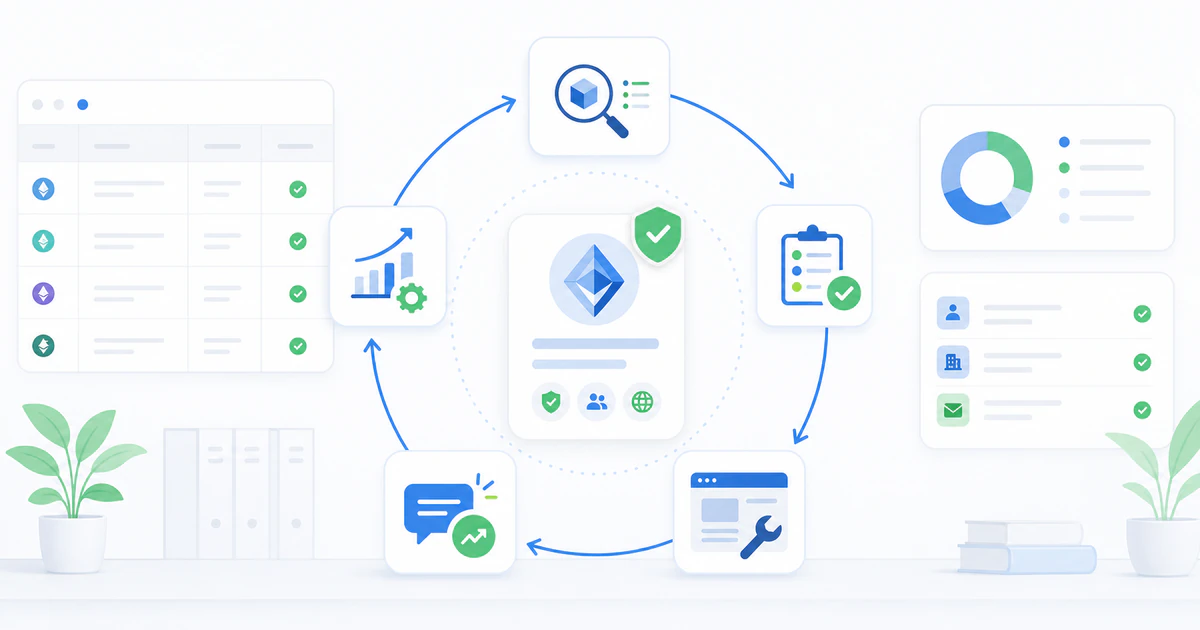
- Your first real client is a truth source, not only revenue.
- AI speeds up building, but real prospects sharpen the offer.
- Fresh token projects expose public, stage-specific service problems.
- One free LeadGenCrypto lead per day is enough to build a validation habit.
- Scale CSV, API, and CRM only after replies prove the message.
Most AI-native service businesses can polish the wrong offer faster than the market can correct it.
You can launch a landing page in an afternoon. You can generate a pitch in minutes. You can make the deck, the demo, the proposal, and the follow-up sequence look real before a single qualified crypto project has reacted.
That is the trap this article fixes.
If you sell services to token-based crypto projects, use this 7-day First Real Prospect Loop to find crypto projects to pitch, inspect one real account per day, send one useful micro-teardown offer, and let the market improve the service before you build a bigger outbound system.
For the broader discovery system, read the guide to turning fresh project discovery into a lead pipeline. This page is narrower. It is about the first few prospects who tell you whether the offer is worth scaling.
Your first real crypto client is a truth source
The first client should not be treated as proof that the business is solved. It should be treated as the first hard contact with reality.
When you are early, every part of the offer is still a guess. The service category is a guess. The problem framing is a guess. The price is a guess. The pitch is a guess. Even the type of project you think needs you may be a guess.
A real prospect gives you data that a friend, AI assistant, community comment, or landing page visitor cannot give you. They can ignore you. They can object. They can ask for proof. They can say the problem is real but badly timed. They can ask what it costs. They can forward you to another person. They can say yes to a small audit.
Those signals are useful because they come from the market you want to serve.
False signal vs real signal
A false signal sounds like validation, but it does not create pressure.
| Signal type | Example | What it really proves |
|---|---|---|
| False signal | A friend says the idea sounds strong | The idea is easy to support socially |
| False signal | AI says the landing page is clear | The copy follows a pattern |
| False signal | A community post gets reactions | The topic may be interesting |
| Real signal | A qualified project asks for the teardown | The pain may be relevant now |
| Real signal | A prospect asks for proof or price | The offer is being evaluated |
| Real signal | The same objection repeats | The offer has a positioning or proof gap |
The dangerous part is that AI can make false signals look professional. A polished pitch feels real. A polished landing page feels real. A polished demo feels real. But the useful test is whether a qualified project understands the value and takes the next step.
Use this before you count a signal as real:
Real Signal Checklist

[ ] The project matches the service category I want to sell.
[ ] The timing makes sense right now.
[ ] I can see one public reason they might care.
[ ] The contact route is business-relevant.
[ ] The reply, objection, or silence teaches me what to improve.
Next action: before you write another pitch, write down the one thing you need the market to prove or disprove this week.
Y Combinator's guide to practical user observation supports this sequence: observe and speak with real potential users first, then scale only after the pattern becomes clear.
Fresh token projects are better validation targets than generic Web3 companies
Newly launched token projects have live public pressure. That makes them useful for early validation.
A generic Web3 company may be interesting, but it may not have urgency. A fresh token project usually has visible launch surfaces: a website, token page, chain, public channels, basic messaging, maybe a community, maybe a trust gap, maybe a listing or tracker profile.
That matters because your first outreach should not be generic.
You should be able to say, in plain language, "I noticed this specific thing, and here is why it may matter now."
That is much easier when the project is fresh.
What service providers can spot in public
| Service provider type | Visible trigger | Useful first observation |
|---|---|---|
| PR agency | Token is live but launch story is unclear | The project has features, but no simple press angle |
| SEO or content provider | Website exists but search pages are thin | The project has no pages for obvious buyer or community questions |
| Audit or security firm | Token is public but trust proof is weak | Security claims are hard to verify from public pages |
| Listing or exchange team | Token is live on one chain | Discovery and listing readiness are incomplete |
| Community growth team | Social channels exist but the path is messy | Attention is not routed toward a useful action |
| Influencer or AMA seller | Community is active but launch content is weak | The project needs a clearer promotional hook |
| Conversion consultant | Landing page exists but calls to action are unclear | Visitors do not know the next step |
You do not need to be harsh. You need to be specific.
A useful first observation is not "your marketing is bad." A useful first observation is "your homepage explains the token mechanics, but a new visitor cannot find a simple reason to trust the team before reaching the call to action."
Why timing beats company size
Early service providers often chase the biggest names they can find. That can be a mistake.
Large projects may have teams, vendors, processes, and locked budgets. Fresh projects may have messier operations, but their problems are closer to the surface. They are still forming their story. They are still learning which channels matter. They are still patching trust gaps.
That is exactly where a small, useful service can enter.
Fresh Project Timing Filter

[ ] The token or public project page is recent enough to feel active.
[ ] The project has a visible business or credibility gap.
[ ] My service can improve one small part of the launch surface.
[ ] I can explain the issue without needing private data.
[ ] The first step can be a teardown, checklist, or small pilot.
Next action: choose one service problem you can spot from public information before you contact anyone.
Where to find your first real crypto prospects
At the validation stage, the goal is not the largest list. It is enough real prospects to learn whether the offer creates interest.
Manual research teaches you the market. Communities teach you language. LeadGenCrypto gives you a repeatable daily input. Use each source for its job.
| Method | Best use | Strength | Weakness | Best time to use it |
|---|---|---|---|---|
| Token listing platforms | Learn what fresh projects look like | Good for pattern recognition | Slow to turn into verified contacts | Days 1 to 3 |
| Blockchain explorers | Find very fresh activity | Strong timing signal | Requires filtering and context | Days 1 to 5 |
| Crypto communities | Learn language and objections | Shows how teams talk about pain | Noisy and hard to systemize | Ongoing |
| LeadGenCrypto free daily lead | Build a daily validation habit | One real project input per day | Limited volume by design | Days 1 to 14 |
| CSV export | Build a small batch after proof | Easier to route and track | Can scale a weak message too early | After reply signals |
| Public API | Automate intake into systems | Good for repeatable operations | Too early before message proof | After a working workflow |
| CRM sync | Manage stages and follow-up | Prevents forgotten conversations | Adds overhead if too early | After several active threads |
The LeadGenCrypto Leads docs explain the Free plan behavior: one free lead can be claimed every 24 hours, and delivered rows can include website, token address, blockchain, token name or symbol, verified emails, and other information. That is enough context to run the loop without pretending you have a mature sales machine.
If you want to understand what a higher-quality contact list should contain before you scale, read why static crypto project contact lists go stale.
Use manual research for market literacy
Manual research makes you look at the market with your own eyes.
Spend a few days opening token pages, websites, docs, and communities. Notice what repeats. Which chains appear often? Which websites feel unfinished? Which projects have a real story? Which ones look risky or low quality? Which ones look active but under-served?
This creates judgment.
Do not let manual research become a hiding place. If you spend all week researching and contact nobody, you did not validate anything.
Use communities for language, not as your only pipeline
Communities are useful because they show the words people use when they are not being pitched.
You may see teams complain about fake engagement, audit pressure, listing questions, weak documentation, community distrust, bad PR, low-quality influencers, or unclear token utility. Those phrases should shape your outreach.
But communities are noisy. They are not a clean pipeline. Use them to improve the message, then bring that message to specific projects.
Use one daily LeadGenCrypto lead for discipline
One free lead per day sounds small. At the beginning, that is a feature.
It stops you from hiding behind volume. You have one project. You need to inspect it. You need to find a real observation. You need to write one useful message. You need to record the result.
One-Lead Rule

One lead.
One public observation.
One micro-offer.
One respectful message.
One recorded result.
One improvement before tomorrow.
Next action: use manual research to learn the market, but use one daily project contact to force contact with reality.
The 7-day First Real Prospect Loop
Do not use the free daily lead like a tiny cold email campaign. Use it like a founder exercise.
The purpose of the 7-day loop is to learn whether the right projects understand your offer. It has four outputs:
- A clearer ideal customer profile.
- A sharper message.
- A smaller first offer.
- A decision to keep, pivot, or kill.
For a larger sample after this first week, use the broader guide on validating a Web3 service idea with cold outreach. This loop is the smaller daily version you can run before a 100-account sprint.
Day 1: choose one narrow promise
Do not start with "we help crypto projects grow." That is too broad.
Choose one promise that can be tested through public information.
| Broad promise | Testable first promise |
|---|---|
| We help Web3 projects grow | We find 3 trust leaks on new token launch pages |
| We do PR for crypto projects | We map 3 launch angles for newly listed tokens |
| We improve SEO | We identify 5 search pages a token project should own |
| We do community growth | We audit the path from community attention to action |
| We do security consulting | We review the public security story before users ask questions |
A narrow promise makes the reaction easier to read. If nobody responds, you know what was tested.
Days 2 to 4: send one useful message per day
Take one LeadGenCrypto lead each day. Open the project. Look at the website, token symbol, chain, token URL, and public channels. Look for one issue connected to your service.
Then write a short message around that issue.
Do not ask for a meeting first. Ask if they want the small artifact.
A small artifact could be:
- a 3-point landing page teardown;
- a 3-angle PR map;
- a listing-readiness note;
- a trust-gap review;
- a short SEO opportunity map;
- a community conversion audit.
Days 5 to 6: turn interest into a micro-audit
If a project replies, do not rush into a large proposal.
Send the micro-audit. Make it useful. Keep it tight. Show that you understand the project's current stage. Then suggest one small paid next step if the problem is real.
Micro-Audit Format

1. What I noticed:
2. Why it may matter now:
3. What I would fix first:
This is also useful when prospects do not buy. The act of creating the audit teaches you what a good project looks like and where your service creates leverage.
Day 7: decide keep, pivot, or kill
Do not judge the week only by revenue.
Judge it by signal quality.
| Signal | Interpretation | Decision |
|---|---|---|
| Relevant replies and teardown requests | The pain may be real | Keep and refine |
| Replies, but confusion about the offer | Target may be right, but wording is weak | Pivot the framing |
| Same objection repeats | You found a positioning or proof gap | Fix proof and try again |
| No replies and no clear reason to care | Target, trigger, or pain may be weak | Change the ICP or offer |
| Interest but no willingness to act | Problem may be annoying, not urgent | Reduce scope or improve timing |
Next action: run the loop for 7 days before you rewrite the landing page or scale outreach.
Write the first message as a micro-teardown, not a generic pitch
A generic pitch asks the prospect to trust you. A micro-teardown gives them a reason to trust you.
Crypto inboxes are sensitive. Many teams receive low-quality vendor pitches, scam-like messages, fake partnership offers, and vague promotion claims. Your first message should do the opposite.
It should be specific, useful, easy to decline, and tied to public context.
The first-message structure
Use this structure:
First-Message Structure

1. I noticed your project is live.
2. I saw one public detail connected to my service.
3. I think it may affect trust, visibility, conversion, or launch momentum.
4. I can send a small teardown if useful.
5. If not relevant, you can say no.
This works because it reduces risk. You are not asking them to buy. You are asking whether a relevant small artifact would help.
Subject: Quick question about {{tokenSymbol}} on {{blockchain}}

Hi team at {{website}},

I noticed {{tokenName}} is live on {{blockchain}}. I pulled your token URL from {{tokenUrl}}.

I work with [service category] for newly launched token projects. One thing I noticed on your public pages is [specific observation]. It may affect [trust, visibility, conversion, launch story, or outreach readiness].

Would it be useful if I sent a quick 3-point teardown?

If this is not relevant, reply "no" and I will not follow up.

Thanks,
[Your Name]
If you need a wider protocol after this validation loop, use the step-by-step cold email framework for Web3 service providers.
What to avoid
Avoid messages that sound like this:
- "We are the leading agency in Web3."
- "We can guarantee growth."
- "We have a huge network of investors."
- "We can get you listed everywhere."
- "Let us schedule a call to discuss synergies."
Those lines create risk. They do not create trust.
Next action: rewrite your first message so the prospect can say yes to a small teardown without booking a call.
Use replies to polish the product, not only to sell
Every reply is product research. Every silence pattern is product research too.
Your first prospects are not only potential buyers. They are the people who show you whether the product makes sense in the real world.
If the same confusion appears twice, your offer is unclear. If prospects ask for examples, your proof is weak. If they ask for price, you may have intent. If they say they already have someone, your differentiation may be too broad.
| Prospect reaction | What it may mean | What to improve |
|---|---|---|
| No reply | Weak timing, weak relevance, weak first line, or wrong inbox | Improve trigger and first sentence |
| "Not interested" | Wrong ICP or too generic | Narrow the target segment |
| "Send more info" | Curiosity exists, but value is unclear | Add a concrete micro-outcome |
| "Do you have examples?" | Trust gap | Build a sample teardown or proof asset |
| "What does this cost?" | Possible buying signal | Prepare a small paid pilot |
| "We already have someone" | Category is understood, but differentiation is weak | Show a sharper wedge |
| "Maybe later" | Timing is not strong enough | Find a better launch or urgency trigger |
Objections are not interruptions. They are requirements.
Reply Feedback Loop

[ ] Copy the exact objection or question.
[ ] Label it as timing, trust, price, clarity, ICP, or proof.
[ ] Rewrite one sentence in the offer.
[ ] Rewrite one line in the first message.
[ ] Add one proof asset, example, or micro-audit if needed.
[ ] Test the improved version with the next daily lead.
Next action: create a simple objection log before you send the next message.
Score each daily lead before you spend time on it
When you only use one lead per day, selection matters. Do not contact a project just because it exists.
A validation lead should have fit, timing, a visible problem, reachability, and urgency. If it does not, the silence may not tell you much.
| Criterion | Question | Score |
|---|---|---|
| Fit | Does this project match the service category? | 0 to 2 |
| Timing | Is the project newly launched or visibly active? | 0 to 2 |
| Visible problem | Can you find one specific issue before outreach? | 0 to 2 |
| Reachability | Is there a relevant verified email or contact channel? | 0 to 2 |
| Urgency | Would solving this problem matter now? | 0 to 2 |
| Total score | What to do |
|---|---|
| 8 to 10 | Send a personalized message today |
| 5 to 7 | Research more before sending |
| 0 to 4 | Skip for now or save for later |
Imagine you sell launch-page trust audits.
You open today's free lead and see a new token project with a live website, active social links, and a token page. The homepage explains token mechanics, but it has no clear trust path for a first-time visitor. There is no visible team section, no clear audit status, and no simple explanation of why the launch matters now.
That is a good validation prospect.
Your message does not need to be dramatic. It can say that the public launch page may be asking new visitors to understand the token before it gives them a reason to trust the project. Then offer a 3-point teardown.
Next action: score your next lead before you open your email tool.
Scale only after the message earns the right to scale
CSV, API, CRM, and automation are powerful after you have a signal. Before that, they can multiply a weak guess.
This is the most common mistake in AI-native outbound. The founder builds the system before the message has earned the system.
A clean CRM does not fix a vague offer. An API does not fix a weak trigger. A large contact export does not fix a message that no one understands.
Before choosing what to change, use the lead-versus-offer constraint matrix to separate offer failure from targeting, proof, deliverability, sales, or delivery problems.
Scale after you have evidence.
Scale-Readiness Checklist

[ ] I have sent at least 7 highly personalized validation messages.
[ ] I have at least 2 real replies, teardown requests, or repeated objections.
[ ] I know which project type is most promising.
[ ] I know which public trigger creates the strongest first line.
[ ] I have a small paid pilot ready.
[ ] I have a suppression process for projects that say no.
[ ] I have basic deliverability and list hygiene in place.
When those boxes start getting checked, you can move from one daily lead to a repeatable pipeline.
For data operations, look at pulling new token project contacts via the Public API. Once replies and follow-ups become hard to remember, use a CRM workflow instead of tracking everything in your head.
If you want a low-pressure first input, start with the free daily lead, inspect one project, and write one useful teardown offer before you scale the list.
LeadGenCrypto Blog and Updates
Get sharper validation and outreach notes
Subscribe for short, practical emails on finding token projects, testing service offers, and turning fresh Web3 signals into better B2B conversations.
- Fast summaries of new LeadGenCrypto articles
- Practical ideas for teams selling services to crypto projects
- Useful resources, templates, and outreach angles without hype
Keep first-client outreach respectful and scam-aware
Validation is not an excuse to spam. The fastest way to lose trust in crypto is to sound like every risky vendor in the inbox.
The first-client loop only works if the prospect feels that the message is relevant, respectful, and easy to decline.
Use business-relevant contact data and public project context. Do not scrape personal inboxes or contact people who have no clear business reason to receive the message.
Make the opt-out obvious:
If this is not relevant, reply "no" and I will not follow up.
Then honor it.
Treat this as general information, not legal advice. Review the email, privacy, and outreach rules that apply to your audience and jurisdiction before scaling sends.
Also verify the opportunity before you invest time. Crypto has low-quality projects, impersonators, clones, and scams. Before you spend serious delivery effort, check the project's website, token page, social channels, team signals, community quality, and basic legitimacy.
Trust and Safety Checklist

[ ] The website and token URL appear connected.
[ ] The project has consistent naming across public surfaces.
[ ] The contact channel looks business-relevant.
[ ] The project is not making obviously suspicious promises.
[ ] I can explain why my outreach is relevant.
[ ] I included a clear opt-out.
[ ] I will suppress the contact if they say no.
Before larger sends, run a cold outreach pre-flight checklist to catch list, copy, deliverability, and compliance issues.
Next action: treat relevance as the first compliance layer.
Copy-paste checklist for the first 7 real crypto prospects
The goal is to finish the first week with real market feedback, not a perfect system.
Use this checklist as the working version of the First Real Prospect Loop.
First 7 Real Crypto Prospects Checklist

Strategy
[ ] I chose one narrow service promise.
[ ] I defined the project type I want to reach.
[ ] I wrote down the visible trigger that makes timing relevant.
[ ] I chose one micro-audit I can offer quickly.

Daily lead workflow
[ ] I used one LeadGenCrypto lead today.
[ ] I inspected the website, token URL, blockchain, and public context.
[ ] I scored the lead before sending.
[ ] I found one specific public observation.
[ ] I wrote a message around a micro-teardown, not a generic pitch.
[ ] I included a clear opt-out.
[ ] I recorded the result.

Learning workflow
[ ] I copied every reply, objection, or silence pattern into a log.
[ ] I labeled the signal as timing, trust, price, clarity, ICP, or proof.
[ ] I improved one line of the offer before the next message.
[ ] I repeated the process for 7 days.

Decision
[ ] I decided whether to keep, pivot, or kill the offer.
[ ] I prepared a small paid pilot if the signal was positive.
[ ] I delayed CSV, API, and CRM scale until the message earned it.
This loop is deliberately small.
Small is good at the beginning. Small forces clarity. Small makes it harder to hide behind tools. Small gives the founder direct contact with the market.
Once the signal is real, you can scale the system. Until then, the one free daily lead is not a limitation. It is the training weight.
FAQ
Is one free LeadGenCrypto lead per day enough to validate an offer?
Yes, if you use it properly. One lead per day is enough to test message clarity, project fit, and the strength of your micro-offer. It is not enough to run a full outbound campaign, but that is not the goal in the first week.
Who is this workflow for?
This workflow is for agencies, freelancers, consultants, auditors, PR teams, SEO providers, community growth teams, listing services, and other B2B service providers selling services to token-based crypto projects.
Who is this workflow not for?
It is not for token buyers, traders, investors, retail acquisition, or projects looking for fundraising leads. The audience is service providers who want to sell useful work to crypto projects.
Should I ask for a call in the first message?
Usually, no. Ask whether the project wants a small teardown first. A call is a larger commitment. A micro-teardown is easier to accept and gives you a clearer signal.
What if nobody replies in the first week?
No replies can still teach you something. It may mean the project type is wrong, the trigger is weak, the message is too generic, or the offer is not urgent enough. Change one variable and test again.
What is the best first offer for a service provider?
The best first offer is small, specific, and easy to understand. Examples include a 3-point landing page teardown, a launch-angle map, a trust-gap review, a listing-readiness note, or a short SEO opportunity map.
When should I move from free leads to CSV export or API?
Move when you have real signals: relevant replies, repeated objections, teardown requests, or pricing questions. Scaling before that only multiplies uncertainty.
Can AI write the outreach message for me?
AI can help draft and edit. It should not replace the founder's judgment. You still need to inspect the project, choose the real observation, and decide whether the outreach is relevant.
How do I avoid sounding like spam?
Be specific. Mention one public observation. Offer one small artifact. Avoid hype. Include a clear opt-out. Do not send irrelevant messages to contacts who have no reason to care.
What should I measure during the first 7 days?
Measure signal quality, not just revenue. Track replies, teardown requests, objections, pricing questions, and repeated patterns. Those signals tell you what to improve before you scale.