Can an AI Sales Agent for Crypto Outreach Replace Junior Reps?

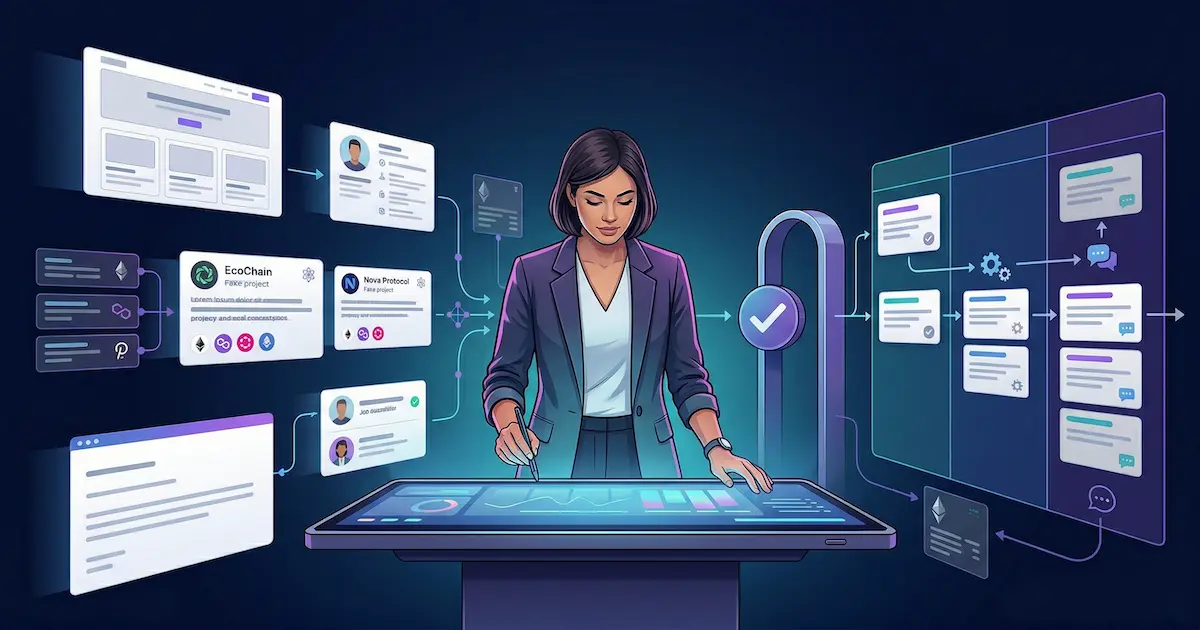
- Agencies can automate research, enrichment, routing, and first-draft outreach work today.
- Junior reps still matter when judgment, negotiation, approvals, or calls decide outcomes.
- Review speed, data freshness, and suppression rules decide whether the economics work.
- LeadGenCrypto can feed daily project contacts into CSV or API-based workflows.
- Start with one offer, one reviewer, one channel, then scale carefully.
- Human review gates should stay in place until reply quality stays consistently strong.
If you run an agency, consultancy, dev shop, audit firm, listing desk, PR team, or growth studio that sells services to token-based crypto projects, this article is for you.
It is not for token buyers, traders, or teams looking for investors.
Here, leads means project contacts and outreach targets, not customers for a token.
By AI sales agent for crypto outreach, I mean a system that researches prospects, enriches context, drafts first touches, and routes work before a human closer steps in.
I call this the Replace, Review, Escalate Framework. By the end, you will know which junior-rep tasks can already be automated, which ones still deserve human review, and where the economics make sense for teams that sell services to crypto projects.
If your team only needs pre-send research and a sharper first touch, start with AI prospect research on public pages before the first email. If you need the full outbound protocol, use a step-by-step cold email framework for Web3 service providers. This article answers a different question: how much of a junior-rep workload a hybrid system can safely take over.
How this guide differs from other resources on this site: it does not replace the six-step sales process for agencies selling to token projects (stages, field map, CRM automation patterns). It focuses on workload split, reviewer economics, and where AI should stop before a human sends. If your issue is weak replies or funnel leaks after send, start with diagnose your outbound funnel before scaling instead.
| If your main question is | Start with |
|---|---|
| Which junior-rep tasks to automate versus review first | This article (Replace, Review, Escalate) |
| End-to-end CRM stages, imports, and automation patterns | Human + automate sales process in six steps |
| Copy, sequence, and trust protocol for cold email | Cold email to crypto projects, step by step |
| Public-page research and one first email only | AI teardown before the first email |
What an AI sales agent for crypto outreach can replace today
A junior rep is a bundle of tasks, not a single job title. The useful move is to separate repetitive pre-negotiation work from judgment-heavy work that still needs a human.
The winning setup is not "AI replaces sales." It is "AI clears the queue before sales touches it." For agencies and service providers, the most automatable work usually happens before a real sales conversation starts. An audit firm can let the agent flag newly launched projects with visible docs and contracts. A PR agency can let it summarize public announcement pages and spot likely marketing contacts. A dev shop can route projects by chain and offer fit before a human ever opens the record.
| Task in the workflow | Best owner today | Why |
|---|---|---|
| Build or refine ICP rules | Hybrid | AI proposes segments, a human accepts the tradeoffs |
| Find target token projects | AI first pass | Search, filtering, and repeatable screening are structured tasks |
| Remove clients and duplicates | AI plus rules | Good suppression logic catches waste before outreach starts |
| Enrich company context from public pages | AI first pass | Fast to produce and usually quick to review |
| Guess likely decision-maker and route | Hybrid | Directionally useful, but often incomplete |
| Draft first-touch email | AI draft, human edit | High speed, uneven judgment |
| Call, negotiate, and handle objections | Human | Trust, nuance, and adaptation still matter |
| Approve final send | Human | Brand, compliance, and opportunity quality are on the line |
Before you automate any step, use this five-point gate:
- Define the task in a short SOP.
- Check whether a reviewer can verify the output in less than two minutes.
- Limit automation to work where a wrong answer has small downside.
- Suppress duplicates automatically before the step runs.
- Tie the result to a real business action.
Then use the framework this way:
- Replace work that is repetitive, documented, and easy to verify.
- Review work where the model is useful, but a wrong answer would still waste time or budget.
- Escalate anything involving live conversation, hard judgment, unclear fit, or reputational risk.
The human role does not disappear. It narrows. Your rep stops spending hours jumping between trackers, docs pages, and contact forms. Instead, they reject weak records, adjust messaging for the best targets, and work the replies that can actually become pipeline.
List every junior-rep task from the last two weeks. Mark each item Replace, Review, or Escalate before you buy another tool.
The economics break when review is slow, not when tokens are expensive
An AI SDR for crypto projects is usually an operations question, not a prompt question. The system works when a reviewer can approve outputs quickly and confidently.
That is why the compute bill is rarely the whole story. If a reviewer needs 90 seconds to approve a record, the workflow can make sense fast. If that same reviewer needs nine minutes to repair every output, the savings disappear even if model usage looks cheap on paper.
True operating cost
= model usage
+ tool fees
+ retries
+ failed enrichments
+ QA time
+ deliverability and suppression maintenance
Here is an illustrative workload model for one agent-driven pass:
| Step | Illustrative token load | Why it matters |
|---|---|---|
| Decide plan and tool stack | 3,400 | Planning is cheap, but still real work |
| Pull and normalize company list | 18,000 | Intake quality shapes everything downstream |
| Read the company website | 9,500 per company | Public pages usually give the clearest context |
| Review search results for the likely decision-maker | 12,300 per company | Useful, but often noisy and incomplete |
| Review job listings and hiring context | 14,600 per company | Helps infer timing and current priorities |
| Assess fit against your offer | 15,200 per company | Good prompts help, but clean inputs matter more |
| Write the email draft | 15,500 per company | Fast to generate, risky to send raw |
The direct cost story can look excellent because a hybrid system can process far more companies in hours, not weeks. The hidden costs show up elsewhere: setup and orchestration, weak upstream data, incomplete decision-maker clues, duplicate handling, and the QA tax of fixing bad drafts.
The math usually works when all five conditions hold:
- A clear service is aimed at a clear segment.
- Fresh project records reach the queue daily or weekly.
- Human review happens before anything gets sent.
- Duplicates and prior contacts are suppressed automatically.
- Team time shifts toward replies, calls, and real opportunities.
If the offer or positioning still feels fuzzy, validate it with a short cold outreach sprint to token projects before you invest in agent automation. Before you scale AI-assisted volume, run a pre-flight outreach checklist for agencies so review time stays low.
Before you model ROI in a spreadsheet, get a free verified lead to test data quality and time how long a reviewer needs to approve it.
Measure review minutes per approved record for one week. Raise volume only after edit time drops and reply quality stays steady.
Fresh data matters more than smarter prompts
A smart agent on stale inputs is still a weak system. In crypto outreach, freshness matters because launch timing, legitimacy, and relevance can shift quickly.
This is where LeadGenCrypto fits. The platform delivers verified leads of newly launched token-based crypto projects on a daily cadence. In this article, that means daily project contacts and outreach targets, not customers for a token. A record can include the website, token address, blockchain, token name, token symbol, one or more verified emails, and often Telegram.
That matters because the agent starts from a cleaner record before it tries to score fit, summarize public context, or draft a first touch. The operating model becomes simple: fresh records enter the input queue, the agent enriches and drafts, the human approves or rejects, then the CRM logs the result. Teams can export to CSV for manual QA or use pull new token project contacts via the Public API with viewRecentLeads and viewLatestLeads when they want CRM sync or a token project contacts API for agencies and service providers. Create API keys in Settings before you automate scheduled pulls, and use the CRM integration pattern when you map fields into HubSpot, Kommo, or similar stacks.
Use a simple intake contract before you let the workflow run:
Minimum agent intake contract
- Limit records to blockchains and project types that match our offer
- Exclude every current client, closed-lost account, and prior contact
- Attach one fit score and one short reason
- Save the source page for each important claim
- Stop drafting when an email or token URL matches the exceptions list
A PR agency may filter for active launch activity and verified emails. An audit firm may care more about chain, docs depth, and technical pages. A growth studio may want fresh launches plus one clear reason why the offer fits right now. Before you scale, set network filters and exceptions to avoid duplicates so the same project does not hit the queue twice and burn budget.
Write your intake contract in plain English today. If a reviewer cannot explain why a record entered the queue, the agent is not ready to scale.
Review-first handoff: CRM stages that force approval before send
Most crypto outreach automation tools fail at the handoff, not the draft. If the CRM does not force review, the agent simply helps you send mistakes faster.
This section is not a full CRM pipeline blueprint. For stage definitions, CRM field maps, and import or API patterns, use human + automate sales process to crypto projects in six steps first. Here, the job is to align a few stages with mandatory human approval so AI drafts never ship unchecked.
For that reason, AI cold email for crypto outreach should stop at draft stage until the review loop is clean. The point of automation is to reduce low-value research time, not to remove accountability from the send decision.
| Stage | Primary owner | Success metric | Fail-safe |
|---|---|---|---|
| Target intake | System | Relevant projects enter the queue | Filter by ICP and blockchain |
| Enrichment | Agent | Useful context lands in structured fields | Store source pages and confidence |
| Fit assessment | Agent plus reviewer | Clear accept or reject decision | Reject low-confidence records |
| Email drafting | Agent | Draft is mostly usable | Human edits high-value targets |
| Final send decision | Human | Relevant, respectful first touch | No send without review |
| Follow-up and calls | Human | Meetings and qualified replies | Escalate only real opportunities |
A practical pipeline also needs visible fields that force quality control:
Required CRM fields before send
Status:
Offer fit:
Why now:
Source page:
Verified contact:
Reviewer:
Next action:
Keep the operational rules simple. Contact relevant business roles, not random personal emails. Preserve the source notes so reviewers can verify claims quickly. Add a clear opt-out to sequence logic. Maintain suppression lists and exceptions. Treat this as business development, not mass blasting. For a wider tactic menu beyond this review-first map, read ten outreach tactics for selling services to token projects. This is operational guidance, not legal advice.
If your domains, authentication, and list hygiene are weak, better prompts will not save you. Pair the rollout with email validation and list hygiene before sending.
Do not blast cold email via Mailchimp, Mailgun, UniSender, or Apollo bulk. Expect spam placement.
Replace junior sales rep with AI by launching a small hybrid workflow
The real win is not full replacement. The real win is moving human time out of tab-hopping and into replies, calls, and opportunity handling.
In practice, that means shrinking the junior role into a narrower lane. Let the system collect project contacts, summarize public context, draft the first pass, and route the record. Let humans handle ambiguous fit, brand-sensitive edits, live conversations, and deal movement. If you still need the discovery side, use the delegate-ready playbook for finding crypto projects to pitch and layer this review system on top. When you are ready to connect outreach tools to sequences, market-driven outreach sequence design for token projects covers timing and length without duplicating this workload split. When you use Instantly or similar senders, follow this Instantly walkthrough for crypto outreach so human approval still gates every send.
Copy and paste this checklist into your operating doc:
- Pick one ICP, one service, and one outreach goal.
- Decide which fields the agent must fill before review.
- Start with fresh project contacts rather than a stale spreadsheet.
- Load current clients, prior contacts, and closed-lost accounts into exceptions.
- Let the agent research public pages and draft the first pass.
- Require one fit score plus one written reason.
- Force human approval before any send goes out.
- Route approved records into your CRM or outreach stack.
- Log every reject reason so the workflow learns what not to guess.
- Watch reply quality, not just output volume.
- Audit reviewer time each week and tighten weak prompts or inputs.
- Keep calls, negotiation, and edge cases with humans.
Use this quick rule before you commit more budget:
- AI first for repetitive work that is easy to verify.
- Hybrid for work that is useful, but still risky to trust raw.
- Human only for live conversation, messy judgment, and opportunity handling.
Run the framework on 25 records this week. Keep approval notes beside each record so you learn what the agent should never guess again.
If you want more client conversations with new token teams, claim a free verified token project lead and start outreach today.
Frequently Asked Questions (FAQ)
Can an AI agent really replace a junior rep today?
It can replace a meaningful share of routine workload, especially research, enrichment, routing, and drafting. It cannot safely replace live conversations, negotiation, or final judgment.
What is the best first use case for an AI SDR for crypto projects?
Start with pre-negotiation work. Project discovery, public-page research, fit scoring, routing, and first-draft email generation are the strongest first use cases.
Which outputs should AI prospect research for crypto projects actually produce?
It should produce a short, reviewable packet: what the project is, why it may fit your offer, which public pages support that view, and whether a verified contact is available.
Do I need a token project contacts API, or is CSV enough?
CSV is enough when a human reviewer wants batch checks or manual imports. API intake makes more sense when you want records to enter a CRM or agent workflow continuously.
How accurate must AI cold email for crypto outreach be before it is useful?
It does not need to be perfect. It needs to be accurate enough that a reviewer can verify and improve it quickly without rewriting every line from scratch.
Which fields belong in a CRM pipeline for crypto project outreach?
At minimum, include status, offer fit, why-now context, source page, verified contact, reviewer, and next action. Those fields make review faster and mistakes more visible. For a fuller pipeline view and automation patterns, see the six-step CRM and outreach process for token projects.
Where do crypto outreach automation tools usually break first?
They usually break at data quality, duplicate handling, weak fit logic, and deliverability. Most failures come from workflow design, not from the model alone.
How does LeadGenCrypto fit in this stack?
It fits at the input layer. Fresh project records, verified contacts, blockchain filters, CSV export, API intake, and exceptions handling make the rest of the workflow more reliable.
When should a human step in immediately?
A human should step in when the fit is unclear, the contact looks risky, the offer needs judgment, the account is strategically important, or a live reply arrives.
LeadGenCrypto • Blog & Newsletter
The Operator's Field Notes
Subscribe for steady updates, practical sales and outreach ideas, and short resources for teams that sell services to crypto projects. We send compact emails you can skim between calls.
Brief digests of new articles so you catch the takeaway without the scroll marathon
Actionable prompts you can paste into reviews, sequences, or team standups
Calm tone, no pump language. Unsubscribe in one click if it is not useful.