How to Find Crypto Projects to Pitch and Build a Lead Pipeline

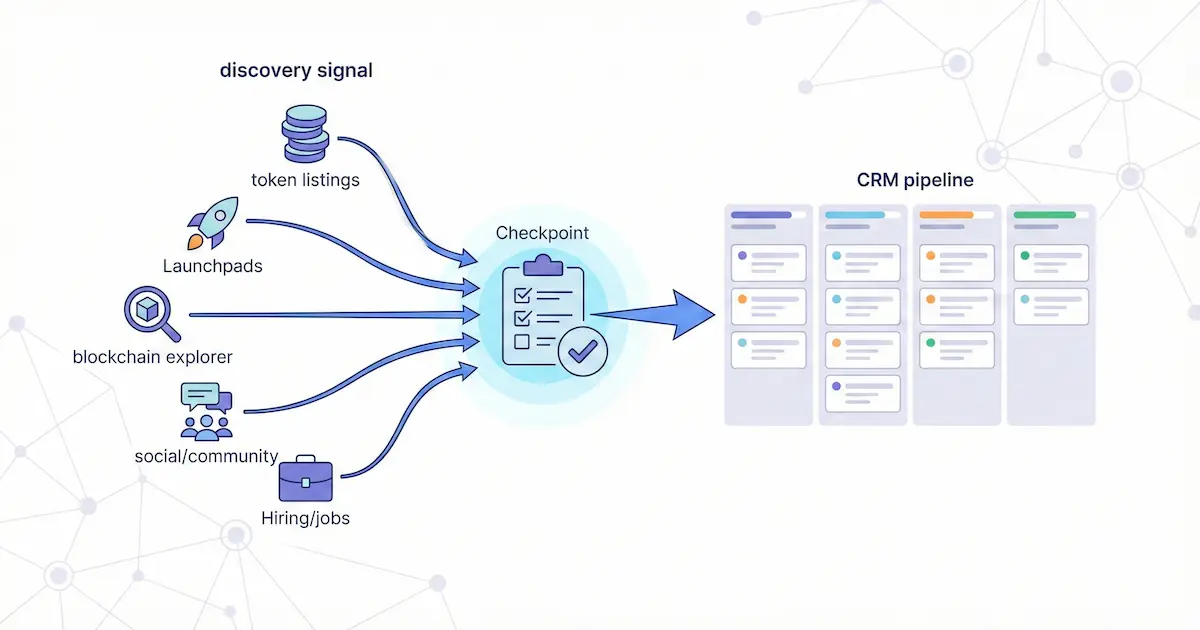
- Track new token launches across listings, launchpads, explorers, jobs, and communities.
- Qualify fast using a scorecard, filter noise before writing outreach.
- Capture project contacts from official sources, then personalize with on-chain proof.
- Build a CRM pipeline with stages, follow-up rules, and duplicate prevention.
- Automate dealflow with LeadGenCrypto using CSV exports or Public API sync.
- Use filters and exceptions to avoid duplicates and protect outbound budget.
If you sell services to token-based crypto projects (agency, studio, or specialist operator), your pipeline is only as good as your discovery engine. This guide shows how to find crypto projects to pitch and turn that into a daily, delegate-ready lead pipeline. When we say leads, we mean project contacts and outreach targets for agencies and service providers, not token buyers or investors.
How this guide differs from other resources. This page is the hands-on pipeline playbook: what to do each day, which channels to monitor, how to qualify and capture contacts, and how to run a CRM pipeline you can hand to a teammate. For the higher-level operating system (segment choice, ICP, compliance, and pipeline measurement), see the Crypto Project Acquisition operating system. For a single-channel deep dive, use the CoinMarketCap, CoinGecko, BscScan, or the DexScreener New Pairs workflow for early pairs across chains.
Crypto moves fast. The number of token projects launched each month shifts by chain and cycle, so static databases go stale quickly. Use fresh signals and a simple system instead of a one-time list (see why static contact lists go stale for agencies). See the data behind that velocity in the charts for new token projects launched per month by chain.
How to Find Crypto Projects to Pitch using a signal-based discovery loop
Early-stage projects allocate service budget fast, and the window is short. Your goal is not to find every project, it is to spot the right ones while they still have urgency.
A practical way to do this is a signal-based loop:
- Discover: watch places where launches and milestones appear first.
- Verify: confirm the project is real, active, and service-ready.
- Capture: store contacts and context so outreach is relevant.
- Sequence: match timing signals to the right offer.
- Sync: push the record into your CRM so follow-up is consistent.
This approach is the opposite of "hunt until you're tired." It is a repeatable pipeline you can delegate.
The dealflow signals that usually matter for service providers
Most service buying happens around visible milestones. Here are the triggers worth tracking, and what a service provider can pitch without sounding generic:
- Token launch or first traction: onboarding, positioning, lifecycle emails, community ops, growth experiments.
- Audit announced or completed: follow-up security content, post-audit PR, developer relations, documentation cleanup.
- Listings momentum: listing support, market making readiness, PR amplification, analytics and reporting.
- Funding announcement or treasury event: go-to-market planning, PR, partnerships, reporting.
- Product release: onboarding fixes, docs, lifecycle messaging, growth experiments.
- Hiring wave: team onboarding, process tooling, brand refresh, recruitment marketing, internal comms.
Quick template: the "stage-fit" one-liner
Use this as a mental check before you write any outreach:
- Signal observed: the milestone you can point to publicly
- Risk they feel: what breaks if that milestone goes sideways
- Asset you can offer: a small deliverable you can ship in 48 hours
- Next step: a low-friction teardown or a short call
The point is to force relevance before you hit send.
Pick two milestones you can reliably deliver around, then write your stage-fit one-liner for each.
Build a new token launches list for agencies and service providers from high-signal channels
There is no master directory of new crypto projects, so you need a channel mix. The best channel mix gives you both coverage (enough volume) and intent (teams that actually buy services).
Below is a practical channel stack you can use to build a new token launches list, then turn it into outreach targets.
Channel decision table: where to find projects and what to pitch
| Channel | What you actually get | Why it works for service providers | What to do next |
|---|---|---|---|
| Listing sites (CoinMarketCap, CoinGecko) | Newly listed tokens and project sites | Listing-driven teams care about visibility and growth | Review site and comms, pitch the next missing piece |
| Launchpads and token sale calendars | Pre-launch and launch announcements | Great for pre-launch relationship building | Offer post-launch support, PR, community ops, partnerships |
| Blockchain explorers and on-chain feeds | Verified contracts and early token activity | Often earlier than mainstream trackers | Verify the website and contact routes, then qualify quickly |
| Social and community channels (X, Telegram, Discord) | Real-time milestones and narrative shifts | Crypto happens in public and moves quickly | Confirm via the official website, then capture proof points |
| Job boards and freelance marketplaces | Public buying intent and budget signals | Hiring is a loud signal of spend | Map the job post to a packaged offer and timeline |
| Events and ecosystem communities | Relationship-first access to founders | Higher trust, lower scale | Capture contacts, set follow-ups, then systematize |
For detailed workflows on two of these channels, use our guides on turning CoinMarketCap new listings into an outreach list and doing the same with CoinGecko.
Listing site playbook: find the "missing piece" you can fix
When a project pushes for listings, it is usually investing in growth. Your job is to spot what is clearly broken for their current stage, then pitch one fix, not everything.
Common gaps that create an easy, credible first message:
- Positioning is vague, and the homepage does not explain the product.
- Onboarding is missing, users cannot tell what to do first.
- Partnership pages are thin, and there is no clear partner CTA.
- Comms look messy, updates are inconsistent across channels.
What "high-signal" looks like on each channel
Use these micro-checks to avoid drowning in noise:
- Listing site check: find the project site, then scan for an actual team contact route.
- Launchpad check: confirm the sale date, then build a post-launch offer, not a hype pitch.
- Explorer check: look for verified token pages and consistent project metadata. For a dedicated on-chain workflow, see our BscScan prospecting guide.
- Social check: save a milestone post, then verify it against the project's own site.
- Job check: extract scope, timeline, and channel, then build a tight starter package.
- Event check: collect a clear follow-up hook (not just a business card and a promise).
Pick three channels you can monitor weekly, then assign a 30-minute sweep on your calendar.
Qualify prospects so your crypto project outreach list stays worth your time
The fastest way to lose outbound efficiency is to contact everything that moves. If you are building a crypto project outreach list for agencies, qualification is what protects your time, deliverability, and reputation.
The goal is not perfect accuracy. It is making sure your next 50 messages go to real teams who can buy help.
A 5-minute qualification scorecard
Score each project quickly. If it fails the basics, archive it and move on.
| Check | Pass criteria | Why it matters |
|---|---|---|
| Website quality | Real product story, not a single-page meme | Service buyers invest in clarity |
| Contact path | Team email, form, or verified channel listed | You need a real route to talk |
| Narrative consistency | Site, token page, and social match each other | Inconsistency is a risk signal |
| Activity signal | Recent updates, shipping, or community activity | Dead projects do not buy services |
| Buyer fit | Your offer maps to their current milestone | Relevance drives replies |
Qualification checklist you can hand to a VA
- Confirm the website exists and loads reliably.
- Find a contact route on the site (email, form, or official channel).
- Cross-check token details on an explorer for basic legitimacy signals.
- Screenshot one milestone signal (listing, launch, audit, hiring, partnership).
- Write one sentence explaining why your service is the next logical step.
- Mark the record as "ready" only if it passes your minimum bar.
If you want a real example of why timing and qualification matter, a PR team shared in a LeadGenCrypto case study that manual prospecting delayed outreach until budgets were already allocated elsewhere. Before you scale sends, run a pre-flight checklist for cold lead generation in crypto to protect deliverability and offer clarity.
Define your minimum bar as three pass criteria, then stop outreach below that bar.
Create a crypto projects contact list with verified emails and Telegram
Most projects look "discoverable" long before they are "contactable." Your advantage comes from capturing verified crypto project contact emails for agencies and service providers, plus the context that makes your message believable. If you are building a crypto projects contact list for agencies and service providers, store the contact route and the proof point together.
Start with official sources. It keeps your list cleaner and your outreach safer.
Where to capture contacts (ranked by reliability)
- Official website: contact page, footer email, press kit, partnership page.
- Verified token pages: some explorers display official links or contact fields.
- Official social profiles: Telegram and Discord are often linked from the site.
- Hiring pages: role postings sometimes include operational inboxes.
Avoid scraping personal emails from random GitHub commits or doxxing databases. It is risky, and it is a fast way to get spam reports.
The contact capture schema (store this per project)
Use a simple structure so your list can become a CRM asset, not a messy spreadsheet:
website
tokenAddress
blockchain
tokenName
tokenSymbol
contactEmails
telegram
sourceSignal
notes
dateAdded
Cold email template for service providers (use proof, not hype)
Subject: Quick question about {{tokenSymbol}} on {{blockchain}}

Hi team at {{website}},

I saw {{tokenName}} is live on {{blockchain}}. I pulled the token URL from {{tokenUrl}} and noted the contract at {{tokenAddress}}.

I run a service team that helps token projects with [your service category]. Based on your public pages, I can share a short teardown with 2 to 3 fixes you can ship this week.

If you want it, reply "yes" and I will send it over.
If this is not relevant, reply "no" and I will not follow up.

Thanks,
[Your Name]
For the full sequence and trust-building protocol, follow our cold email to crypto projects step-by-step guide. If you need deliverability guardrails before you scale, use the checklist in crypto cold email outreach best practices for agencies.
Do not blast cold email via Mailchimp, Mailgun, UniSender, or Apollo bulk. Expect spam placement.
Build a CRM pipeline for crypto project outreach for agencies and service providers
A list does not become pipeline until follow-up is consistent. The fastest teams win because they turn discovery into a CRM routine, not because they "found a secret list."
If you want to sync token project contacts to CRM for agencies and service providers, you need three things:
- one record per project (not per email)
- contacts attached to that record
- a stage model that forces next actions
Pipeline stages that work for Web3 services
| Stage | Entry rule | Exit rule | Operator note |
|---|---|---|---|
| Discovered | You saw a launch or milestone signal | Verified and captured contacts | Keep raw records separate from ready ones |
| Qualified | Passes your minimum bar | Message drafted and queued | Add one proof point and one stage-fit angle |
| Contacted | First touch sent | Reply or no-response sequence complete | Keep daily send volume stable |
| Conversation | Two-way replies started | Meeting booked or disqualified | Move fast, crypto attention is short |
| Proposal | Scope and outcome agreed | Closed-won or closed-lost | Document objections for future positioning |
| Nurture | Not ready now | New signal appears | Re-enter based on triggers, not time |
CRM field checklist (minimum viable)
- Project name and website
- Blockchain and token address
- Primary contact email(s) and Telegram (if present)
- Source channel (listing, launchpad, explorer, social, job, event)
- Stage-fit angle (one sentence)
- Last touch date and next action
- Duplicate prevention notes (what inboxes to avoid)
Create these stages in your CRM today, then move one real project through them end to end.
For a fuller CRM and automation setup (including sync and follow-up rules), see the six-step sales process for agencies selling to crypto projects. If your pipeline is already running but underperforming, use the pipeline bottleneck and metrics guide to diagnose and fix weak spots.
Automate your pipeline with LeadGenCrypto (CSV, filters, and API)
Manual prospecting does not scale in crypto because dealflow shifts daily. LeadGenCrypto is built for agencies and service providers who sell services to token-based crypto projects, and it helps you find newly launched projects and reach them with verified contact data, not token buyers. For the full picture on lead streaming instead of static lists, see the API and streaming guide.
LeadGenCrypto delivers verified leads of newly launched token-based crypto projects on a daily cadence.
Here is what you can operationalize without changing your whole stack:
Option 1: Start with the daily leads feed
Use the Leads page documentation to understand what a lead record includes. A lead can include the project website, token address, blockchain, token name and symbol, verified email(s), and often Telegram.
Practical use case for an agency:
- Pull fresh records daily.
- Filter by the chain(s) you actually service.
- Route "ready" projects into a short outbound sequence.
Option 2: Export to CSV for fast ops
If you prefer spreadsheets first, export token project contacts to CSV and import into your CRM or outreach tool. This is the easiest way to validate your workflow before you automate.
Option 3: Use the token project contacts API for agencies and service providers
If you want automation, use the Public API quick reference with actions like viewRecentLeads and viewLatestLeads.
A practical integration pattern looks like this:
- Pull the latest leads on a schedule.
- Upsert by website and token address to avoid duplicates.
- Create or update a single "Project" record, then attach contacts.
- Assign an owner based on chain, region, or service line.
The CRM integration pattern shows how to structure that upsert logic in a way that works across CRMs.
Because the API is standard JSON over HTTPS, it can also be connected to custom solutions, including automation tools and AI-agent workflows. For example, teams can route new lead records into internal enrichment pipelines or agent systems like OpenClaw (formerly Moltbot), if that matches their sales motion.
Protect budget and reputation with filters and exceptions
Duplicate outreach is one of the easiest ways to look spammy. Use network filters to stay in your lane, and upload email and/or token URL exceptions to avoid re-contacting the same inboxes or re-buying the same projects. See the setup workflow in Filters and Exceptions.
If you are new to the platform, start with the quick setup steps in the How to Start guide and then automate from there.
Decide your starting workflow (CSV or API), then run it for seven consecutive days.
Copy-paste checklist: a daily pipeline you can delegate
Consistency beats intensity in crypto outbound. A small daily system will outperform a "big list" that you touch once. The checklist below is the main takeaway of this guide: a delegate-ready daily pipeline you can hand to a teammate or run yourself.
Copy, paste, and adapt this checklist for your team:
- Monitor 3 discovery channels and capture 10 to 30 new projects.
- Verify each project with the 5-minute scorecard, then label it.
- Save one proof point per project (milestone, listing, audit, hiring).
- Capture contacts from official sources, then store emails and Telegram.
- Write one stage-fit angle sentence in your CRM notes.
- Send first touches from a warmed mailbox with stable daily volume.
- Log replies, objections, and stage changes for future positioning.
- Add exceptions for any inbox that opts out or is a duplicate.
- Review wins and losses weekly, then refine your qualification bar.
If you want to put this into practice with real contact data, claim a free verified token project lead and run one project through the pipeline this week. For a broader map of inbound and outbound tactics, see the Ultimate Guide to Crypto B2B Lead Generation.
Hand this checklist to a teammate and ask for a weekly pipeline report.
LeadGenCrypto • Blog & Newsletter
Stay in the loop without the noise
Get timely updates, practical sales advice, and useful resources for teams selling services to crypto projects, delivered straight to your inbox.
- Quick summaries of our latest articles so you can skim or go deep
- Actionable ideas to boost sales and fill your pipeline
- Templates and checklists you can use the same day
- No hype. Unsubscribe anytime with one click.
Frequently Asked Questions (FAQ)
Is this guide for token projects looking for investors or token buyers?
No. This is for agencies and service providers selling services to token-based crypto projects. When we talk about leads, we mean project contacts for outreach, not customers for the token.
What is the fastest way to build a new token launches list?
Use a channel mix: listing sites for coverage, launchpads for pre-launch signals, explorers for early verification, and social for real-time milestones. Then qualify quickly so the list stays usable.
How do I know a project is real before I pitch?
Start with basics: real website, consistent narrative across channels, verified token details, and recent activity. If the contact route is missing or the story changes everywhere, archive it.
What should I pitch first to a brand-new token project?
Pitch what reduces risk right after launch: messaging fixes, onboarding, community ops, analytics, PR support, partnership support, or technical cleanup. Tie it to a milestone you can prove.
How do I find verified crypto project contact emails?
Prioritize official sources: the project website, verified token pages that list official links, and official community profiles linked from the site. Avoid scraped personal emails.
What is a good CRM structure for crypto outreach?
Keep one record per project, attach contacts to it, and use stages with clear entry and exit rules. That structure is what turns "contacts" into a CRM pipeline that produces follow-ups.
Can I sync token project contacts to my CRM automatically?
Yes, if your workflow needs automation. Use CSV exports for a quick start, then use the Public API actions such as viewRecentLeads and viewLatestLeads to pull new records and upsert them into your CRM.
How do I avoid contacting the same inbox twice?
Deduplicate at two levels: project-level (website and token address) and contact-level (email). If you use LeadGenCrypto, upload email and token URL exceptions and keep filters aligned to your target chains.
How many cold emails should a small agency send per day?
Start with a stable volume that protects deliverability and allows personalization. Many teams do better at 30 to 60 new first touches daily per mailbox, then scale based on reply quality, not a volume target.
Pick one discovery channel, one offer, and one CRM stage model, then run it this week.