Crypto Projects SEO Outreach Email List: Send, Suppress, or Recycle

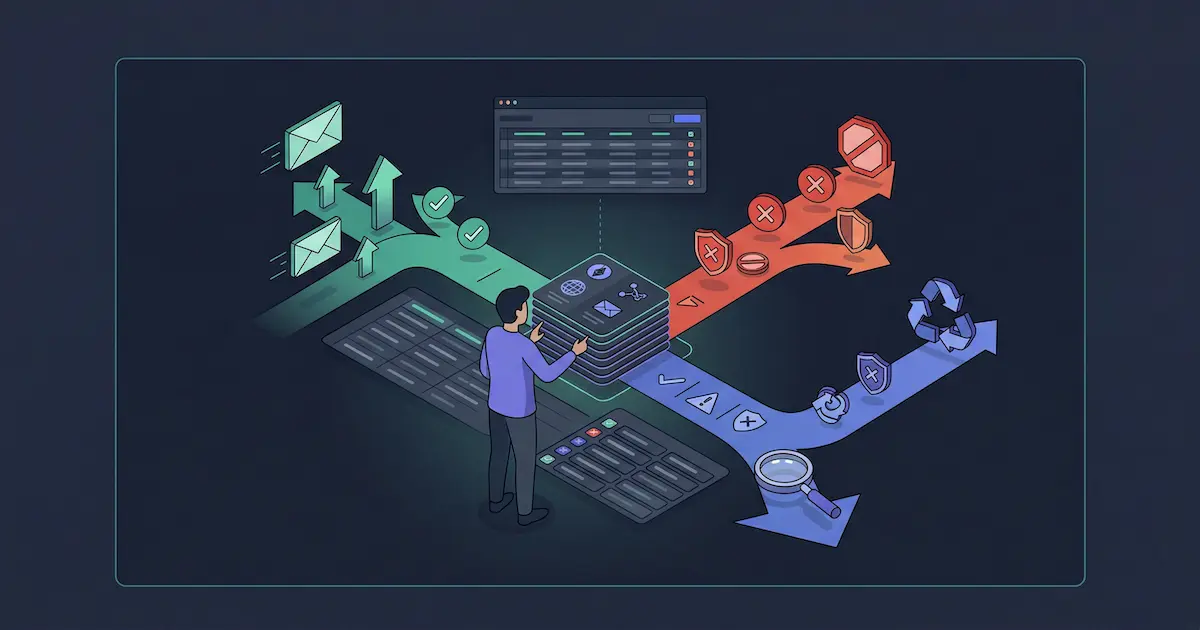
- B2B service sellers win with smaller, cleaner lists, not bigger spreadsheets full of guesswork.
- This page is crypto SEO outreach list triage: label each row as send, suppress, or recycle before anyone writes copy.
- Strong records pair public proof, chain context, fit notes, and verified contacts.
- Suppress duplicates, stale inboxes, prior conversations, and poor-fit projects before copywriting.
- Recycle borderline leads when timing is unclear, contact quality is weak, or proof is thin.
- Manual cleanup proves rules first, CSV scales them, and API keeps intake fresh.
- LeadGenCrypto helps route project contacts into filters, exports, CRM sync, and exceptions.
If you sell SEO, link building, content, or related services to crypto projects, this guide is for you. It is not for token issuers hunting buyers, investors, or exchange demand. Crypto SEO outreach list triage means you label each spreadsheet row before copywriting, not after a campaign is loaded.
Elsewhere on the site you can go deep on sourcing, what “verified” should mean at intake, and how to validate inboxes. Those questions come first in the stack. This article sits one step later: you already have candidate rows, and each one still needs a blunt call. Does it earn a first touch now, sit in a suppress bucket, or go back to recycle until proof and timing improve?
If your bottleneck is still “we need more names,” start with how to build a discovery-to-pipeline workflow. If the bottleneck is a noisy sheet where half the rows should never reach copy, stay here and run the sections below in order.
The hard part is not finding more names. The hard part is deciding whether each record is safe, relevant, and timely enough to contact. A large spreadsheet still fails when it mixes stale inboxes, duplicates, poor-fit projects, and rows with no real context. If your rows look clean but replies stay flat, troubleshoot the full outbound funnel in order so you fix list issues before you rewrite copy.
What makes an SEO outreach row usable before copywriting
Email alone is not list quality. A row is usable only when a sender can explain why this project, why this service, and why now. If the offer itself is fuzzy, fix how services map to crypto projects first; routing rules below assume you can state the fit in one sentence.
For service providers, your first touch needs enough context to sound informed. A link building team may need the website, the chain focus, a content gap, and a verified business contact. A technical SEO consultant may need the website, token context, a crawl or indexing clue, and a source page that proves the crypto project is live. A guest post seller may need the website, the niche, and one reason the team is likely buying exposure now.
The same logic applies whether you are assembling crypto projects link building contacts, a crypto guest post buyers list, or a broader crypto project outreach list.
| Field | Why it matters for service providers | What happens if it is missing |
|---|---|---|
| Website | Lets you verify the project is live and review public pages | Recycle or suppress if the site cannot be confirmed |
| Token name and symbol | Prevents confusion across similar projects and token URLs | Recycle until identity is clear |
| Blockchain or chain focus | Helps match the row to your actual service line | Suppress when the project is outside your market |
| Source page or token URL | Gives you proof for timing and personalization | Recycle if you cannot explain why the row entered the queue |
| Business contact, ideally verified email | Gives you a real route for B2B outreach | Suppress risky addresses, recycle weak ones |
| One fit note | Turns data into a send decision | Recycle until the offer fit is explainable |
Use this minimum-send template before you write a single email:
Website:
Token name / symbol:
Blockchain:
Source page:
Business contact:
Why our service fits now:
Route:
Owner:
If you cannot fill these fields in plain English, the row is not ready. It may still become usable later, but it is not usable now. For the wider path from first touch to revenue, see a repeatable acquisition system for token project outreach.
Pull 20 rows from your current sheet. Mark any row without a website, source page, business contact, or fit note as not send-ready.
Send, Suppress, or Recycle: the routing model
The goal is not maximum list size. The goal is maximum safe first sends.
The simplest way to protect list quality is to force every record into one of three routes before copywriting. This prevents the common mistake of treating every contact as equally ready.
| Route | Use it when | Next action |
|---|---|---|
| Send | The website is live, the offer fit is clear, the timing is relevant, and you have a real business contact | Write the first touch and send at controlled volume |
| Suppress | The row is a duplicate, the address looks risky, the project is irrelevant, or the team has already been contacted | Block the row from future sends and log the reason |
| Recycle | The project may fit, but the contact is weak, timing is unclear, or more research is needed | Set a review date and return when the record gets stronger |
A few practical examples help. A new DeFi project with a live site, a verified business email, and a clear need for content or technical SEO belongs in Send. A project that is already a client, already in conversation, or duplicated through multiple token URLs belongs in Suppress. A launch with a live website but only a Telegram link, no business email, and no strong fit note belongs in Recycle until you can improve the record.
Keep the reason codes simple enough for a team to use consistently:
SEND = live website | business contact | source saved | fit clear
SUPPRESS = duplicate | risky address | prior contact | current client | poor fit
RECYCLE = fit possible | timing unclear | weak contact | more research needed
The point is not perfect categorization. The point is to stop weak rows from drifting into the send queue because nobody made a decision.
Routing decision matrix: signals to routes
Use this when a row is messy but not obviously duplicate or unsafe. Pick the route that matches the first failing gate you cannot clear today.
| If this is true | Route | Why |
|---|---|---|
| Live website plus verified business contact plus saved source page plus a one-line fit note you can defend | Send | The row clears minimum-send criteria and timing still makes sense |
| Same domain, token URL, or email already in clients, active convos, suppression, or a prior batch | Suppress | Repeating the row wastes budget and can look sloppy |
| Fit might work later, or contact is generic, or proof is thin, or timing is unclear | Recycle | You need research, a better inbox, or a trigger before a first touch |
When two cells could apply, default to the safer route: Suppress beats Send for duplicates and risk; Recycle beats Send when the fit note is forced or the contact is a guess.
Force every row in your active batch into one route today. If a teammate cannot defend the route in 15 seconds, send it back for review.
Where list quality breaks before the first email
Most bad outreach starts as bad intake, not bad copy. Once weak records enter the queue, every later step gets more expensive.
This is also where email list verification before sending stops being a side task. List hygiene for crypto outreach and email validation for cold outreach belong inside triage.
SEO sellers usually lose quality in the same places:
- Old emails that still look valid in a sheet: A row can look complete and still be stale. That is why validation belongs before scale, not after the campaign is loaded.
- Duplicate projects hiding behind different token URLs: One project can surface through multiple launch pages, token pages, prior spreadsheets, or on-chain exports. If you dedupe by email only, you still spend time and budget on the same account twice. When you blend explorer-based sourcing, tighten intake with a staged BscScan funnel built for teams pitching token projects before you apply the same Send, Suppress, or Recycle labels.
- Generic inboxes with no role context:
info@orcontact@is not always wrong, but it becomes weak when you have no clue who monitors it and no fit note that justifies the send. - Projects outside your chain or service focus: If you only sell SEO to infrastructure, DeFi, or specific networks, a broad list creates self-inflicted poor-fit outreach.
- Rows with no website, no source page, and no why-now note: Those rows force the copywriter to guess, which usually ends in generic messaging.
- Current clients or prior conversations still sitting in the queue: That is a process failure, not a copy failure.
Use this suppression and hygiene checklist before anyone writes copy:
- Match domains against current clients and past outreach.
- Compare token URLs, root domains, and contact emails for duplicates.
- Remove rows with no live website or no usable source page.
- Recycle generic inboxes when the fit note is still weak.
- Validate business emails before you scale volume.
- Log one reason code for every suppressed record.
A useful crypto outreach suppression list should track email, domain, token URL, route, and reason code so you can dedupe crypto project contacts before another batch goes live. When your tooling is LeadGenCrypto, upload email and token URL exceptions so duplicates sit out of new exports the same way you apply Suppress labels in a sheet.
This section overlaps with deliverability, but it is not a full validation manual. For the deeper workflow, use validate your list before scaling cold outreach and review why static contact databases break fast in crypto outreach. For pre-flight checklist before you send cold outreach, see the scorecard that covers offer, list quality, and copy in one pass.
Do not blast cold email via Mailchimp, Mailgun, UniSender, or Apollo bulk. Expect spam placement.
Manual cleanup, CSV rules, or API-fed intake
The right workflow depends on volume and repeatability. A small team can start in a spreadsheet, but repeated triage deserves rules that survive handoffs.
| Workflow | Best when | Where it breaks | What to standardize first |
|---|---|---|---|
| Manual spreadsheet cleanup | You are proving the first version of your routing logic | The same mistakes repeat every week | Route definitions, reason codes, and required fields |
| CSV-based enrichment | You already have a list and need to merge, tag, dedupe, and route it | The list changes too often for manual review | Import headers, dedupe rules, suppression logic |
| API-fed intake | You want fresh projects entering a CRM or queue on a regular cadence | The team has no stable field map or no review process | Field mapping, routing rules, and reviewer ownership |
Teams that move triaged rows into a sequencer can align CSV headers and send windows with an Instantly-oriented workflow for agencies pitching token projects.
The progression is simple. Start with one segment, prove the rules in a sheet, move the same rules into CSV imports, then automate intake only after the reviewer can explain why a row qualifies. When ownership and CRM stages need tightening, map human review and automation across a six-step pipeline.
A lightweight field map keeps each workflow aligned:
projectWebsite, tokenAddress, blockchain, tokenName, tokenSymbol, contactEmail, telegram, sourcePage, fitNote, route, reasonCode, owner
Where LeadGenCrypto fits in this workflow
LeadGenCrypto fits at the intake layer. It delivers verified leads of newly launched crypto projects on a daily cadence. A lead can include the website, token address, blockchain, token name, token symbol, verified email(s), and often Telegram.
That matters because triage works better when the input is fresh and structured. Teams can get a free verified lead to test data quality, export approved rows to CSV for review, pull new token project contacts via the Public API using actions such as viewRecentLeads and viewLatestLeads, set network filters and exceptions to avoid duplicates, and sync token project contacts into your CRM. For a wider view of ICP, sourcing, and nurture alongside row routing, read the end-to-end B2B playbook for service providers working with token projects.
Even teams working from verified crypto project contact emails for service providers still need route rules, reviewer ownership, and exception handling. In practice, that means you can apply blockchain network filters before research starts, export to CSV when the team wants manual review, or move approved records into a CRM when the process is stable. The same workflow also supports email and token URL exceptions so duplicates and prior contacts do not keep draining budget.
Prove the route logic on one chain and one service line first. Then move the same fields into CSV imports and API mappings without changing the rules.
Copy-paste checklist before the first send
A good outreach list is the shortest list you can defend. If a row cannot survive a plain-English review, it does not belong in the send queue.
Use this before every SEO outreach batch to crypto projects:
- Check that the project website is live.
- Match the row to the service you actually sell.
- Save one public source page for context.
- Tag the relevant blockchain or network.
- Remove duplicate domains, emails, and token URLs.
- Upload email and token URL exceptions where needed.
- Validate the business email before scale.
- Add one sentence on why your offer fits now.
- Route the record to Send, Suppress, or Recycle.
- Approve the first email only when the row is explainable in plain English.
Good lists are not the longest lists you can export. They are the shortest lists your team can defend. After a row is Send, use a step-by-step cold email framework for Web3 service providers so the sequence matches the proof you saved during triage.
Paste this checklist into your CRM stage notes or QA SOP. Require every reviewer to clear the list before a first touch is approved.
If you want more client conversations with new token teams, claim one free verified lead and run it through Send, Suppress, or Recycle before your team writes copy.
LeadGenCrypto • Blog & Newsletter
List hygiene notes for teams pitching crypto projects
Add your email if you want timely updates, grounded sales tips, and resources built for B2B service sellers working with crypto projects. Straight to your inbox, no fluff, no filler dashboards.
- Short digests of new articles so you see what changed before your next batch
- Concrete outreach and triage ideas you can hand to SDRs or account leads
- Checklists and snippets you can drop into CRM QA, not vague trends
- Honest tone, easy opt out, whenever you want to stop
Frequently Asked Questions (FAQ)
These are the questions that usually surface when a team turns a rough spreadsheet into a real outreach queue.
Is this article for B2B service sellers, or for crypto projects looking for buyers?
It is for consultants, founders, and teams that sell services to crypto projects. It is not about finding token buyers, investors, or retail customers.
What does a send-ready record need?
At minimum, it needs a live website, clear project identity, chain context, a source page, a business contact, and a short fit note. If one of those is missing, the row is usually recyclable at best.
Should I suppress every generic inbox?
No. A generic inbox can still work when the website is live, the service fit is clear, and the contact route is the best public business option. When the inbox is generic and the fit note is weak, recycle it instead of forcing a send.
When should I recycle a record instead of suppressing it?
Recycle when the project may fit but the contact is weak, the timing is unclear, or the source evidence is thin. Suppress when the row is a duplicate, a bad fit, risky, or already worked.
Do I need a separate crypto outreach suppression list?
Yes, if your team merges rows from multiple sources or runs repeated batches. A dedicated suppression layer prevents repeats, protects budget, and keeps current clients or prior conversations out of the send queue.
How do I dedupe crypto project contacts?
Check more than one field. Use the root domain, contact email, and token URL together. That catches the common case where the same project appears multiple times through different token pages or exports.
Is manual cleanup enough for most teams?
It is enough to prove the rules. It stops being enough when you repeat the same cleanup every week, hand rows between people, or need fresh intake at a daily rhythm. That is usually the point where CSV rules or API intake becomes worth it.
Where does email validation fit in the process?
It belongs after initial fit screening and before scale. Validate too late and you waste research time. Skip it entirely and you raise domain risk.
What does LeadGenCrypto add to this workflow?
It gives teams fresh project contacts at the input layer. That includes verified leads of newly launched crypto projects, fields such as website, token address, blockchain, token name, token symbol, verified email(s), and often Telegram, plus CSV export, Public API access, blockchain filters, and exceptions handling.
How often should recycled and suppressed records be reviewed?
Recycled rows should return on a fixed cadence, often weekly or after a real trigger such as a launch update or a better contact route. Suppressed rows should stay blocked unless the underlying reason changes.
Take your oldest active outreach sheet and label every row as Send, Suppress, or Recycle. The value comes from decision discipline, not from sheet size.