Crypto Project Contacts for Agencies: Why Static Lists Fail

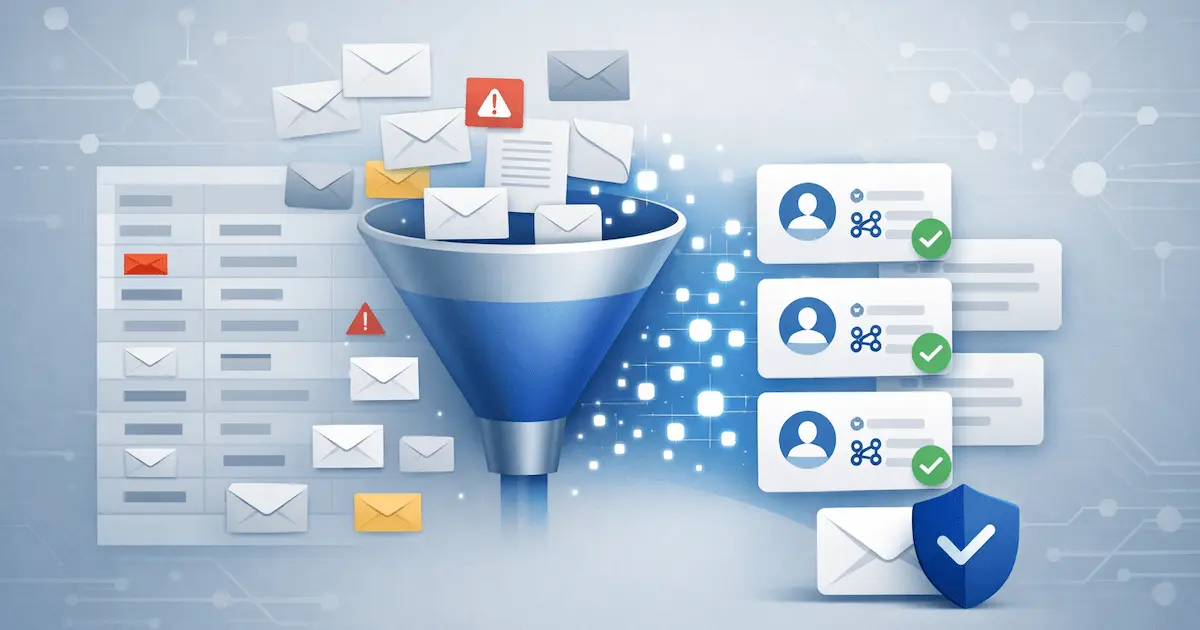
Static crypto company databases go stale fast. If you sell services to token projects, treat contact data like a living feed, then verify, dedupe, and outreach in small batches.
- Start here: List decay in crypto
- Next: What “verified” should mean
- Then: A freshness-first workflow
- Finish with: The one-screen QA checklist
Note: This guide is for agencies and service providers selling services to token projects. It is not a guide for token issuers looking for investors or token buyers.
If you are shopping for a “crypto companies email list” and your campaigns keep bouncing, landing in spam, or getting ignored, the issue is usually not your copy. The problem is the data.
This article explains why static databases fail, what to look for in verified crypto project contact emails, and how to keep a crypto projects contact list deduped and outreach-ready.
Quick start: Get one example record and review the fields before you buy anything, get a free lead.
Who this is for (and not for)
- Built for: marketing agencies, PR teams, auditors, dev shops, listing vendors, and other providers selling services to crypto projects.
- Useful when: you are comparing list vendors, researching DIY scraping, or trying to reduce bounce risk and wrong-fit outreach.
- Not aimed at: token issuers searching for investors or retail buyers.
The core problem: list decay in crypto
In Web3, contact data decays faster than in most B2B niches.
A static database is frozen in time. Crypto projects are not. Teams rebrand, replace marketing leads, rotate inboxes, change domains, and shift communication to Telegram or Discord. Even if the project still exists, the email you bought might not.
The result for agencies is predictable:
- Higher bounce rates (deliverability damage).
- More duplicates (same project in your list multiple times).
- Lower reply quality (you hit the wrong role, at the wrong time).
List decay math (a simple example)
The exact decay rate varies by segment and source. The point is that even small weekly decay compounds.
usableContacts = totalContacts * (1 - weeklyDecay) ^ weeks
Example (illustrative only): if you start with 500 contacts and 2% go stale each week, after 12 weeks you have about 500 * (0.98 ^ 12) usable contacts, which is roughly 442. If you wait longer, decay keeps compounding.
What “verified” should mean (a practical definition)
“Verified” should not mean “someone exported a spreadsheet last year.”
For agency outreach, a verified contact record should be recent and should pass basic sanity checks that reduce obvious waste.
Here is a practical definition you can use when evaluating any crypto project email database:
| Verification check | What it means in practice | Why it matters for service providers |
|---|---|---|
| Email looks deliverable | The address is formatted correctly and checked for obvious issues | Reduces bounces and protects sender reputation |
| Website is reachable | The project has a live site you can visit | Enables quick qualification and personalization |
| Project identifiers exist | You have a token address and a chain (or a reliable project URL) | Enables dedupe and clean CRM routing |
| Data is recent | The record is captured or refreshed on an ongoing basis | Aligns outreach with fast-moving buying windows |
If you personalize using data fields, keep it grounded and minimal. A safe pattern is to reference {tokenName}, {blockchain}, and what you saw on {website}, then ask a simple “micro yes” question.
Why static databases fail (5 reasons)
1) Decay outpaces your sending
Even a well-built list gets stale before most teams finish writing campaigns, setting up mailboxes, and doing follow-ups. Buying once and emailing for months is a mismatch in crypto.
2) Duplicates are baked in
Static lists are often resold, repackaged, and combined. That creates overlap across vendors and within your own CRM, which increases complaint risk and wastes spend.
3) Context is missing
A raw “email list of crypto companies” rarely includes the context that makes outreach relevant, chain, token address, lifecycle stage, or even a working website.
Without context you cannot segment, and without segmentation you sound generic.
4) Compliance and reputation risk increases
When data is stale, it is harder to honor opt-outs, harder to maintain suppression lists, and easier to re-contact the same inbox after an unsubscribe or “not a fit.” That creates avoidable risk.
5) Timing is misaligned
Service buying windows in crypto can be short. If you reach out after a launch, after a rebrand, or after the role owner changes, you miss the moment where your offer is relevant.
To compare the real cost of static lists against manual research, VA teams, and pay-per-lead delivery, see the cost and ROI breakdown for crypto outreach.
What to use instead: a freshness-first workflow
Instead of treating contact data as a one-time purchase, treat it as a pipeline you refresh.
Two practical options work for most agencies:
Manual sourcing workflow, use a source like CoinMarketCap to find new projects, then collect contact points, follow this CoinMarketCap workflow.
Streaming workflow, use a feed model that delivers new, verified contacts continuously instead of a frozen database, here is a guide to lead streaming vs static lists.
Data hygiene pipeline checklist
- Discover: identify new or newly active projects that match your ICP.
- Verify: confirm the website works and the email is not obviously broken. For a full validation workflow for verified contacts, see our Web3 list hygiene guide.
- Dedupe: remove repeats by email and by project identifier before sending.
- Enrich: add minimal context, chain, service fit, and a one-line note.
- Route: map the record into your CRM fields consistently.
- Outreach: send small batches and measure replies before scaling.
- Suppress: add bounces, opt-outs, and wrong-fit contacts to a no-contact list.
- Refresh: replace stale records with newly verified ones regularly.
How to keep your list clean
Data hygiene is what turns “contacts” into a usable crypto projects contact list.
A simple policy that works well for agencies is:
- Treat email and token URL as dedupe keys.
- Keep a suppression file for bounces, opt-outs, and “do not contact” replies.
- Segment by chain and offer before you write copy.
To prevent duplicates and protect budget, use Filters and Exceptions as part of your workflow.
One-screen list QA checklist
| QA item | Quick test | Fix if it fails |
|---|---|---|
| Bounce risk | Scan for obvious typos, dead domains, and role inboxes | Remove or re-verify before sending |
| Duplicate risk | Sort by email and project identifier | Deduplicate and keep a suppression list |
| Missing website | Check that the site loads and looks real | Skip the record until verified |
| No project ID | Confirm you have {tokenAddress} and {blockchain} or a stable {tokenUrl} | Capture identifiers so you can dedupe later |
| Wrong-fit ICP | Review chain, category, and stage notes | Re-segment or exclude |
Where LeadGenCrypto fits
LeadGenCrypto is built for teams that want verified crypto project contact emails delivered continuously, instead of buying static databases.
A grounded way to use it is:
- Daily delivery: new verified contacts for newly launched token projects arrive on an ongoing basis.
- Useful fields: records include website, token address, blockchain, token name and symbol, verified email(s), and Telegram when available.
- Targeting: filters help you focus on the chains you serve best.
- Hygiene: email and token URL exceptions help you avoid duplicates and repeated outreach.
- Workflow: export leads to CSV, automate intake with the Public API, or stream new leads into your agent or CRM with an AI agent like OpenClaw.
Want occasional outreach notes for agencies and service providers? Subscribe here: Get the Crypto Outreach Notes.
Next steps (simple checklist)
- Clarify your ICP, service category, chain, and buyer role.
- Pick a sourcing model that matches crypto speed, manual research, streaming, or a hybrid.
- Implement the QA checklist before any send.
- Add dedupe and suppression rules so you do not burn your domain on repeat contacts.
- Run a small test batch, then scale only after you see clean delivery and relevant replies.
For a replicable PR workflow using fresh contacts and a short sequence, see the PR agency lead generation case study.