Crypto Project Contacts API: Stream New Token Launch Contacts

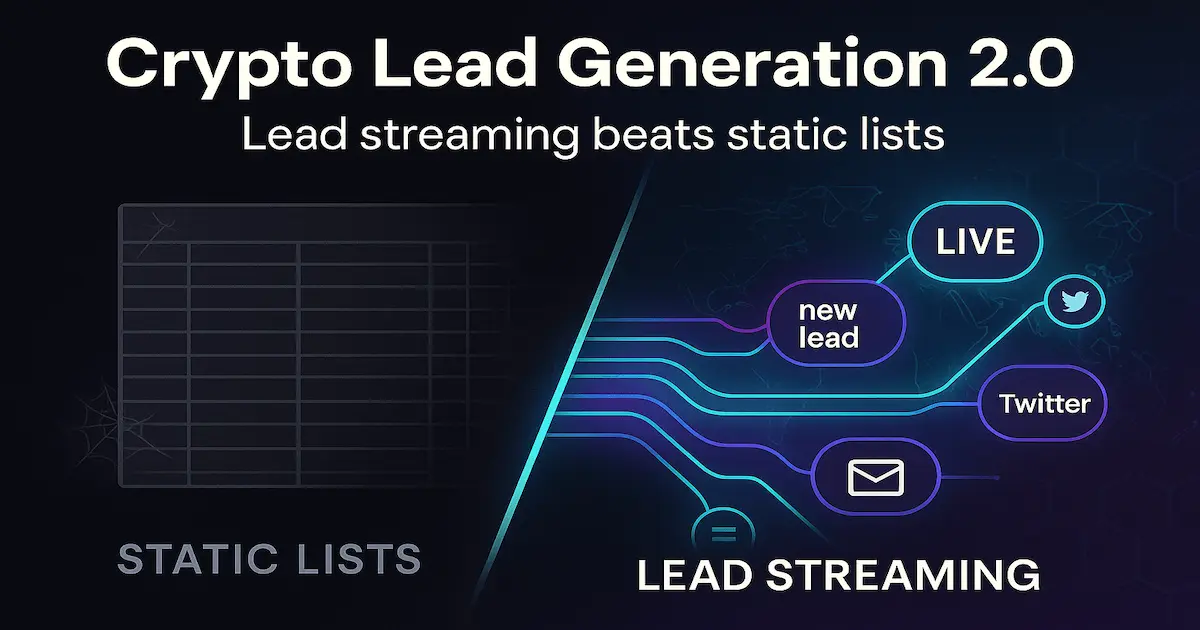
If you sell services to token-based crypto projects, list freshness is a revenue lever. A static spreadsheet of “new projects” can go stale before your first sequence finishes.
Note: This guide is for agencies and service providers selling services to token-based crypto projects. It is not a guide for token issuers looking for investors or token buyers.
Lead streaming solves the timing problem by delivering newly launched token-project contacts as a fresh daily feed, then letting you route those records into your CRM via CSV or a crypto project contacts API.
Start small and validate your workflow with real data, then automate the intake once the basics are stable: Start with one free lead.
Who this is for and who it is not
This page is designed for teams that need a repeatable intake system, not another generic “lead gen” pep talk.
Good fit:
- Agencies selling marketing, PR, SEO, growth, dev, analytics, listing, or similar services to token projects
- B2B providers building an outbound pipeline with clear targeting, tracking, and follow-up
- Operators who want a simple path from discovery to CRM to outreach
Not a fit:
- Token issuers trying to find token buyers, investors, or exchange listings via mass outreach
- Teams looking for “a database” they can buy once and use forever
Why static lists fail in crypto outreach
Static lists fail in crypto for the same reason they fail everywhere, except faster. Projects rebrand, rotate contacts, switch domains, and change priorities around launch windows.
If you want the deeper breakdown, read the pillar on contact list quality: Verified crypto project contact emails, why static databases fail.
Common failure modes to plan around:
- Decay, contacts change or disappear after launch
- Timing, your “new projects” are already saturated with vendor pitches
- Duplicates, you re-contact the same project and create complaints or opt-outs
- Mismatch, the list includes projects outside your ICP and budget band
- Risk, stale or scraped data increases deliverability and compliance headaches
What lead streaming means
Lead streaming is a freshness-first workflow where you continuously receive new token-project contact records, then decide what to do with them in your own systems.
Practical definition for agencies:
- Fresh feed, a daily delivery of newly launched projects and verified contact data
- Fast routing, records go into your CRM with consistent fields and tags
- Clean targeting, segments are filtered by chain or other criteria before you send
- Safer ops, exceptions and suppression prevent repeat contact
You can run this with a spreadsheet, but the workflow gets much easier when the intake becomes automated.
A minimal lead streaming architecture
You do not need a complex data stack to benefit from streaming. Most teams start with five layers and upgrade only when they hit volume.
Reference architecture (no-code first):
Lead feed (CSV export or Public API)
        |
        v
Intake (sheet, Airtable, or a simple database table)
        |
        v
Hygiene (Filters + Exceptions, suppression, dedupe)
        |
        v
CRM (company + contacts + token fields)
        |
        v
Sequences and reply handling (email, then optional multi-channel)
To keep this lean, focus on two outcomes:
- Routing outcome, every new record lands in the right segment and owner queue
- Hygiene outcome, you do not email duplicates or wrong-fit segments
How the LeadGenCrypto Public API fits
LeadGenCrypto supports lead streaming via CSV and via a Public API. The API is useful when you want automation and consistent daily intake.
At a high level, endpoints like viewRecentLeads and viewLatestLeads can return fresh lead records that your system can pull on a schedule, then upsert into your CRM.
When you are ready to automate intake, start here: Use the Public API. If you use OpenClaw or another AI agent, follow the step-by-step integration to pull leads into your bot.
Sample record fields to map into your CRM
Keep your data model simple. You need enough structure to personalize responsibly and route leads to the right playbook.
A practical minimum set:
- Website field:
{website} - Contract field:
{tokenAddress} - Chain field:
{blockchain} - Symbol field:
{tokenSymbol} - Name field:
{tokenName} - Token URL field:
{tokenUrl} - Email field: verified email address (standard contact field)
- Telegram field: handle when available
Important: only treat those placeholders as safe after human review. Do not let automation invent facts about a project.
Dedupe and hygiene
Streaming only works if you control duplicates. Otherwise, you burn budget and reputation by contacting the same project repeatedly.
Hygiene patterns that scale:
- Suppression, add opt-outs and “do not contact” replies to a suppression list immediately
- Exceptions, exclude known emails and token URLs so you do not re-buy or re-contact them
- Segmentation, filter by blockchain network so each playbook stays consistent
- Notes, store one short reason for inclusion so outreach stays specific
To operationalize this, use product-level controls instead of manual spreadsheet policing: Filters and Exceptions. For a step-by-step walkthrough of email and token URL exceptions, see Connect LeadGenCrypto to your email suppression list.
CRM routing patterns for agencies and providers
A streaming feed is only useful if your CRM can answer, “Who owns this lead, and what happens next?”
Simple routing rules that work without fancy scoring:
- Chain routing, segment by blockchain network and assign owners who know that ecosystem
- Lifecycle routing, tag projects as “new launch” or “post-launch growth” based on your offer window
- Service routing, map each segment to one service offer and one short sequence
If you need a full process and stage model, use the CRM playbook: Human plus Automate, a 6-step sales process for agencies selling to crypto projects. For the full picture from sourcing through outreach to revenue, see the acquisition operating system for service providers.
Automation pitfalls to avoid
Scaling makes the wins bigger, and it also makes mistakes louder. Avoid these common failure patterns before you scale volume.
Typical pitfalls:
- Over-pulling, ingesting more leads than your team can follow up on consistently
- Under-deduping, missing suppression and exceptions so duplicates slip into sequences
- Bad routing, mixing chains or offers so the message stops matching the segment
- Fast scaling, increasing send volume before your list quality and deliverability are stable
Getting started with a small test
A lightweight rollout reduces risk and keeps the system maintainable.
- Define one segment, pick one chain and one service offer
- Pull a small batch, start with the free lead and a small daily intake
- Map fields once, store website, chain, token address, and contact email cleanly
- Add hygiene early, set up Filters and Exceptions before you run sequences
- Automate later, once the CSV workflow is stable, switch intake to the Public API
LeadGenCrypto • Blog & Newsletter
Practical sales intel, straight to your inbox
Get timely updates and useful resources for teams selling services to crypto projects. No hype, no fluff. One-click unsubscribe anytime.
- Short summaries of our latest articles so you can skim and decide what to read
- Actionable ideas to boost sales and warm-lead conversion
- Templates and checklists you can use in your next campaign
- Weekly delivery so you stay in sync without inbox overload
FAQs
1) What is a crypto project contacts API?
A crypto project contacts API is a way to programmatically pull outreach-ready contact records for token-based crypto projects, then route them into your CRM and outreach workflows.
2) What does “lead streaming” mean in practice?
Lead streaming means you receive a continuous, freshness-first feed of new token-project contacts, instead of buying a one-time static database that decays quickly.
3) Can I start without code?
Yes. Many teams start with CSV export, then automate later with the Public API once field mapping and dedupe rules are working.
4) How do I avoid contacting the same project twice?
Use suppression lists, maintain email and token URL exceptions, and keep segmentation consistent. Filters and Exceptions make this easier to run at scale.