Outreach Sequence for Token Projects: A Market-Driven Guide

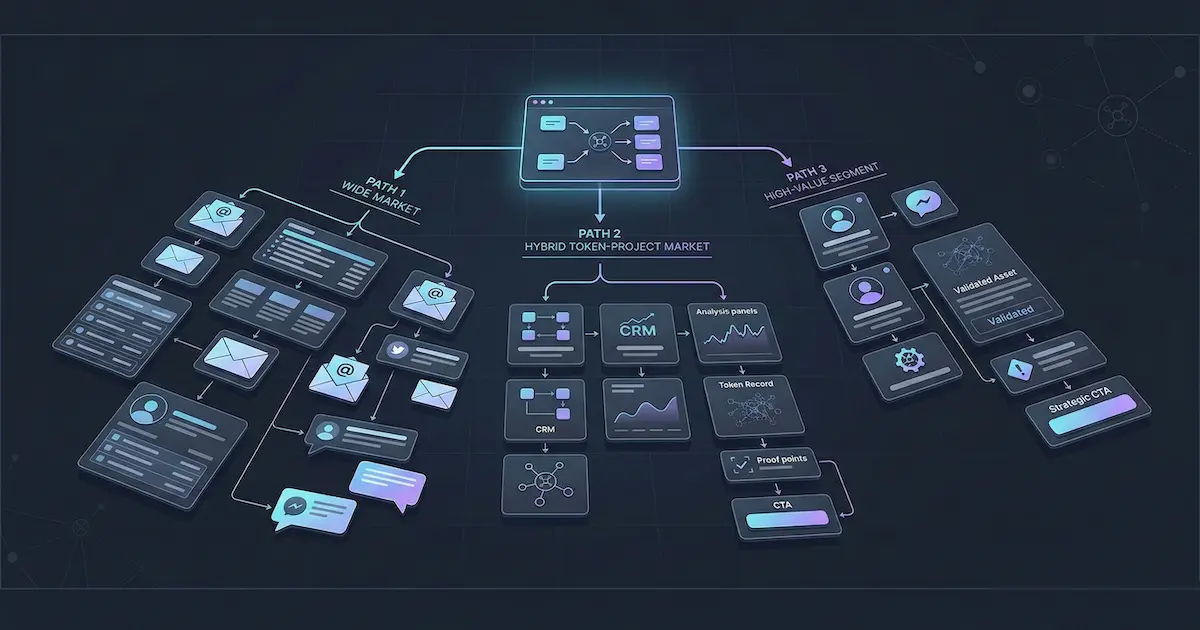
- Service providers should size sequences by market shape, not habit.
- Broad Web3 lists need coverage, while narrower segments reward depth.
- Faster time-to-value usually beats longer storytelling and more reminders.
- Every touch should carry pain, value, proof, and a micro-yes CTA.
- Use project-level data, dedupe rules, and a six-month recycle rhythm.
- Daily lead flow matters more than squeezing out two extra reminders.
If you run an agency, consultancy, exchange listing desk, audit team, dev shop, PR firm, or growth service that sells to token projects, this guide is for you. It is not for token teams looking for buyers, fundraising, or retail investors. Here, leads means project contacts and outreach targets, not customers for the token. Your outreach sequence for token projects should follow market size, segmentation, and time-to-value, not a generic seven-touch habit.
Use one rough planning model before you write copy. Treat the broader Web3 universe as a 50,000+ company market, but treat live token projects as a much smaller active layer, often closer to roughly 10,000 real opportunities at a time. The exact live count moves, which is why your coverage assumptions should stay tied to LeadGenCrypto’s monthly launch report. That report is useful because it keeps planning tied to project-level launches instead of meme-coin noise, and because newly launched token projects often buy audits, listings, liquidity support, marketing, dev help, compliance support, and tooling soon after launch.
The working rule in this article is simple:
Market size → segmentation depth → first-touch value → proof → CTA → channel mix → recycle window
That is the LeadGenCrypto outreach formula. It explains why two service providers can sell the same service, use the same list source, and still need very different sequence designs.
How this guide differs from other outreach resources. This page focuses on sequence design and planning (how many touches, which channels, when to recycle), not on copywriting, deliverability setup, or step-by-step email execution. For the full strategy layer from ICP through nurture, see the ultimate guide to crypto B2B lead generation. For the actual cold email protocol and templates, use our step-by-step cold email guide. For troubleshooting weak reply rates, use the outreach funnel diagnosis guide.
Why an outreach sequence for token projects should start with market size
Most teams start with copy, but smart teams start with market geometry. Sequence length is a market design choice before it is a writing choice.
Broad markets reward coverage. Narrow markets reward depth. Borderline markets should start broad, then deepen only when the extra effort is justified by better conversion.
| Market shape | Typical example | Recommended sequence | Channel mix | Personalization depth | Why it wins |
|---|---|---|---|---|---|
| Broad market | All Web3 companies | 3 to 4 touches | 1 to 2 channels | Light to medium | Coverage usually matters more than handcrafted follow-up depth |
| Hybrid market | Live token projects | 4 to 8 touches | 2 channels | Medium | The market is smaller, but still too large for deep work on day one |
| Narrow market | Chain-specific or role-specific token segment | 10 to 20 touches | 3 or more channels | Deep | Missing one account is expensive, so extra relevance pays back |
A useful shortcut for sequence length by market size looks like this:
- Pick broad when new accounts appear fast and missing one rarely changes pipeline.
- Choose hybrid when launch timing matters, but the segment still has enough volume to punish overwork.
- Move to narrow when each account is valuable enough to justify deeper follow-up and multi-threading.
If the market is huge, do not build a museum-quality sequence. If the market is small, do not treat it like a spray-and-pray list.
So if your team contacted 100 prospects in a month while 600 plus projects launched, the likely bottleneck is under-coverage, not a missing ninth follow-up. That is why the monthly launch view matters operationally, not just as a market statistic.
Label your current market as broad, hybrid, or narrow. Then cut or extend your sequence to match that label before you rewrite any copy.
Turn token project segmentation strategy into a cleaner list and cleaner CRM
Better messaging starts with a better segment. "Web3 companies" is a category, not a usable outreach segment.
On larger markets, segment by business model, industry, and company size first. On smaller markets, go deeper: chain, token lifecycle, service need, operating signals, and buyer role. A solid ICP for token-based projects makes segmentation decisions clearer. This is also where cost discipline shows up. The method vs price vs risk comparison for crypto outreach data is a good reminder that outbound cost is not just contact acquisition. Verification, deliverability infrastructure, tooling, and follow-up labor usually decide whether a list is profitable.
Static crypto lists decay quickly. Projects rebrand, teams rotate, inboxes change, and some opportunities go inactive. That is why project-level data is more useful than a generic company spreadsheet. For a daily playbook that moves from discovery to pipeline, see how to find crypto projects to pitch and build a lead pipeline.
LeadGenCrypto is built around verified leads of newly launched token-based crypto projects on a daily cadence. A lead can include website, token address, blockchain, token name and token symbol, verified email, and often Telegram. You can get a free lead to test data quality and segment fit, export records to CSV, pull the same stream through the Public API quick reference, including viewRecentLeads and viewLatestLeads, apply blockchain network filters, and upload email or token URL exceptions through the Filters & Exceptions workflow for dedupe and suppression. When you route those records into a CRM, the CRM integration pattern for upserting projects and contacts gives you the cleanest place to dedupe around website, token URL, token address, and primary email. A repeatable 6-step sales process for agencies can structure the rest of your pipeline. Duplicate outreach is one of the fastest ways to look spammy.
Use this segment card before you write messaging:
Segment name:
Primary service:
Buyer type:
Chain:
Lifecycle signal:
Likely pain:
Proof asset:
Best first channel:
Suppression rule:
That simple card forces one message for one segment, instead of one vague message for everyone.
Choose one segment you can name in a single line. If the label is still "all Web3," the segment is not ready for outreach.
Use crypto outreach time-to-value to earn the next reply faster
Longer sequences do not rescue a weak first touch. Faster value usually beats more storytelling.
Time-to-value is how quickly the prospect receives something useful from you. It is not your company story. It is not a request for a call. It is not a paragraph about why your team is passionate.
Useful first-touch value can be a data point, a teardown, a benchmark, a short diagnostic, or one clear opportunity the buyer has not noticed yet. The sooner that value appears, the less your results depend on adding more touches later.
| Service type | Best first-touch value | Best proof format | Best CTA |
|---|---|---|---|
| Lead or data product | A sample record or a tiny data win | Concrete fields, freshness, source clarity | "Want one more?" |
| Marketing, PR, or promotion | A mini audit or one messaging gap | Before-and-after logic with one sharp observation | "Want the short breakdown?" |
| Token listing service | An exchange-fit angle or partner thesis | One reputation cue and one non-scam signal | "Worth a quick review?" |
| Dev, audit, or advisory | A scoping note or a risk observation | Technical specificity tied to the public surface | "Want a 10-minute sanity check?" |
Run every first touch through this value test:
- Offer something the buyer can use without booking a meeting.
- Show one concrete observation before you explain your service.
- Prove the insight belongs to this segment, not to everyone.
- Ask for the smallest next step that still moves the deal forward.
If your service has a long delivery cycle, create a shorter value cycle. A sample record, short teardown, or scoped note does that job better than a longer pitch.
Build one reusable first-touch asset for your best segment. Then adapt the proof line, not the entire message, per account.
Apply the pain value proof CTA framework on every touch
Crypto inboxes punish vague praise and generic asks. The fastest way to lower trust friction is to make each touch feel specific, useful, and low pressure.
Use the same internal structure every time:
Pain
Start with a likely business problem, not a biography.
Bad: "Loved your recent updates and your journey is inspiring."
Better: "Looks like the launch is live, but partner or outreach routing is still hard to spot on the public surface."
Value
Give the prospect something usable right now.
Bad: "We help projects grow."
Better: "I noticed the project is live on Base, but your contact path still forces every partner request through a generic front door. That usually slows listings, PR, and business development after launch."
Proof
Reduce scam suspicion in one line.
Good proof can be one real result, one concrete asset, one credible link, or one technical observation that a random spammer would not know.
CTA
Ask for the smallest reasonable yes.
Bad: "Do you have time for a 45-minute call this week?"
One option: "Want the short version?"
Another option: "Should I send the one-page breakdown?"
Smallest ask: "Worth mapping the next three targets?"
Here is a clean template that follows the pain value proof CTA framework:
Subject: Quick idea for {tokenSymbol} on {blockchain}

Hi team at {website},

Noticed {tokenName} is live on {blockchain}. I checked {tokenUrl} and your public site, and it looks like partner or outreach routing is still fragmented.

I can send a short 3-point teardown on how that usually slows listings, PR, or business development after launch.

If useful, reply "send it" and I will send the short version.
Otherwise, reply "no" and I will stop following up.
If you need a deeper execution layer, pair this section with a step-by-step cold email framework for Web3 service providers and 30 cold email best practices for scaling outreach. This article is the design logic behind the sequence, not a full deliverability or copywriting course.
Do not blast cold email via Mailchimp, Mailgun, UniSender, or Apollo bulk. Expect spam placement.
When a hybrid token-project sequence beats a generic cold email sequence for crypto projects
Most multichannel outreach for token projects fails because teams add channels before the segment proves it deserves the extra labor. Start lean, then deepen only where the economics justify it.
Use the broad-market model when you sell into the whole Web3 industry and your main problem is under-coverage. Use the hybrid model when you sell into live token projects as a market. Use the narrow model only when the slice is small enough and valuable enough that each miss hurts.
| Blueprint | Best use case | Total touches | Default channels | What makes it work |
|---|---|---|---|---|
| Broad market | All Web3 or another very large market | 3 to 4 | Email, then one secondary channel if reply proof exists | One sharp thesis, low resource burn, high coverage |
| Hybrid token-project model | Live token projects with a defined service offer | 4 to 8 | Email plus LinkedIn or Telegram | Short sequence first, deeper work only for proven subsegments |
| Narrow segment model | Exchange-fit, audit-ready, or chain-specific slices | 10 to 20 | Email, LinkedIn, Telegram, intros | Multi-threading, net-new value, and smarter proof over time |
A broad-market default can stay simple:
- 1st touch: Email with pain, value, proof, and a micro-yes CTA.
- 2nd touch: New angle two to three days later, not "just following up."
- 3rd touch: Channel switch only if it adds context, not because a playbook says so.
- 4th touch: Permission-based close with one last useful observation.
A hybrid token-project sequence works best in phases:
- Phase one, prove the segment with 3 to 4 touches, one offer, one buyer type, and one to two channels.
- Then deepen the winners to 6 to 8 total touches, add a second persona, and introduce a second value asset.
- Finally, commit only where the economics justify it, using multi-threading and chain-specific proof.
Use the narrow model only for high-value slices such as exchange listing targets, audit-ready launches, or projects inside a very specific window. Long sequences only work when the content gets smarter over time. For chain-specific segmentation and nurture tracks, see our multi-chain email nurture playbook.
Take one current segment and write the exact rule for when you switch from short coverage mode to deeper multichannel follow-up. If the rule is fuzzy, your team will over-sequence by default.
Set the recycle window for crypto outreach before scale hides the problem
Follow-up without a recycle rule creates quiet market damage. Teams usually notice too late, after they have trained the market to ignore them.
A practical operator rule is:
Total market ÷ 6 = monthly recontact ceiling
It works because people change roles, priorities shift, budgets move, and the same project can become relevant again six months later. This keeps pipeline moving without making your team look chronically needy.
Use the rule like this:
- Start with the number of truly relevant contacts in your working market.
- Divide that number by six to set the monthly recontact ceiling.
- Refresh the whole market on a roughly six-month rhythm, not every few weeks.
- Reset faster only when a real trigger changes the account, such as a launch, listing, or role change.
If your working market contains 12,000 relevant contacts, think of roughly 2,000 as one month’s natural recycle ceiling. That is aggressive enough to keep opportunity flow moving, but restrained enough to protect the market.
Protect the ceiling with clean data hygiene. Before you scale, use email validation and list hygiene before sending and keep suppression rules current so recycled contacts do not collide with active conversations or prior opt-outs.
Cap each mailbox near 30 to 60 new first touches daily. Let reply quality, not volume pride, decide when to scale.
Copy and paste the LeadGenCrypto outreach formula
A good sequence should survive delegation. If a junior operator cannot follow the system, the system is still too vague.
Use this copy-paste checklist before you launch or rebuild a sequence:
- Define the market as broad, hybrid, or narrow.
- Decide whether coverage or depth matters more right now.
- Pick one segment, not "all Web3."
- Write the one problem that segment feels first.
- Build one first-touch value asset.
- Add one proof line that lowers scam suspicion.
- Choose a micro-yes CTA.
- Select the channel mix before you write touch two.
- Set the recycle window before the first send.
- Add dedupe, suppression, and exception logic before volume.
- Validate the list before scaling. Use the cold outreach pre-flight checklist to catch gaps before you send.
- Review reply quality weekly and deepen only proven segments.
The operating rule behind all of it is simple: broad markets need reach, hybrid markets need proof first, and narrow markets need depth that earns its cost.
For execution support after the planning work, keep cold outreach tactics that sell services to crypto projects next to your sending SOP so operators can turn the sequence logic into daily actions. For turning replies into booked calls, use B2B sequences that close Web3 deals.
Paste this checklist into your outreach SOP. Then mark the three steps your team skips most often and fix those before adding more touches.
Ready to turn this into pipeline? Claim a free token project lead and start outreach today.
LeadGenCrypto • Blog & Newsletter
Stay sharp on outreach and sequences
Weekly updates for agencies and service providers selling to token projects. Practical advice, playbooks, and shortcuts delivered to your inbox so you can run better sequences without the noise.
- Concise takeaways from our newest posts (read in under 2 minutes)
- Sequence design ideas, segment cards, and time-to-value tweaks you can use Monday
- Launch volume notes and market sizing context to refine your outreach plan
- Straight talk only. No hype, no fluff. One-click opt-out anytime.
Frequently Asked Questions (FAQ)
How many touches should I use if I sell to all Web3 companies?
Start with 3 to 4. On very broad markets, the hidden cost is usually under-coverage, not under-follow-up.
Is the token-project market broad or narrow?
Usually hybrid. It is much smaller than "all Web3," but still big enough that you should prove the segment before you build a 20-touch sequence.
When should I add LinkedIn or Telegram?
Add a second channel when the segment is working and the channel adds context or access. Do not add channels just to look sophisticated.
Should I personalize every email heavily?
No. Personalization should increase as the market gets smaller and the account value gets higher.
What if my service has a long time-to-value?
Create a shorter value cycle first. Use a mini audit, a scoping note, a benchmark, or a small data sample before you ask for a meeting.
Should I contact more than one person in the same token project?
Yes, for smaller or higher-value segments. Multi-threading helps because buying decisions rarely live inside one inbox.
How often can I re-run the same market?
A six-month recycle window is a strong default. It is long enough to reset context and short enough to keep pipeline moving.
What is the biggest sequencing mistake in crypto outreach?
Confusing more touches with better outreach. On most teams, weak segmentation and slow time-to-value hurt reply rates long before sequence length does.