AI Teardown Before First Email to Crypto Projects

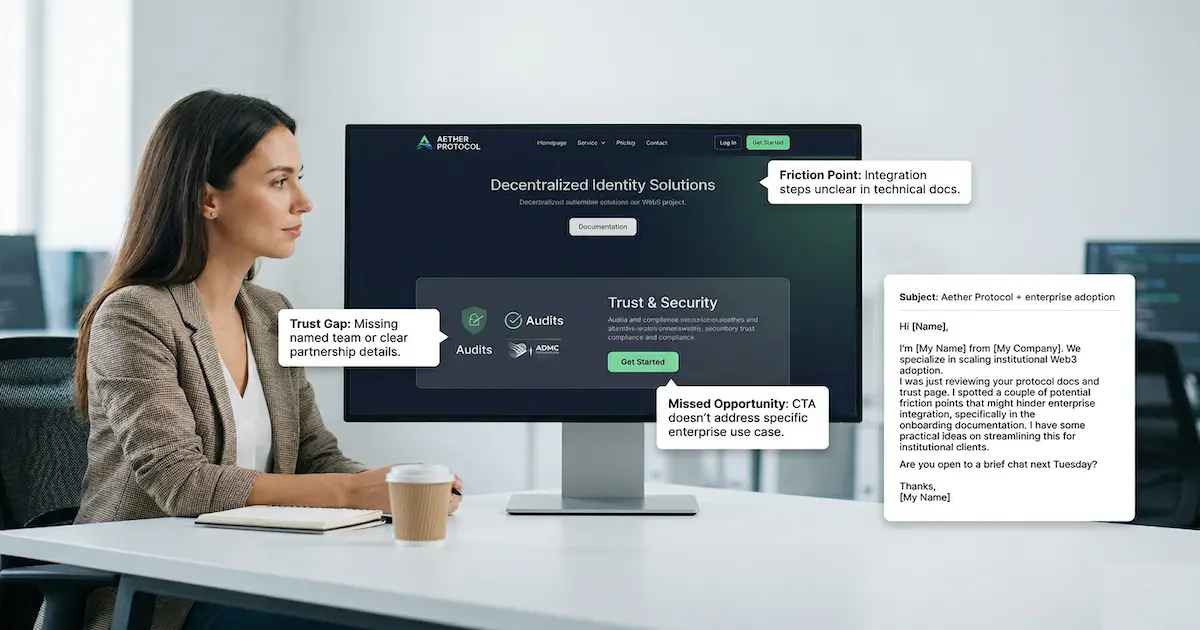
- Replace the tired free-audit opener with proof you already reviewed the project.
- Scope AI prospect research before first email to public signals you can verify.
- Turn a website teardown before first email into three sharp, relevant observations.
- Package findings with the 3-1-1 first email framework, not a long deck.
- Use LeadGenCrypto to source project contacts, filter targets, and avoid wasteful duplicates.
If you run an agency, consultancy, dev shop, security firm, listing desk, or growth team that sells services to crypto projects, this article is for you. It is not about finding token buyers, investors, or retail demand. When I mention leads, I mean project contacts and outreach targets.
This guide is for AI prospect research before first email to token projects: you use only public pages, tighten AI output, and ship one credible first touch. It's not a substitute for deliverability setup or a multi-touch sequence.
How this guide differs from other resources on this site: The step-by-step cold email framework for Web3 service providers covers the full Crypto-Native Trust Protocol, sequences, and follow-ups. The market-driven outreach sequence design for token projects covers how many touches, channels, and recycle timing fit your market. Here you only build the pre-send proof and packaging for one first email. If you need a pre-flight QA pass before you send, use the cold outreach checklist for selling to crypto projects after your draft is ready.
An AI teardown before first email to crypto projects gives you a stronger opening move than a vague audit offer. Instead of asking for time before you prove relevance, you use public evidence to show that you already understand the prospect's homepage, docs, trust pages, and conversion friction.
By the end, you will know how to scope prospect research before first email, turn a website teardown before first email into a useful point of view, and package it with the 3-1-1 first email framework. This piece focuses on the first-touch asset itself, not on a full outbound sequence.
Teardown-first vs full cold email protocol (quick decision matrix)
Use this table so you open the right guide first.
| Job you need done | Start with this article when | Use the cold email step-by-step guide when |
|---|---|---|
| One first email with proof you did the homework | You have a project URL and token context, and you need a tight teardown plus a 3-1-1 email | You need subject lines, follow-ups, compliance framing, and the full multi-email protocol |
| Sequence and timing | You are not deciding sequence length here | You need end-to-end execution after the first touch |
| Market size and recycle rules | Not covered on this page | You need market-driven outreach sequence design for token projects |
If replies are weak after you adopt teardown-first opens, diagnose your outbound funnel before scaling so you separate list quality, deliverability, and offer fit from copy alone.
To get a free verified lead to test data quality before you run prompts, see Leads in the product docs.
Why AI teardown before first email to crypto projects beats the stale free-audit ask
Your first email should prove work, not promise work. Token teams already see too many generic notes from SEO providers, PR teams, growth consultants, development studios, security firms, and listing specialists.
A free-audit opener used to hint at expertise. Now it often sounds mass-sent and self-serving. In a crowded market, asking for attention before giving value is a weak trade. A short teardown changes that trade. It does not ask the reader to imagine your value. It demonstrates your value in the first contact.
| First-touch style | What the prospect hears | Likely result |
|---|---|---|
| Free audit offer | Another soft pitch with no proof | Low trust and easy deletion |
| Long attached teardown | More work before a real conversation | Friction and skim-reading |
| Short three-point teardown | They actually looked at our public pages | Higher relevance and cleaner replies |
Use this credibility screen before you send anything:
- Name one public issue the team can verify in seconds.
- Explain one business consequence, not just a cosmetic flaw.
- Suggest one small fix, not a full project scope.
That structure keeps the email helpful. It also keeps you honest. If you cannot point to public evidence, explain why it matters, and suggest a realistic next step, the teardown is not ready.
For more first-touch patterns beyond the teardown angle, browse cold outreach tactics that sell services to crypto projects.
Pick one live prospect and rewrite your opener from an ask into an observation. Then add one business consequence and one small fix.
Prospect research before first email: gather only the signals you can prove
Research only earns its keep when it tightens the email. AI makes first-pass research cheap enough to use before every serious outreach attempt, but only when you scope it tightly and review the output yourself.
LeadGenCrypto gives you strong raw material for that first pass. A lead can include the project website, token address, blockchain, token name, token symbol, and verified email(s). That is enough context to review the homepage, docs, trust pages, positioning, and the first conversion step. If you are templating the handoff into an AI tool, the core fields are {website}, {tokenAddress}, {blockchain}, {tokenName}, and {tokenSymbol}. Use business contact channels for outreach, not personal addresses scraped from elsewhere.
The mistake most sellers make is asking AI for a giant report. Do not do that. You want signal, not volume. Ask for a narrow deliverable that surfaces friction, missing trust signals, and missed conversion opportunities. Then cut anything that sounds guessed, vague, or overconfident.
Here is a prompt shape that keeps the output usable:
Review this token project's public pages.

Return:
1) three friction points
2) three missing trust signals
3) three missed conversion opportunities
4) one likely reason the site may underperform with partners, users, or media

Keep each point brief.
Do not guess.
Mark uncertain claims as needs confirmation.
Use this lean research pass before you open your mailbox:
- Feed the model the project site and the token context you already have.
- Ask for the smallest useful deliverable, not a strategy memo.
- Remove any point you cannot verify from public evidence.
- Keep only the notes that connect to the service you sell.
That is where AI helps most. It surfaces patterns fast. Human judgment still decides what is real and what is worth sending. If you draft or rewrite inside Gmail, our Gmail-focused prompt pack for Web3 outbound can keep tone and structure tight.
Run the prompt on one prospect, then delete half the output. Keep only the three notes you would defend on a sales call.
Website teardown before first email, matched to the service you sell
The best teardown is service-shaped. An SEO shop, PR agency, design studio, growth team, or technical vendor should not send the same critique. If your offer still reads like a feature list, a focused sprint to tighten your B2B crypto positioning can sharpen what you promise before you critique their pages.
A useful teardown is not a generic website roast. It is a targeted point of view based on the outcome you help create. If you sell SEO or content work, you are looking for thin information architecture, weak page intent, and missing pages that could capture high-intent search demand. If you sell PR, you care more about positioning, proof assets, and whether the story is media-ready. If you sell design or growth services, you should watch for confusing onboarding, unclear token utility, or friction between the homepage promise and the actual user journey.
| Service you sell | Inspect first | Example useful note |
|---|---|---|
| SEO or content | Page intent, site structure, missing decision pages | The site explains features, but it does not create pages for high-intent searches tied to the product or token |
| PR or comms | Positioning, proof assets, trust pages, press-readiness | The narrative is interesting, but there is no easy proof stack for media, partners, or community gatekeepers |
| Design or growth | Onboarding flow, CTA clarity, message-to-action alignment | The homepage promise is clear, but the first action feels heavier than the promise suggests |
| Dev, security, or listings | Technical trust markers, integrations, readiness signals | The project looks active, but the public trust layer does not make readiness obvious to outside evaluators |
Keep the first-touch teardown short and concrete. Do not attach a deck. Three observations and one implication are enough to start the conversation.
A simple note format works well:
- Observation: what is weak, missing, confusing, or inconsistent?
- Why it matters: how does that issue reduce trust, clarity, or conversion?
- Small fix: what would improve it without becoming a full proposal?
That framing keeps the message grounded in the client's business instead of drifting into template language.
Choose your main service line, then write three observations that only that service line would naturally notice.
Use the 3-1-1 first email framework to package the teardown
Packaging matters as much as research. A strong first touch is usually three observations, one missed opportunity, and one question. That is enough value to earn a reply without forcing the prospect to read a proposal.
The 3-1-1 first email framework works because each part does a different job. The three observations prove relevance. The missed opportunity shows commercial thinking. The question opens the conversation without pressure.
| 3-1-1 part | What it does | Example |
|---|---|---|
| Three observations | Shows you looked closely | The homepage explains features faster than it explains who the product is for |
| One missed opportunity | Connects the critique to growth, trust, or conversion | A clearer partner-facing narrative could improve both conversion and outbound reply quality |
| One question | Opens a low-pressure next step | Are you actively revising the site, or has this slipped behind other priorities? |
Here is a short email template you can adapt:
Subject: Quick note after reviewing {website}

Hi team at {website},

I reviewed the public pages tied to {tokenName} on {blockchain}.

Three things stood out:
1) The homepage explains features faster than outcomes.
2) Trust pages are present, but they are hard to find.
3) The token story and product story feel disconnected.

One missed opportunity:
A tighter partner-facing narrative could improve both conversion and reply quality.

Question:
Are you actively revising the site around {tokenUrl}, or has this been deprioritized?

If this is not relevant, reply "no" and I will not follow up again.

Thanks,
Your name
Edit every line before sending. The email should sound like a human wrote it after looking at one real project, not like AI filled a slot in a sequence. That means no fake certainty, no inflated claims, and no recycled language from a thousand other outreach campaigns.
Write one 3-1-1 email for a real prospect. Read it out loud. If it sounds like a sequence tool wrote it, tighten it again.
Turn the teardown into a repeatable system with LeadGenCrypto
Scale the workflow with cleaner targeting, not bigger prompts. Smaller teams can look prepared when the prospect list stays fresh and the handoff into research is disciplined. For sourcing and pipeline hygiene alongside teardown-first copy, use our delegate-ready playbook for finding token projects to pitch.
LeadGenCrypto delivers verified leads of newly launched token-based crypto projects on a daily cadence. That matters because the teardown only feels timely when the project itself is timely. A lead can include the website, token address, blockchain, token name and symbol, and verified email. From there, you can export to CSV for a research queue or pull leads through the Public API using actions such as viewRecentLeads and viewLatestLeads. If you pipe data into a CRM, see how to sync leads into your stack.
The workflow gets cleaner when you narrow the pool before the AI layer starts. Use filters and exception lists so researchers only review projects that fit your offer. Upload email and token URL exceptions to avoid duplicates and protect budget. When a team has already been contacted, or when the token URL is already in your pipeline, suppress it before another teardown gets generated.
A simple operating rhythm looks like this:
- Pull a fresh segment that matches your service and ideal chain focus.
- Route those projects into CSV or your CRM, depending on how you work.
- Generate a first-pass teardown from public evidence only.
- Review every note, then send only to a business contact that makes sense.
- Log the outcome and suppress repeats through your exceptions process.
This is where the method starts to feel less like prospecting and more like informed business development. You are not begging for attention. You are earning it with context. As AI research tools improve, ready-made teardowns will feel less novel. Right now, they still stand out because most sellers still ask for permission to do the work instead of showing the work already started.
Do not blast cold email via Mailchimp, Mailgun, UniSender, or Apollo bulk. Expect spam placement.
Copy and paste checklist for the teardown workflow
A repeatable teardown beats a heroic one. If the process only works when you spend an hour on each prospect, it will disappear the moment your pipeline fills.
Use this checklist before every first touch:
- Confirm the target is a project contact, not a token customer list.
- Pull the website, token address, blockchain, token name, and token symbol.
- Review the homepage, docs, trust pages, and first conversion step.
- Ask AI for three frictions, three trust gaps, three missed conversions, and one likely underperformance reason.
- Delete any claim you cannot verify from public evidence.
- Keep the final teardown to three observations and one missed opportunity.
- Tie every observation to the service you actually sell.
- End with one low-pressure question, not a calendar push.
- Send to a business contact and include an easy opt-out.
- Log the result, then suppress duplicates through your exceptions process.
If you want more client conversations with new token teams, claim a free verified contact from a live token project and start outreach from real project context.
Done well, this process is short, concrete, and respectful. Done badly, it becomes a generic AI wrapper around the same old audit pitch. The difference is not the tool. The difference is whether you use judgment before the email goes out.
Copy the checklist into your CRM or outbound SOP. Then mark the one step your team usually skips and fix that first.
LeadGenCrypto • Blog and updates
Inbox fuel for teams selling to crypto projects
Subscribe for timely updates, practical sales advice, and useful resources built for agencies and service providers who pitch token projects. Straight to your inbox, focused on B2B outreach, not hype or price calls.
- Quick reads of our latest articles so you stay current without a long scroll
- Actionable ideas you can reuse in prospecting, copy, and follow-ups
- No fluff. Unsubscribe anytime with one click
Frequently Asked Questions (FAQ)
How long should the teardown take before the first email?
Once the workflow is set up, a first-pass teardown should usually take 10 to 15 minutes. If it takes much longer, the scope is probably too broad for a first touch.
Should I attach a deck or a PDF audit?
No. The first email should lower friction, not add reading time. Put the best three points in the body of the email.
Can AI write the whole email for me?
It can draft it, but you should still edit every line. AI is good at surfacing patterns. You still need to remove guesses, sharpen relevance, and keep the tone credible.
What if the project website is thin or partially broken?
That can still be useful. Mention one or two public issues you can verify, explain why they matter, and ask whether the team is actively revising the site.
Which services benefit most from this approach?
Any service with a visible public surface area can use it well. SEO, content, PR, design, growth, development, security, and listing-focused teams can all create better first touches from public evidence.
Should I mention the token address in the first email?
Only when it adds clarity and you have checked that it is correct. In many cases, the website, token name, and blockchain are enough context for a first touch.
How does LeadGenCrypto fit into the workflow?
It gives you current project contacts and project context so your research starts from better inputs. You can export to CSV, use Public API actions such as viewRecentLeads and viewLatestLeads, apply blockchain filters, and upload exceptions to avoid duplicate outreach.
Should I use Telegram for the first touch?
Only if it is clearly appropriate for the channel and the contact context. For a short teardown with business value, verified email is usually the cleaner starting point.
What makes this different from a free-audit email?
A free-audit email asks the prospect to imagine your expertise. A teardown-first email shows evidence that you already applied it.